


This article is part of the Under the Lens series
Innovations in Community Ownership
It all started around 2015. Globeville and Elyria-Swansea, two adjacent north Denver neighborhoods, were beginning to see rapid change. Community leaders, activists, and neighbors formed the GES Coalition to focus on improving the quality of life for the residents—largely working class Latines.
“We were doing organizing around very neighborhood-based things. We had a very specific cohort of 20 women who were working on starting their businesses,” remembers Nola Miguel, the GES Coalition’s executive director. “It seemed like overnight we lost 10 of them. People were saying they were displaced—the landlord raised their rent, that kind of thing.”
Miguel, the microentrepreneurs themselves, and other community members talked about the problem and began researching potential solutions. They wanted access to more affordable housing, and they wanted some measure of control over it, too. One idea kept coming up: a community land trust.
The result was Tierra Colectiva, founded in 2016. This month, together with its development partners, Tierra Colectiva is celebrating the groundbreaking of a 170-unit affordable apartment building that will have room for very low income people and large families; the land trust will own the ground floor commercial space. In addition, the organization has several other real estate projects and campaigns in the works.
It’s impressive scale for a fairly new group, and also for one that has remained targeted on a narrow geographic area, authentically rooted in its two neighborhoods, and acutely focused on it residents’ needs. Getting to this point has required vision, grit, and deep commitment on the part of its members. But for the residents of a neighborhood that’s been on the wrong end of growth for years, that level of dedication comes naturally: it’s about survival.
Decades ago, Globeville and Elyria-Swansea were bustling working-class communities containing slaughterhouses, stockyards, and a smelter, all of which employed residents. Those industries are gone, but they’re not forgotten, says Alfonso Espino, the GES Coalition’s lead organizer, who grew up in Elyria. “Many of the other working class neighborhoods [in Denver] have been completely gentrified,” he explains. “We’re one of the last neighborhoods with a link to that history.” Espino thinks the neighborhoods’ living connection to the labor struggles of an earlier era have made community organizing among residents easier.
I didn’t really have anywhere to go after I left my mom’s house. If it weren’t for the land trust, I wouldn’t still be here.”
Alfonso Espino, GES Coalition’s lead organizer
The area has had its challenges. Interstate 70 runs through the community, and the National Western Center—home to a century-old stock show that meets for 16 days every January—lies between Globeville and Elyria-Swansea. As they’ve expanded over the years, both the highway and the center have gobbled up blocks of neighborhood homes, often using eminent domain to force residents out. And the smelter and other heavy industries have left their own legacies; the community lies within the US’s most polluted ZIP code, according to a 2017 study.
Around 2015, Denver’s city government began paying more attention to the area. The nearby River North, or RiNo, arts district had been revitalized, and rents and property values in Globeville and Elyria-Swansea were starting to rise. The city had targeted a main corridor for infrastructure improvements, and officials were talking about expanding the National Western Center. And a plan was hatched by the Colorado Department of Transportation (CDOT) to bury and broaden I-70 and build a park on top of it, ultimately costing the community another 56 properties.
Change was in the air, and residents were worried. A 2016 survey conducted by the GES Coalition found that 88 percent of residents were at risk of displacement. In particular, many of the area’s renters were dangerously vulnerable; 60 percent earned less than $25,000 annually, and half had no lease at all.
It was amid this fear and uncertainty that the GES Coalition began talking about a land trust, which appeared to be a way to keep displaced families in the community. Eventually, the group connected with Jason Webb, a staff member at Grounded Solutions Network, which provides technical assistance to land trusts and other affordable housing groups; Webb is a former resident of Dudley Neighbors, Inc., a similarly community-focused land trust in Massachusetts.
He visited and worked closely with the Denver group. Over time, GES Coalition leaders and others in the community created a business plan that showed how the land trust would operate. “But I was very clear,” says Webb. “This will be a lot of work, not just on staff but also on each resident.”
They were committed, and Tierra Colectiva became a formal community land trust. It’s housed within the GES Coalition, which, unlike a typical coalition, has a membership base not of other organizations, but of 600 individual community members. That means the CLT’s decisions about affordable housing and land draw directly from the larger group’s organizing efforts and expertise about community needs.
For several years, Tierra Colectiva incubated with the Colorado Community Land Trust, which helped the nascent group gain credibility and buy its first properties. Eventually it went out on its own and gradually amassed 14 single-family homes, all priced to be affordable to residents earning between 50 and 60 percent of the area median income. That includes a 2022 five-townhouse construction project financed in part with a $2 million grant from CDOT, given to mitigate some of the impacts of its giant construction project.
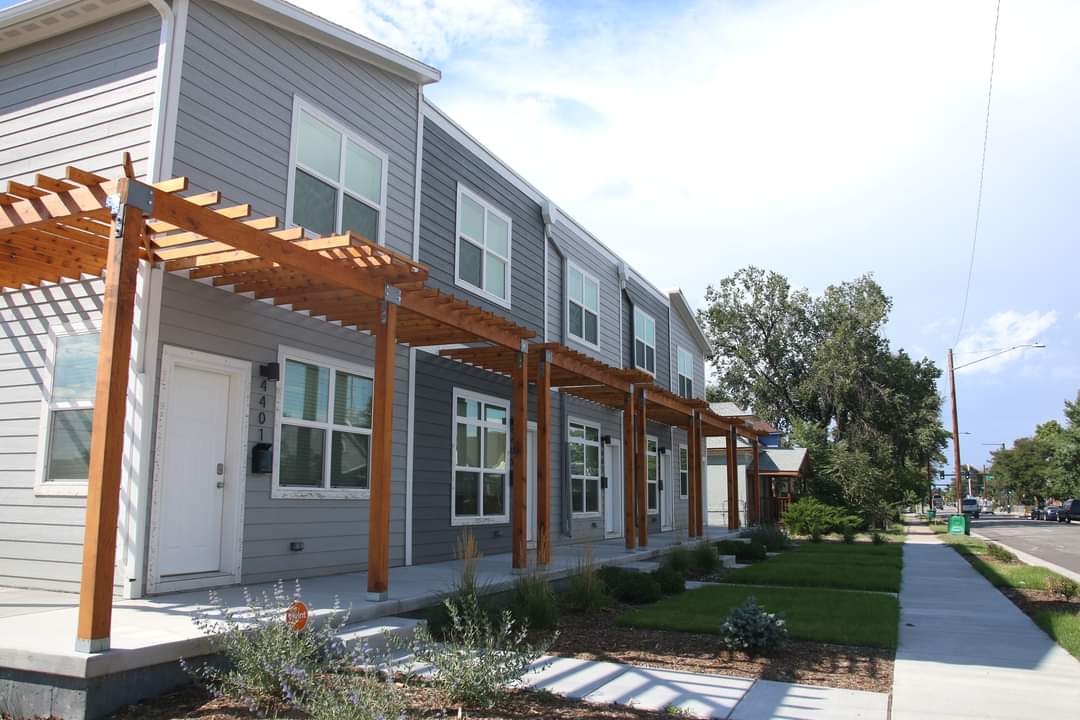
Espino himself wound up qualifying for one of the townhomes. It’s been a lifesaver. “I didn’t really have anywhere to go after I left my mom’s house. If it weren’t for the land trust, I wouldn’t still be here” in the neighborhood, he says.
More homes are in the pipeline, but homeownership isn’t realistic for many of the community’s residents. “[Tierra Colectiva] had one dream way back when: everything would be affordable for sale,” remembers Tracey Stewart, a senior program officer with the Colorado Health Foundation, which has supported Tierra Colectiva for several years. “But that’s way out of most residents’ leagues—you’d be gentrifying your own neighborhood.”

And scaling up house by house is grueling. Getting the land trust initially off the ground was an enormous amount of work, says Miguel, and the group has always had very big ambitions. “We didn’t do this for a couple of houses,” she explained. “We did this to have an impact on the neighborhood. Our first goal was 50 units, and that has continued to grow.”
That’s basically how the land trust found its way to partnering with developers Evergreen Real Estate Group and Rocky Mountain Communities on the 170-unit affordable apartment building in Globeville. A third of the units will be affordable to households making up to 30 percent of the AMI—the highest proportion of extremely low income units in any building in Colorado—and half will have three or four bedrooms, which is important for large, intergenerational families. The property will be affordable for 99 years.
The development is on land owned by the city of Denver, which purchased it in 2019 in its own effort to offset displacement. Originally, Tierra Colectiva had thought the city would donate the land to the land trust, but ultimately Denver’s housing agency decided to keep it. “It was definitely a letdown,” says Miguel.
Still, the land trust has some leverage to ensure that the project is genuinely responsive to community needs. It was Tierra Colectiva’s long relationship with the Colorado Health Foundation (CHF), for instance, that brought CHF into the deal. Without CHF’s low-interest $3.5 million loan to the developers, the project wouldn’t have been financially viable.
The foundation also provided the land trust with a $2.5 million grant to buy the ground floor space, which will hold a library branch and café—providing Tierra Colectiva with an asset it can use as collateral in the future. Altogether, the $6 million investment is the foundation’s largest affordable housing allocation yet.
The land trust is also lending the partnership its robust community connections, something increasingly viewed as valuable by developers and policymakers.
“For a project this complex and in a neighborhood that’s very active and knowledgeable, it was super important that they were there,” says Javonni Butler, a vice president with Evergreen. “They’ve been holding us accountable in terms of the design and AMI levels, making sure the community amenities and services are aligned with what the community wants.”
The organization has other projects in the works, too. Last year, it got a good deal on an almost 10,000-square-foot property that the land trust and broader coalition are turning into a food forest, a green space with harvestable fruits and vegetables. And earlier this year, the coalition won a $3.6 million grant from the Colorado Housing Finance Agency to purchase land that will hold at least 40 affordable units and a commercial space.
Now that it has dipped its toes in the commercial real estate world, Tierra Colectiva is thinking about partnering with a childcare cooperative or a workforce development center. But the group’s biggest project is something it’s been working on for years.
The National Western Center, together with the city and Colorado State University (which has facilities at the complex), is planning a $1.6 billion expansion to become a year-round destination. Slated for construction are a new equestrian center, a hotel, and a parking deck. Some of the work has already started, and properties belonging to four businesses and one home have been taken through eminent domain.

The last undeveloped plot of land on the center’s property has been dubbed “the Triangle” by residents and observers. GES’s website describes the city’s plans for it, released in 2015, as “creating vast areas meant for occasional visitors rather than the daily needs of residents.” Since 2021, the GES Coalition has explicitly targeted the 65-acre parcel—through neighbor-to-neighbor organizing, teach-ins on city planning concepts, walking tours, and the creation of a 3-D model illustrating what residents would like to see there. Specifically, that’s a wide range of housing options totaling over 1,000 units, spaces for local businesses, and a public plaza—all under community control. That, they believe, would make up not only for the homes lost to eminent domain, but for the future displacement they’re sure will come as the area continues to attract investment.
Denver Mayor Mike Johnston has said he’s committed to there being some kind of community ownership of the Triangle, but he’s not sure what the structure of such a plan might look like. Tierra Colectiva would like as much of that land put into the land trust as possible, but the group’s leaders are realistic. They’d be happy to see an RFP that prioritizes community-led organizations that they could apply for.
To Espino, this push isn’t just about Globeville and Elyria-Swansea’s future. At heart, he says, it’s a chance to illustrate a new model of change for communities. “What we’re really trying to do is demonstrate that there’s an alternative way to develop—not just that we can win this campaign, but we can actually make it replicable.”
“At the core, it’s a struggle for the city and who’s shaping it,” he adds. “We’re trying to build the consciousness and power that we can shape it as well, that we have a right to.”
About the Author



Comments