


This article is part of the Under the Lens series
Innovations in Community Ownership
When Ceyenne Doroshow first began raising money to buy a building that would provide safe housing for transgender women in New York City, she recalls, “people were coming out of the woodwork trying to offer us the equivalent of crack buildings, in bad neighborhoods, with horrible policing,” just because those buildings were cheaper. But Doroshow found this unacceptable. Her organization, GLITS Inc. (Gays and Lesbians Living in Transgender Society), primarily serves Black trans women. Doroshow says after facing so much harassment and discrimination in the rest of their lives, they deserve a chance to live in stable housing in a peaceful neighborhood.
Like many of the women she works with, Doroshow has spent time homeless. “Our families just may not be that nice behind the velvet rope,” she observes. This can lead to so much housing insecurity that even when they’re housed, program participants’ anxiety stays high: “As soon as they got into [an] apartment, they were already mentally processing for the next round of . . . moving on again,” she says. That’s one of the reasons GLITS emphasizes supports and leadership development along with housing.
Doroshow held on to her dream. With money raised during Pride Month 2020, GLITS bought a 12-unit apartment building in a quiet Queens neighborhood, now known as GLITS 1 South. The residents are all part of the GLITS Leadership Academy, a program that helps each participant with their health, education, and leadership development goals. The building includes its own classroom and study space.

Discrimination against LGBTQ+ folks in housing has a long history, notes Julia Duranti-Martínez, who works in the community development field and recently authored a report on spaces owned by queer-serving organizations. For example, narrow definitions of family long excluded many LGBTQ+ households from getting mortgages and buying homes in the suburbs. And housing rules placing limits on renting to those with a legal record often disproportionately affected queer and especially transgender people especially at a time when laws that outlawed things like cross-dressing defined their very existence as a crime, and employment discrimination often pushed them into sex work (which it still does). The Lavender Scare in the 1950s drove many LGBTQ people out of federal employment, and of course the AIDS crisis compounded a pandemic with further discrimination. Over the years, these discriminatory practices led to residential concentration, or “gayborhoods,” similarly to how redlining concentrated Black residents. “At every turn, queer and trans communities have fought back to care for each other and provide critical services and information in the face of institutional abandonment,” says Duranti-Martínez.
Today, the LGBTQ+ community, and especially the transgender community, have disproportionately high levels of homelessness. According to the Williams Institute at UCLA, LGBTQ+ adults are nearly three times as likely to have been homeless at some time in their lives. Transgender adults are more than twice as likely as cisgender adults to have recently experienced homelessness. The gap leaps to eight times as likely when compared to straight cisgender adults. Williams also says that 20 to 45 percent of homeless youth identify as LGBTQ+, 2 to 4 times the proportion of all youth who do.
Assumptions like the ones Doroshow faced often keep them segregated in certain areas. “In New York, it’s always the Bronx,” says Duranti-Martínez. “That’s where so many of the service providers, all the LGBT-affirming healthcare programs [are] . . . it’s a cost savings thing, and then also, ‘oh, well, the services are out there, so that’s where you should be.’” Doroshow’s goal is for trans-led organizations and their residents to access a wider array of neighborhoods.Duranti-Martínez supports this. People “have different experiences around what feels comfortable and safe to them,” she says.
Owning an Organizational Home
Queer organizations, especially those serving trans people of color, have sometimes faced similar challenges with their organizational headquarters.
Janetta Johnson is CEO of the TGIJP, or Transgender, Gender Variant, Intersex Justice Project. For 20 years, TGIJP has been working for justice for transgender and gender nonconforming people inside and outside of incarceration, through leadership development, reentry services, name change clinics, advocacy, and recently a wellness program.
The organization’s full name is Miss Major Alexander L. Lee TGIJP Black Trans Cultural Center, in honor of the group’s founder, Alexander Lee, and its first director, nationally known trans mentor and activist Miss Major Griffin-Gracy. “Our name is not ‘Mary and John Wilson Housing.’ Our name is true and authentic to who we are,” says Johnson. But that authenticity can change how the organization is treated. “Landlords looked at us different . . . and also did some extreme background checks,” she recalls. That’s part of why TGIJP decided it wanted to own its own space.
TGIJP purchased a building in San Francisco’s Tenderloin neighborhood in 2023, creating a hub for organizing and supportive services in the Bay. The neighborhood is the location of the 1966 Compton’s Cafeteria uprising, led by young TGNC (transgender and gender non-conforming) people and drag queens against raids and overpolicing of LGBTQ+ communities. “Black trans people deserve ownership, and I’m not talking about being capitalistic,” Johnson says in the report Duranti-Martínez co-authored for LISC, “We Take Care of Each Other”: The Power and Promise of TLGBQIA+-owned spaces. “It’s important for people to have safe cultural spaces. It’s important for people to have ownership so that they can believe in themselves and their abilities.”
While TGIJP doesn’t manage housing directly, it does help its clients access housing using city resources. It’s a struggle. “Our community is the last to be housed,” says Johnson. The organization has considered owning its own housing in the future, but under the current administration, it is not currently looking to take on new projects.
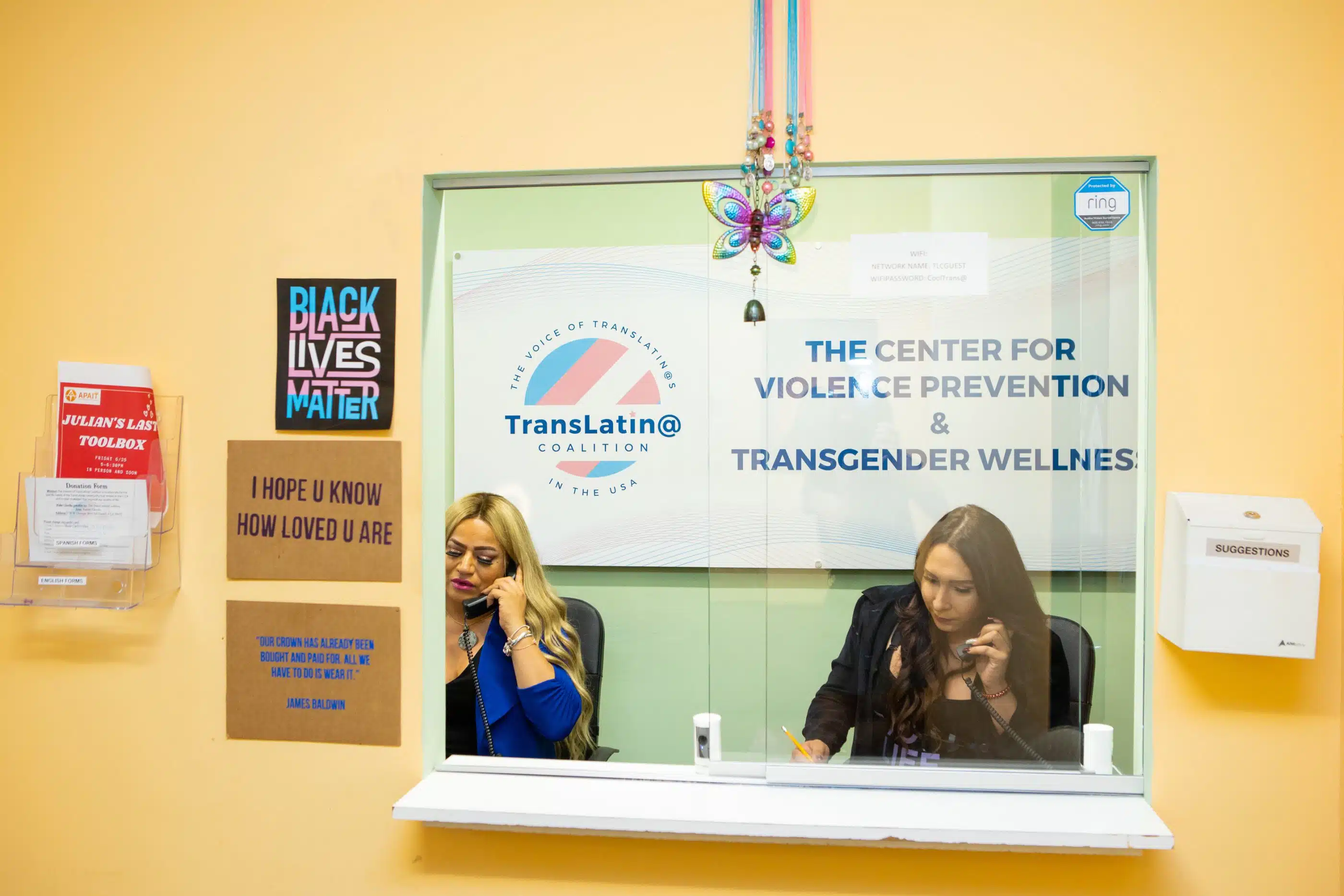
Bamby Salcedo, founder and president/CEO of the TransLatin@ Coalition (TLC) in Los Angeles, says she believes that a long-lasting organization requires building infrastructure, “and part of that is having a space that we own.” TLC has purchased a 24,000-square-foot space that will become a community center and wellness center. The organization learned about and connected with the Los Angeles office of the community development intermediary LISC through their real estate agent, and got a short term loan from LA LISC’s lending arm to complete the purchase. However, TLC then paid it back quickly using grants from the state. Salcedo, reflecting a common ethos in a movement that has had to operate outside the system for so long, feels very strongly about the organization not being in debt. The new center will have a social enterprise area, hosting businesses whose rent will help cover the cost of maintaining the building.
We’d Always Be Pushed Out
If trans-led and LGBTQ organizations in queer-friendly cities in states like California and New York feel a need to invest in owning their own spaces, it might be even more urgent in other parts of the country.
Duranti-Martínez spoke with the director of Esperanza Peace and Justice Center in San Antonio, Texas, for her report. Esperanza was founded in 1987 by mostly queer Chicana organizers to be a multicultural, intergenerational organizing hub. Esperanza executive director Graciela Sánchez says in the report that “because of the mixing of our communities, it allowed me to be in the same space with my mother and my family members and all my queer friends. And then other folks came around, and straight elders or straight younger people were in contact daily . . . and people weren’t afraid.”
But Esperanza’s landlord objected to the organization’s openly queer leadership and work, including the first art exhibit in Texas focused on HIV/AIDS, and evicted Esperanza in 1993. The eviction prompted Esperanza to try to buy its own space. As Sánchez explains in the report, “Once we were given a 30-day notice, it was like, ‘Let’s buy a building, or let’s close down, because based on our finances and our politics, we will always be pushed out.’” Esperanza bought a building through fundraising and a loan from faith-based microlender Common Good 2000.
“Owning property in the South, especially [for] Black folks,” has a particular historical importance, says Rúmba Yambú, one of the founders and leaders of Intransitive, a migrant-led, trans-led, and disabled-led grassroots organization in Arkansas. When Intransitive purchased the building that became its headquarters and community space, the organization had no paid staff. It was doing statewide legislative advocacy and local leadership development, making art, and carrying out mutual aid work, such as food distributions and court and jail support. Leaders were paying “out of our own pockets . . . and just doing it out of anywhere that we could—parking lots, parks, our own house, other community spaces that we’d have access to. Having a physical space . . . was a dream,” says Yambú.
Early in the first Trump administration, Intransitive managed an impressive legislative win, leading a collective advocacy effort that beat back the first state-level attempt to ban gender-affirming care for minors. This win brought them a lot of attention and donations from organizations outside of the state, and even around the world, says Yambú. The leaders considered using the windfall to pay themselves for the first time. It was tempting. However, “we didn’t know if that money was ever going to come back,” recalls Yambú. “And so the thought was to invest it in community, invest it in something that was going to be permanent, even if we weren’t going to be here.” That meant owning their own space.
Intransitive also moved directly to owning their space because Arkansas is famous for having terrible renter protections. “People had always thought of Intransitive as being too radical for Arkansas,” says Yambú. “We were told that a lot: ‘You’re too problematic, you’re too in people’s face, you’re asking for too much.’” Given this combined with the laws that made it easy to remove a renter with no recourse, Yambú figured it would “be a matter of time before people kick us out” if they rented a space. “But whenever you own something, it’s easier to protect it, right?”
A third reason to have their own space was that many of the affordable opportunities for organizations to rent space were in church buildings. Even if the churches were progressive congregations, many transgender people have deep religious trauma, says Yambú. To have a truly safe and and welcoming space, the organization needed to be somewhere entirely outside of a religious context.
And so, Intransitive purchased a building that had been abandoned for a year and spent six months renovating it, primarily through volunteer labor. “We learned through YouTube videos,” says Yumbú. They also learned how to respond to vandalism—to install a cage around their security cameras after replacing ones that had been stolen, and a concrete box around their external water system after vandals flooded the property.
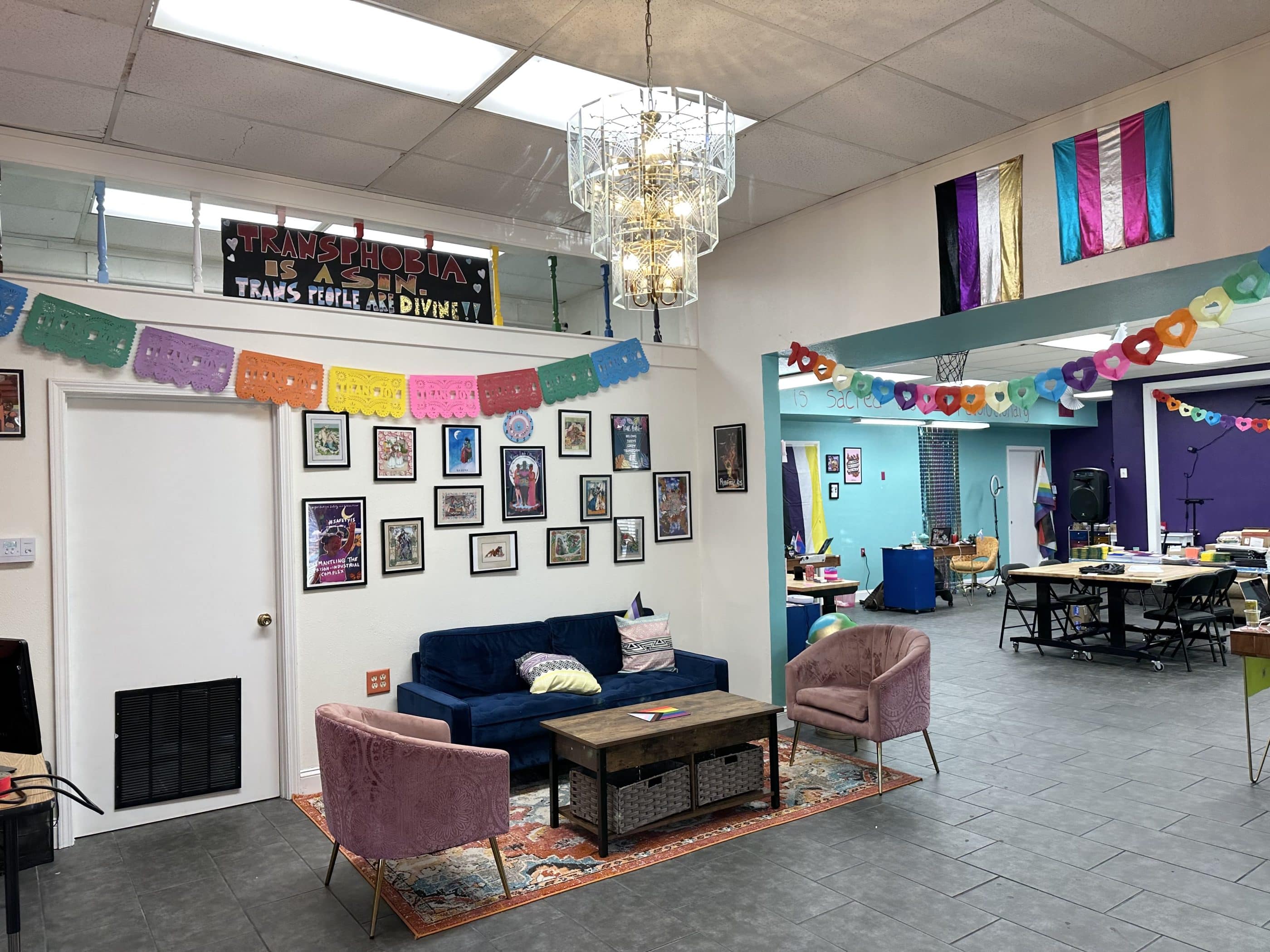
For safety, the outside remains nondescript—not even a sign—but the inside is colorful and bright and full of art, including some made by members. It is a place that people can make their own, says Yambú, and where they can be themselves when it might not be safe elsewhere. The organization also extends its use to other organizations.
For a long time there was a homeless encampment in the vacant lot next to the building. “We’ve become their neighbors, right?” says Yambú. “We also give food to them, and they access the water.” Because of this relationship, encampment residents kept an eye out for vandals, alerting Intransitive to people lurking nearby.
Connecting Two Worlds
More-traditional housing and community development organizations can also prioritize supporting the LGBTQ+ community. In Fresno, California, South Tower Community Land Trust (CLT) serves its entire neighborhood, engaging in classic community planning and permanently affordable housing development work. However, the organization is doing it with explicit acknowledgment that Fresno, and the South Tower neighborhood specifically, is a hub of LGBTQ+ activity and safety for that region of the state, and the CLT is intentional about operating in a way that centers that.
“Everybody sees this as the center of the LGBTQ+ community,” says Kiel Lopez-Schmidt, executive director of the South Tower CLT. “A lot of folks in the rural towns around Fresno find a safe place here. And so it’s natural that within developing our housing strategy that we think about the LGBTQ community.” This can mean designing homes for and welcoming the varied sizes and shapes of households in the LGBTQ+ community, as well as making space for everyone involved to bring all of themselves to the work, says Lopez-Schmidt. They add that half of the board and much of the staff identifies as part of that community.
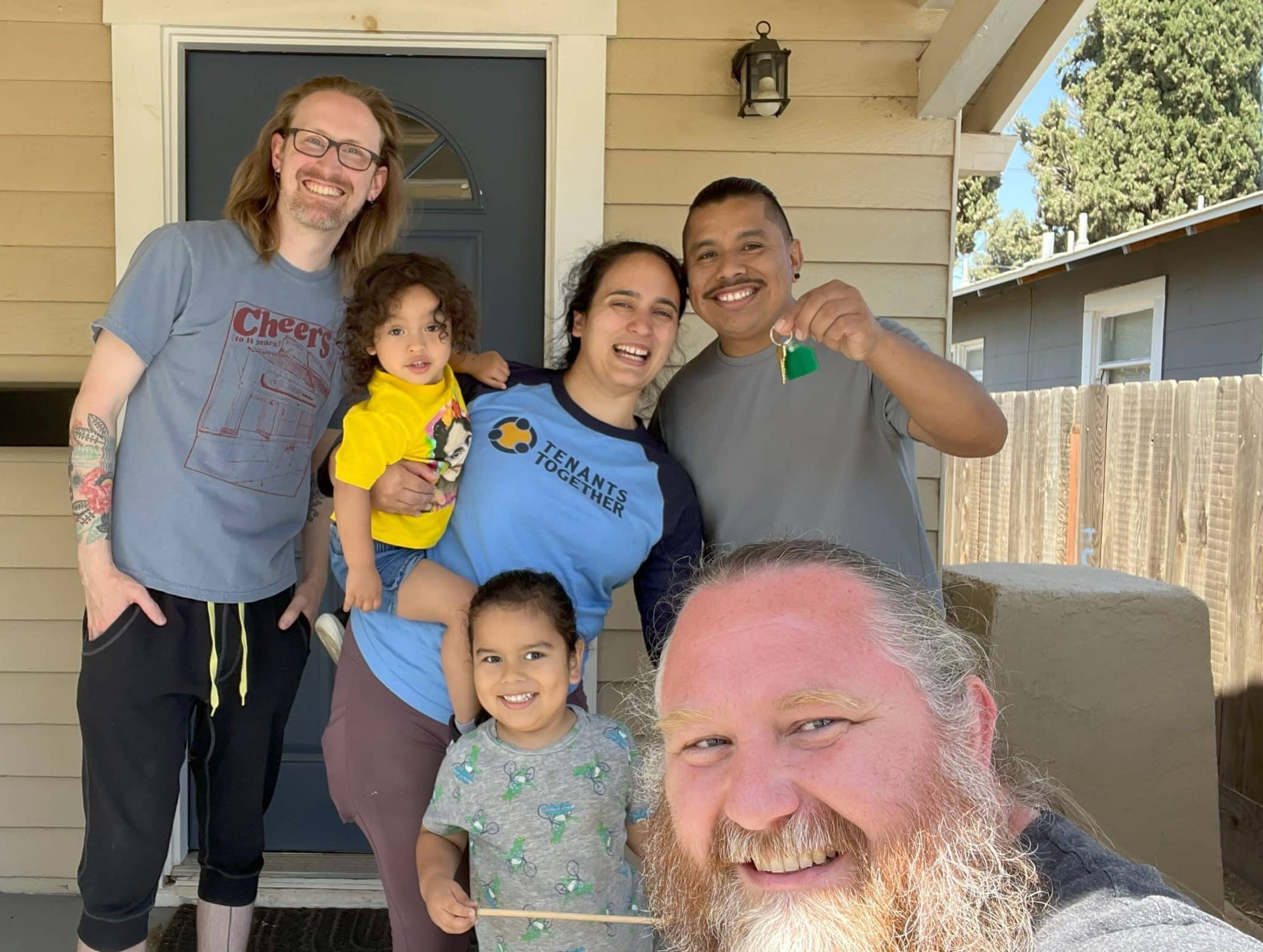
South Tower CLT works on neighborhood planning as well as housing. This year, a park that replaces an old police substation has opened, which is the culmination of eight years of advocacy and organizing that Lopez-Schmidt says led to the creation of South Tower CLT. The organization participated in a large public art project, and listed its first home for sale this fall. It has more homes in the works, including a cottage development on a triangular piece of land left over from highway construction that has been vacant for 30 years.

Lopez-Schmidt and South Tower CLT understand the power of owning your space—in 2020 an evangelical church tried to buy the iconic tower that the neighborhood is named after. “That was protested by our community, and then [we were] counter-protested by Proud Boys and other far-right extremists,” says Lopez-Schmidt. “We were successful as a community at getting the city of Fresno to actually buy the Tower Theater and keep it public and keep it safe and open for all . . . that was a big win.” Currently, the main LGBTQ+ center in Fresno is losing its space because the larger nonprofit it’s a part of is going through a financial crisis. “This is a perfect example why ownership for our community is important,” says Lopez-Schmidt.
South Tower CLT is currently in the process of buying its own commercial space to be its headquarters, and it will share that space with three other organizations, including the community center.
South Tower is situated solidly in both the housing world and the LGBTQ+ community, making it a good organization to bridge the two worlds. It is doing so with the Queer Housing Summit, an annual event it launched in 2023.
Lopez-Schmidt references the disability justice idea of the Curb-Cut Effect—that making spaces more accessible for people with disabilities tends to actually make them more accessible for everybody. “I look at this work around the queer community in a similar way,” they say. Queer folks “are more vulnerable, have higher percentages of experiencing homelessness, have different family types that aren’t necessarily the traditional nuclear family . . . If we’re designing for that, we’re designing for everybody. . . . Our community brings so much incredible creativity and joy and culture, that really centering the queer experience is making really vibrant spaces that other people want to be part of as well.”
Lopez-Schmidt and Duranti-Martínez point out that there are a lot of LGBTQ+ practitioners in the housing and community development space, but few opportunities for them to bring their whole selves to the work. “Folks have said [the Queer Housing Summit] is the most inclusive conference that they’ve ever been to,” says Lopez-Schmidt. “They’re passionate about these issues, but they got to be who they wanted to be in the process.”
Duranti-Martínez feels that there could be a lot of strength from more intentional cooperation and partnership between the LGBTQ+ movement and organizations, and housing and community development organizations. “Folks would just be in a stronger position to fight back and fight forward, if there were more authentic working relationships throughout,” she says. She notes that housing and community development groups often don’t see the LGBTQ+ community as one of their constituencies, while national LGBTQ+ funders tend to focus on legal fights and overlook material needs like housing.
Intransitive, for its part, works in many coalitions. Tenant organizers are part of a statewide campaign the organization works in that ties many different movements into a fundamental fight to protect bodily autonomy. But those relationships extend outside state-level lobbying as well. “There is knowledge that the folks who are doing tenant rights have that we don’t have, that helps us when we’re navigating some of our members’ or some of our clients’ stuff,” says Yambú. “And then there’s knowledge, especially in interpretation, that we’ve been able to provide to them.”
Navigating Funding—And the Lack of It
When it comes to control of buildings, whether residences or organizational spaces, “the biggest thing is funding, like always,” says Duranti-Martínez. In fact, of the 10 case studies in her report, all but one organization closed on their first property between 2020 and 2023. Despite the organizations having longtime, sometimes decades-long, goals of buying property, it wasn’t until the temporary surge of flexible funding that followed the 2020 uprisings for racial justice and beginning of the COVID pandemic, that it became possible. (Intransitive, which wasn’t covered in the report, also falls into this category.) Six of the case study organizations used this temporary windfall to move quickly and buy buildings without taking on debt, and four organizations secured loans from mission-driven lenders.
By purchasing buildings outright, says Duranti-Martínez, organizations avoided loan requirements that may have otherwise excluded them and their organizations. LGBTQ+ people and especially TGNC people of color experience more poverty and financial insecurity, which in turn makes it harder to get loans. At the organizational level, LGBTQ+ issues received just 25 cents of every $100 awarded by private foundations in the U.S. in 2022; less than 5 cents supported transgender issues and communities. Even prior to the current administration, limited funding to LGBTQ+ organizations was already declining in inflated-adjusted terms from its brief 2020 peak, putting the long-term survival of organizations at risk at a time when their organizing work and services are most needed.
Yambú says that one thing that scrappy grassroots organizations like Intransitive can provide to more established housing organizations is the reminder of how to operate when funding goes away—on a DIY ethos and with a volunteer base, for example. “When you grow up with scarcity . . . you tend to be a little bit more creative on how you do things,” they say. In turn, they suggest that more established organizations could share their knowledge of navigating systems, real estate deals, and access to capital with organizations like Intransitive whose leadership did not grow up with privilege and access.
Access to non-extractive capital will be essential. “Investing in community-based TLGBQIA+ organizations and community ownership efforts is a critical part of building lasting community-controlled infrastructure,” says Duranti-Martínez. “As part of this work, community development practitioners and policymakers should build alliances with TLGBQIA+ organizations and drive financial and technical assistance in support of queer and trans-led projects.”
“I own a building where I know people are safe,” says Doroshow. “And that for me, that’s the joy, that’s the legacy, that’s the giving back.”
For more on many of these organizations’ stories, and others’, check out “We Take Care of Each Other”: The power and promise of TLGBQIA+-owned spaces.
About the Author


Love this article. So amazing to see these orgs doing incredible work.