


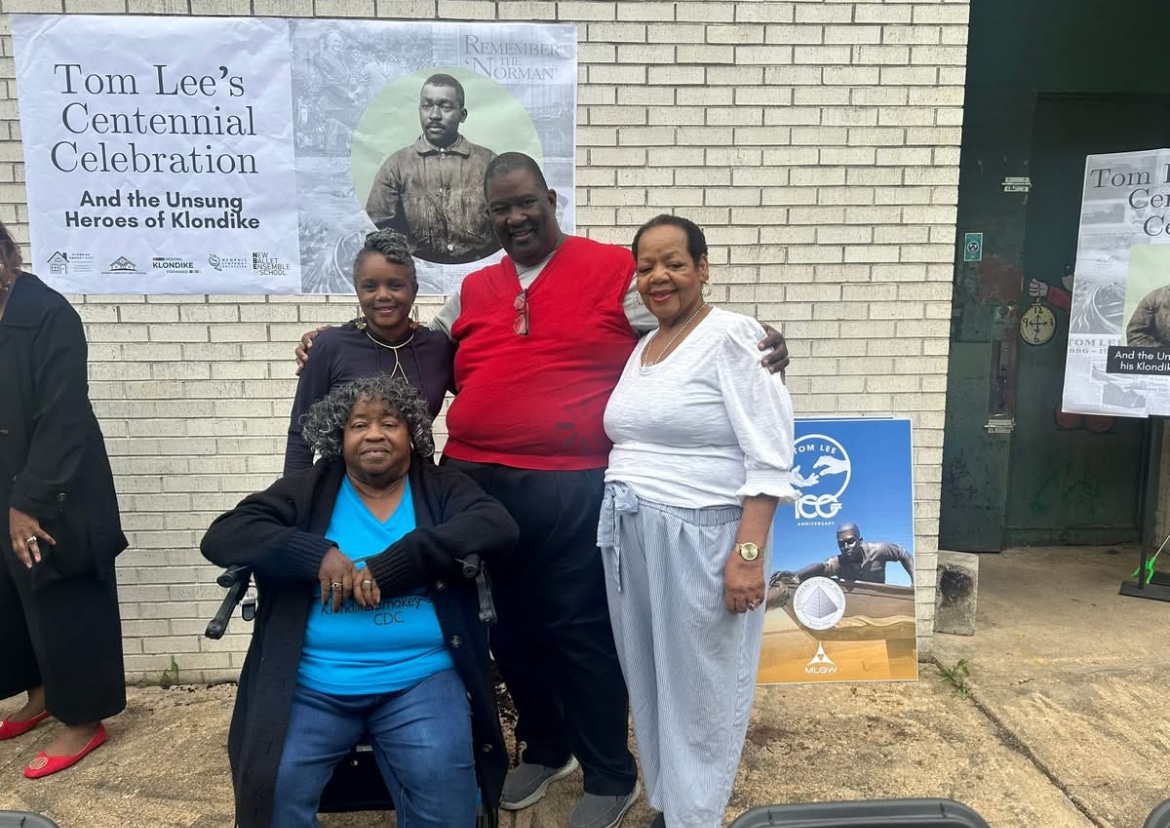
Back when Quincey Morris was growing up there in the 1950s and 1960s, Memphis’s Klondike neighborhood was thriving. “We had everything you needed: grocery stores, pharmacies, dentists, doctors,” she recalls. “There were homeowners and renters on every street.”
That was then. Between 1980 and 2010, disinvestment led the overall population of Klondike and the next-door Smokey City neighborhood to fall by more than half.
Morris has been working to change that. The organization she founded and directs, Klondike Smokey City Community Development Corporation (KSCCDC), now anchors a partnership that seeks to revive Klondike while protecting its long-term residents. Built around a community land trust (CLT) to keep housing permanently affordable, the Klondike Partnership also supports an array of health, economic development, and environmental initiatives—while engaging neighborhood residents along the way.
Hopeful Beginnings, Hard Times
Klondike was founded in North Memphis in the late 1890s by Black residents who were excluded from homeownership in the center city by Jim Crow-era segregation laws. It was named after the site of the Alaskan gold rush, a symbol of hoped-for prosperity. The neighborhood delivered on that promise for many.
But over time, racist policies and economic shifts took a toll. As in many Black neighborhoods across the United States, an interstate highway built in the 1960s and 1970s plowed through the neighborhood, destroying many homes. Then, a nearby Firestone plant closed in 1983, with thousands of local jobs lost as a result.
Now, developers are eyeing Klondike, which is conveniently located around three miles northeast of downtown Memphis. Residents face a familiar conundrum: welcoming an infusion of resources while fearing gentrification and displacement. Those fears intensified when Crosstown Concourse, a mixed-use, market-rate development, opened near Klondike in 2017, putting pressure on land prices.
Gaining Community Control of the Land
For Steve Barlow, vice president and general counsel of The Works, those rising prices signaled an urgent opportunity. “If you want to make a difference in a neighborhood,” Barlow says, “the first thing you have to do is get control of the land.” And if you miss the window of time when land is affordable, “you lose your chance for it to be a community-controlled project.”
In 2012, Barlow cofounded Neighborhood Preservation, Inc. (NPI), a nonprofit dedicated to reducing the number of vacant and abandoned properties in Memphis. More recently, NPI merged with The Works, a citywide community development corporation and affordable housing developer that has invested more than $50 million in Memphis since 1998.
Roshun Austin, president and CEO of The Works, teamed up with Barlow to acquire land in Klondike before the window of opportunity slammed shut. “During the pandemic,” Austin says, “we were secretly buying up hundreds of lots in Klondike,” making purchases through general partnerships. “If Steve’s name or my name were associated with it, the speculators would try to compete.”
You have to be intentional, and the people that you’re serving have to be involved in the conversation. You will only see success if they’re leading.”
Roshun Austin, president and CEO of The Works
But the real prize in Klondike was a tranche of 150 properties owned by the Shelby County land bank. Morris had her eyes on those properties, too. But when she approached the county, she was told that KSCCDC “lacked the capacity” to manage the properties. So, she joined forces with Barlow and Austin, and the county agreed to sell the land to a new joint entity controlled by KSCCDC and NPI (later, The Works). The acquisition was financed by Urban Renaissance Partners, a nonprofit partner whose board majority is comprised by management team members of The Works. Capital for the effort was primarily provided by the Community Foundation of Greater Memphis.
As Barlow and Austin were buying land, community foundation donors were also considering another major project, Northside Square, which would redevelop a high school that closed in 2016. While the Northside development represented a significant investment, its benefits for Klondike were far from assured.
Too often, developers expect neighborhood improvement to occur automatically, “like osmosis,” says Austin. “But that’s not how it works. You have to be intentional, and the people that you’re serving have to be involved in the conversation. You will only see success if they’re leading.”
Austin encouraged would-be funders to take that approach in Klondike—to invest not just in Northside Square but also in the entire neighborhood. And she and Barlow asked Quincey Morris’s organization, KSCCDC, to colead the effort.
In this way, the Klondike Partnership was born. The Works and KSCCDC embarked on a three-year visioning and planning process that began with a series of public meetings and then convened a smaller board of community stakeholders, including the leaders of a local mosque and several churches. Over monthly meetings held in community centers and residents’ living rooms, differences were aired, and a shared vision began to emerge.
Community residents were skeptical at first. Morris understands why: “Let’s say you’re hungry, and somebody brings you a full-course meal,” she says. “You’re going to wonder, ‘Why are you feeding me today? I was hungry yesterday. I’ve been hungry for 20 years.’” But she says that skepticism waned when her neighbors saw the community was well represented.
The result of this process is a master plan with three clear goals: no displacement, permanent affordability, and building resident equity. After considering various options, the partnership proposed a CLT to advance those goals. CLTs often separate land ownership from homeownership, allowing residents to purchase homes while the trust retains control of the land. The land is held in trust indefinitely, ensuring long-term affordability and preventing speculative real estate development.
But this upset residents, for whom the arrangement sounded uncomfortably like sharecropping. So instead, CLT homeowners will own both their house and the land, with affordability maintained through deed restrictions. The CLT will sell homes to buyers at a deep discount; in exchange, the buyer agrees to pass that discount on when they sell, with a formula specifying the share of equity appreciation they can keep. The underlying economics of this arrangement are roughly the same, with equity gains shared by the trust and individual homeowners. But the legal language responds to residents’ discomfort and historic trauma.
A Broader Vision
For the Klondike Partnership, housing is embedded in a holistic view of community well-being. “We’ve all felt some frustration about the limited impact of smaller interventions,” says Barlow. “So, we felt like it was time to go big and try to demonstrate what you can do if you get coordinated around a really comprehensive approach.”
A holistic approach is critical, says Morris: “You can put a person in a house, but if they don’t have the resources or knowledge they need to stay in that house, development is not going to work.”
Northside Square embodies this philosophy. When the $81 million center fully opens later this year, the mixed-use development will include a healthcare clinic, a vocational training organization, a food hall, office space, and a gym. While most of Klondike Partnership’s housing efforts focus on single-family homes, Northside will also contain 42 affordable apartments. The cost of housing at Northside is roughly $11 million, or a little over one-eighth of the cost of the overall project. “This is a development planned by and for people in Klondike. It’s not designed to attract middle-class people from the suburbs,” says Barlow.
Women-owned and people-of-color-owned firms comprise about 40 percent of all vendors associated with the Northside project. An early 2026 report indicates that these firms have received “more than $40 million” of the project’s spend to date.
The partnership also seeks to enhance residents’ physical, economic and environmental health. For example, officials at KSCCDC and the Klondike Community Land Trust (KCLT) say that they have applied to host a YouthBuild program, with the aim of providing job training and wraparound services for young adults who are not in employment, school, or training.
The Works also has long-standing programs to improve public health: a mobile grocer, cooking classes, urban farms, and farmers markets. Those efforts will be expanded as the neighborhood grows, backstopped by the clinic in Northside Square.
Of course, environmental quality also improves public health. Mike Larrivee, director of regenerative initiatives at The Works, points out that the city’s outdated combined sewer overflow system mingles stormwater with wastewater, spilling raw sewage into local creeks after heavy rain. To mitigate against pollution and flooding, Larrivee’s team is building bioswales, vegetated channels, and basins that capture runoff. “All of our bioswales are full of native plants, so it’s a habitat and food source for pollinators and birds,” Larrivee says.
Klondike’s CLT provides food for human inhabitants as well. Across the neighborhood’s vacant lots, The Works has installed orchards that produce vegetables and fruit for residents, farmers markets, and food pantries.
A Web of Funding Sources
These interconnected initiatives rely on a complex web of funding sources. Philanthropic funding, including from the Kresge and Robert Wood Johnson foundations, as well as the local community foundation, has been essential. (Editor’s Note: The Robert Wood Johnson Foundation and The Kresge Foundation support Shelterforce’s work.)
According to Archie Willis, a longtime Memphis affordable housing developer who serves as board president for the Urban Renaissance Partners group, front-end costs for land acquisition and predevelopment are two of the greatest hurdles for affordable housing developers. In Klondike, donor funding covered those costs.
Public funding is also supporting development. The Klondike Partnership was able to create a tax increment financing (TIF) district, a financing tool that enables cities to borrow against future property tax revenue. While TIFs are often abused to support development in wealthy neighborhoods, they can also fund needed investments in marginalized neighborhoods. In Klondike, TIF funds will be used for affordable housing and home repair, infrastructure upgrades, environmental cleanup, and public spaces.
The Need for Sustained Engagement
It’s still early days for KCLT. Incorporated as a Tennessee nonprofit in 2022, it recently obtained 501(c)(3) status and elected a neighborhood resident-led board chaired by Morris, with Corey Davis serving as executive director. Board representatives include Klondike homeowners and renters, as well as local nonprofit and religious leaders.
KCLT now controls the 150 parcels acquired from the Shelby County land bank, along with 10 former rental homes that staff say they plan to renovate and sell. Staff also indicate that KCLT recently renovated and sold its first 7 homes; the new homeowners are the first resident-owners of the land trust. Finally, the land trust is meeting with community members with an eye toward developing those 150 lots “with community input.”
Sustained community engagement will be essential to the CLT’s success, says Davis. “Because people won’t get on board if they’re not involved, if they don’t feel heard.” Morris, for her part, expresses optimism: “So long as the community is sitting at the table, we can do what’s needed to improve the community.”
About the Author

Comments