


In every state across the nation except Arizona, tax increment financing, or TIF—a mechanism that diverts tax revenue, especially property tax revenue, from a city’s general fund to subsidize redevelopment—is the law of the land. The nonprofit Good Jobs First indicates that there are well over 10,000 TIF districts operating across the U.S., involving billions of dollars annually that are siphoned away from schools and other public services to subsidize redevelopment.
The idea behind TIF districts was to enable the government to step in where conventional construction loans were unavailable due to high perceived risk, making projects possible that would benefit low-income communities and ultimately generate new property taxes. However TIFs are often used to fund projects in all parts of the city, including in mostly affluent areas.
TIFs, I contend, have become a major corrupting force in U.S. urban planning. This includes my hometown of Chicago, which Good Jobs First observes has “more TIF districts than any other city.”
TIFs can be reined in, however, through a combination of more accessible data and by building a national network of organizers that can convert data into policy action at the state and local levels.
What Is a TIF?
When TIFs are created as a special district, the number of properties in that district is counted, and the city is informed of how much property tax has been generated by all these properties. That amount is called the base, and, in Chicago, that total is frozen for 23 years. (Different states set different periods.Good Jobs First reports a range of 15–50 years.) That is, the amount of property tax dollars flowing to local units of government—be that a municipality, a county, or a school district—for their operations from these properties will remain the same for a generation. The diagram below illustrates how this process works:

The TIF collects new or incremental property tax value from all properties within the TIF district for the duration of the TIF. This includes both new construction and increased values from existing properties—private and commercial. This process drains from public services: schools, libraries, parks, and city and county government.
Money generated by a TIF and gifted to a developer to subsidize a private project is not a loan it is a cash gift that stays with the developer if the project is sold (a very common occurrence). Therefore, when a developer sells a property created with public TIF dollars, the developer keeps that money along with any profits from the sale.
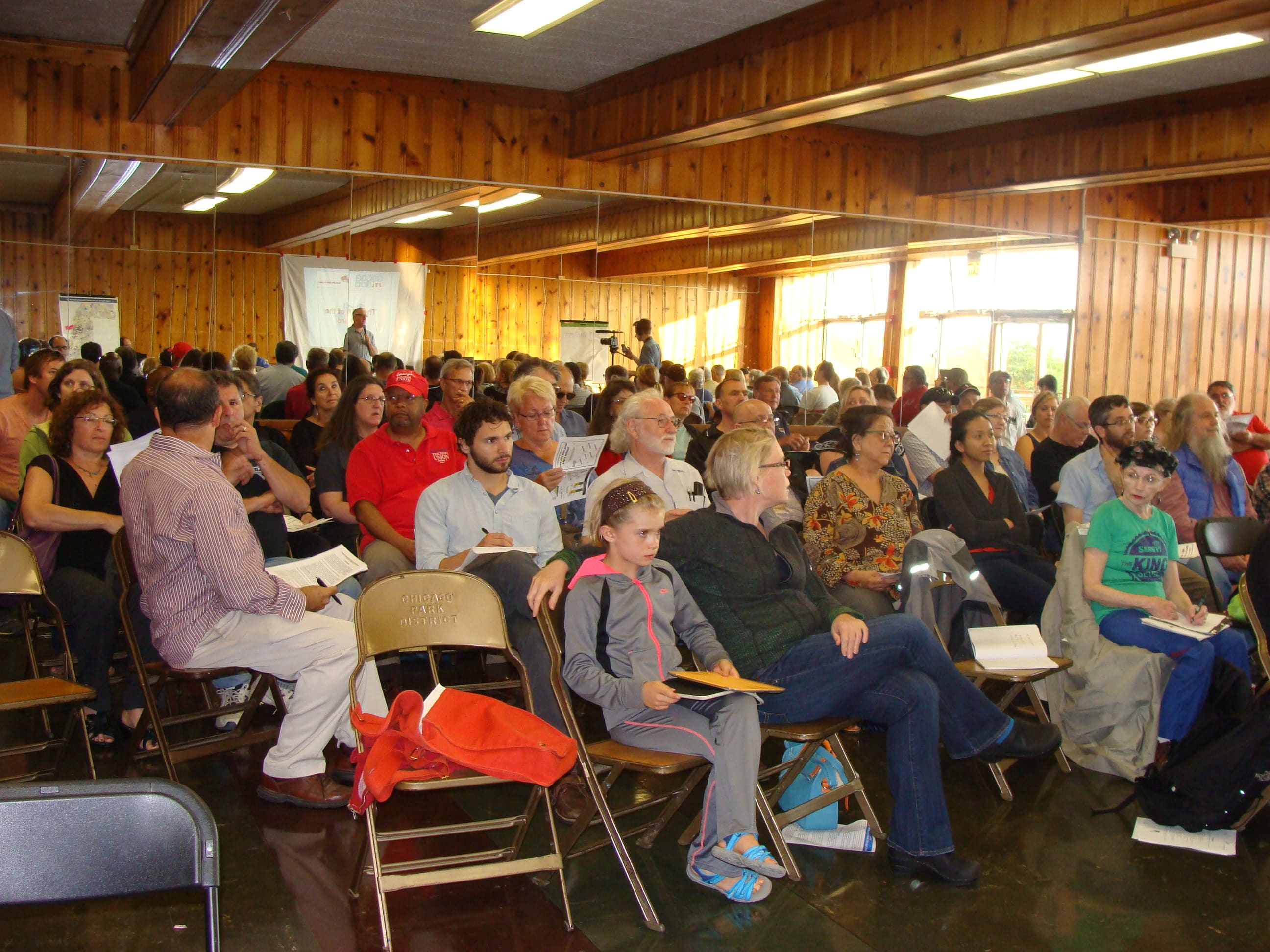
The TIF process is opaque, rife with corruption and conflicts of interest, and difficult for the average person to grasp. The TIF Illumination Project, a volunteer group that I help lead, has conducted an annual review of Chicago’s TIFs since 2013. The project has spawned over 250 public community meetings—called Illuminations—and over 50 open enrollment civic workshops. (Shelterforce covered one of the TIF Illumination Project’s community meetings in 2023.)

Over 16,000 people have attended these events, and over 300,000 have viewed our online presentations. Organizers from more than 25 cities have asked our group for help in unraveling the intricacies of TIF projects being pushed in their communities.
In 2022, Chicago had 127 TIF districts that removed a total of $1.3 billion in property taxes from approximately one third of all the properties of the city. TIF dollars can only be used to subsidize brick-and-mortar private projects, such as shopping malls, hotels, and residential buildings, and to build public facilities like schools, libraries, and park district field houses. This goes by the phrase of eligible “redevelopment project costs.” TIFs cannot be used to pay for daily governance costs, such as hiring hire teachers, librarians, nurses, social workers, or coaches, although these essential workers are often at the top of the list of local “wants” when people are asked what they need to thrive and succeed. TIFs are also used to pay down debt incurred in the past.
Chicago’s publishes annual reports, going back to 1997, on its Planning and Development website. The Illinois Municipal League estimates that, statewide, there are 1,506 TIF districts in as many as 537 municipalities.
The town of Cicero website only provides annual reports for five TIFs from 2019 and 2020. And there are no publicly available TIF reports from 202 to the present. Reportedly, the city’s TIFs have removed a total of $326 million in property tax revenue between 1987 and 2023. In 2025, the town’s budget was just over $246.6 million.
After 13 years on the TIF beat, it is clear to me that:
- TIFs are slush funds controlled by local city council members and mayors.
- TIF money (property tax dollars) is an off-the-books piece of local civic budgeting that is very hard to monitor.
- The TIF process is secretive, shrouded in jargon, and intentionally designed to be hard to track and compare across different times and jurisdictions.
- TIF dollars are doled out to mostly white male developers for private projects in affluent parts of the city that are of little or no public merit.
- The TIF process is corrupting, not only in terms of conflict of interest but also because it perverts the planning process, causing TIF-fueled projects to command greater attention, priority, and scarce resources over other needed projects in low-income communities and communities of color. For example, Chicago is now gifting $260 million to rehabilitate a handful of half-empty office towers in our financial district.
- Finally, created to supposedly benefit underdeveloped Black and Brown and working-class areas, TIFs, as deployed, are racist. They systemically starve communities of color and benefit mostly white and affluent neighborhoods.
Building a National Movement to Rein in TIFs
Exact figures for TIF are hard to come by. (As the primer produced by Good Jobs First attests, public reporting is inadequate.) Our team at the TIF Illumination Project has estimated that TIFs remove over $40 billion a year from serving the public; in Chicago alone, the cost to the city treasury in 2024 was reported as $1.59 billion. Since public schools in the U.S. receive, on average, 35 percent of their funding from property taxes, they are often the hardest hit when property tax revenue is diverted from a city’s general fund into TIF districts.
This is a national civil rights and racial economic justice issue. Yet, while many think tanks, academic policy shops, watchdog nonprofit groups, and other large institutions are concerned with economic development, fiscal policy, and good government, TIF districts often get scant attention from national groups (with the exception of Good Jobs First, which maintains its excellent Subsidy Tracker that offers a searchable database that tracks TIF and other subsidy programs).
Of course, many policy reforms could be enacted to at least mitigate the negative impacts of TIFs. Good Jobs First has developed one list of 10 possible reforms, which includes banning TIFs from taking tax dollars from public schools unless the school board itself approves. Even better would be to abolish the practice entirely. But whether you seek reform or abolition, both require building political power to convert policy ideas into law. Here are few steps that might help:
- Develop a national TIF illumination project modeled after the Chicago group I work with. This project could annually harvest all TIF data so the public can easily determine how much money is being removed and how it is spent—by city, county, and state.It could compare trends across TIFs and among states. It could also assist groups with developing infographics that illustrate the effect of TIFs in their communities.
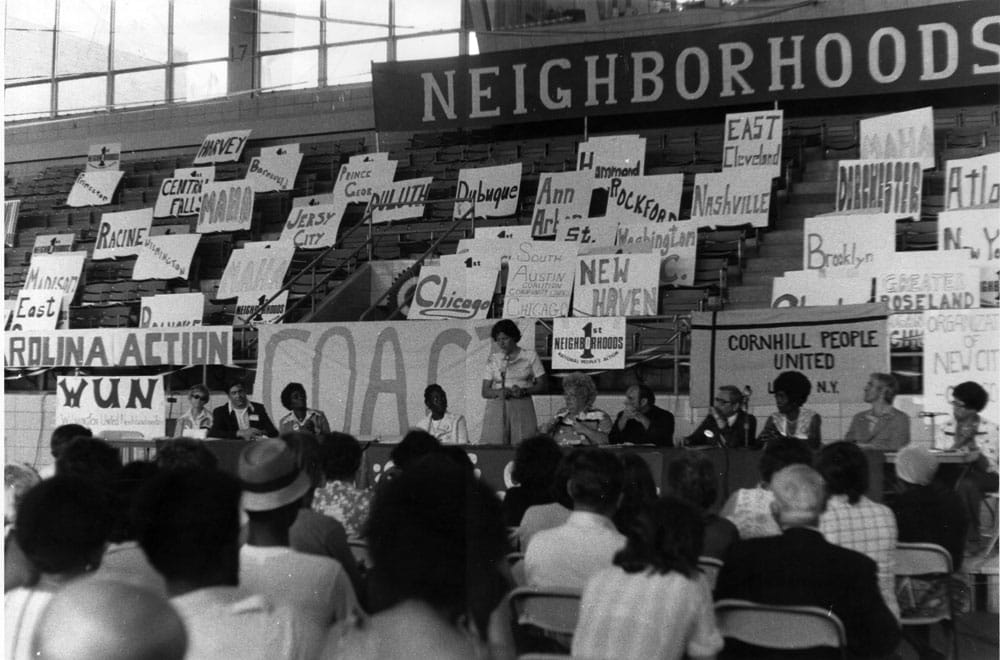
- Convene a national table of organizers working on economic justice issues rooted in local development, property tax abuses, lack of banking services, and the misuse of public dollars. Dozens of organizers and community leaders are wrestling with TIFs and could benefit from connecting with one another. Some groups, such as Good Jobs First, have convened activists. Still, a national convening where presenters are paid to travel and share their stories would be extremely useful.
- Develop a national training program where interested people learn to illuminate the civic finances of their own cities. I’ve seen this work myself. For example, the TIF Illumination Project worked with the Detroit People’s Platform for six months to train their members to illuminate their city’s secretive TIFs. The result was a robust set of findings that were translated into graphics and summary reports and distributed in community forums—and that formed the basis for candidate questionnaires used in their recent municipal elections. The opportunity remains to exponentially expand the scale of collaboration.
The bottom line: If you have a TIF in your community, I invite you to jump into the turbulent waters and examine the impact of TIFs and their corporate tax abatement siblings where you live. Warning: You probably won’t like what you find. More broadly, I challenge all of us—foundations included—to take on this work and move it forward.
About the Author



I hope you will let me know if you read this and what you thought. It would be great for you to email me at [email protected]. I will reply to all who respond. The TIF Illumination Project is at http://www.tifreports.com. I have been trying to get collaborators and support for this work for 13 years – and with very little success. Any insights, connections, or ideas that you may have are most needed and welcome. I will turn 74 in July and am looking for some civic platform – a nonprofit news outfit, a think tank, an economic justice org, Ralph Nader :), or some other crusader – to take this work on. This work has spawned over 300 public meetngs and workshops – it brings people out, gets them angry and energized, and eager to engage and organize! [email protected]
The TIFs have become an important problem for US public finance and urban planning, and the author is right in calling attention to it. I would however add, that besides the unfairness public finance problem, the lack of property taxation has inefficiency effects.
There is a long tradition in conceptual and empirical analyses about the positive effect on urban development and economic growth, of the land component in property taxation. This tradition has been neglected by more recent approaches that emphasize equity effects. I believe that bringing back the efficiency/growth focus, might attract a wider and more compelling attention to the need of abolishing, or at least decreasing the use, of TIFs in US cities.
Really interesting! In Baltimore, a recent film, “Tax Broke,” raised similar concerns. Our mayor has designed a non-contiguous TIF to fund redevelopment in formerly redlined, historically disinvested neighborhoods. I do appreciate the mayor’s ingenuity in using public finance tools that typically antagonize low-income communities for their benefit. How, if at all, does the non-contiguous, neighborhood-focused approach complicate Tresser’s analysis?
Nestor – Can you please elaborate? What would be your line of reasoning/attack using the “efficiency/growth focus” ? [email protected]
Krystle – I am familair with Real News based in Baltimore and their sizzling doc on TIFs. TIFs can not work for the poor – as they depend on rising property tax value to do their thing – how is that happening in a traditonally disinvested community of color – except when gentrification is looming. No. TIFs are inherently corrupting and racist. I am working on a manual for understanding and fighting TIFs (self published) and would welcome your review/comments. [email protected] – http://www.tifreports.com
HOLD THE LINE: Good Jobs First assumes that “economic” and “business” development are the same concept, they are not. The Community Economic Development profession does not exist to “create jobs”, to “expand the tax base”, or to subsidize commercial real estate development. Even worse, no one bothers to define “economic development”. I’ve written to Good Jobs First several times to clarity these matters but have never heard from them. Thus, their Subsidy Tracker needs to clarity that “economic development” DOES NOT mean business development.
In fact, “economic development” per se, has never been practiced or rarely defined; all that has been practiced for decades is the enormous subsidization of private company development, which has passed for “economic development”. This is the commercial real estate’s version of “economic development”, derived from Community Economic Development’s paradigm, which has a different focus and purpose than the commonly accepted idea.
After all, “Community Economic Development” is a public concept, business development is a private concept. Therefore, they are not the same concept. Each has its distinct purpose, goals, objectives, metrics, impacts, and outcomes. The purpose in life for a private company is to earn net profits, many using public dollars to achieve their financial goals. What is the purpose in life of a public sector entity engaged in the Community Economic Development profession? It isn’t to subsidize private corporations so that they can achieve their financial goals.
Fernando – I am with you 100% here. I seek to re-focus what is meant by “community development” from being thing-focused – namely, doing real estate deals, to being “people centric” and asking ourselves what do our neighbors need to be fully “developed” – and the answer won’t be a domed stadium, a glitzy mall, or re-doing your waterfront, or any other billionaire-driven megaproject.
Thx Tom, best of luck! I believe that all affordability and community development issues and challenges are related to market economics; a publication like Shelterforce should unite three interrelated components, to enhance our understanding: socioeconomic development, economic policymaking, and economic well-being, as “Process” & “Outcome” themes.
Just as we apply creative best tools to achieve community equity, the most powerful tool by far is our own capacity to flourish, i.e. to earn a living wage, esp in the private sector. This is what CED is all about, in my view.