



We don’t see immigrant defense work as being separate from workers or tenants rights.
—María Moreno, San Francisco Jobs With Justice
From May 14–16, nearly 1,000 labor union members and supporters gathered in Atlanta for Workers Revive Democracy, a national conference organized by national labor support network Jobs With Justice (JWJ). Founded in 1987, the network has more than two dozen city- and state-based affiliates that support local solidarity actions to “stand with workers and communities to win workers’ rights and economic justice.”
While JWJ primarily focuses on worker justice, the group has sought to build labor-community coalitions since its founding. Its formation, in fact, involved a rebellion against labor officialdom—although advocates would surely argue that the goal was to bring labor unions back to their community roots that had once marked the U.S. labor movement in the 1930s and 1940s.
In The Future We Need, Erica Smiley, executive director of JWJ, and Sarita Gupta, former executive director of the same group and now the vice president of U.S. programs at the Ford Foundation, acknowledge these tensions, writing, “Those of us who advocate a new approach … are sometimes accused of throwing the baby out with the bathwater. That’s wrong. We recognize there are a lot of practices from twentieth-century organizing and collective bargaining that are worth retaining … [but those practices] are no longer enough.”
The work, in short, covers far more than unions. The adopted approach, sometimes labeled “bargaining for the common good,” seeks to find common ground between worker and community needs, which, especially these days, often includes housing.
Lessons from May Day 2026 in San Francisco
As a result, JWJ chapters have long engaged in organizing that extends far beyond union campaigns. In the 2020s, as housing justice, spurred by a growing housing affordability gap, has become more central to movement organizing and as tenant unions have been revived, these community coalition efforts have increasingly incorporated housing concerns. Such is the case in San Francisco. Building on organizing to cancel rent during the beginning of the COVID-19 pandemic, in 2022, Jobs with Justice San Francisco was a major participant in an effort that brought together about a dozen tenant and labor organizations to get the city’s Board of Supervisors to pass a tenant right-to-organize law. Among its provisions, the law protects the right of tenants to form an association, including door-knocking and holding tenant meetings on-site, and requires landlords to meet and negotiate with the association, with fines assessed if these provisions are violated.
Building solidarity across unions and the community is rarely easy. María Moreno, a Jobs with Justice San Francisco leader, notes that it has not been easy to get the mainstream labor movement to ally with JWJ’s coalition of immigrants, workers, and tenants. “One of the biggest challenges this year was aligning labor to march with [the Jobs With Justice] coalition,” she says.
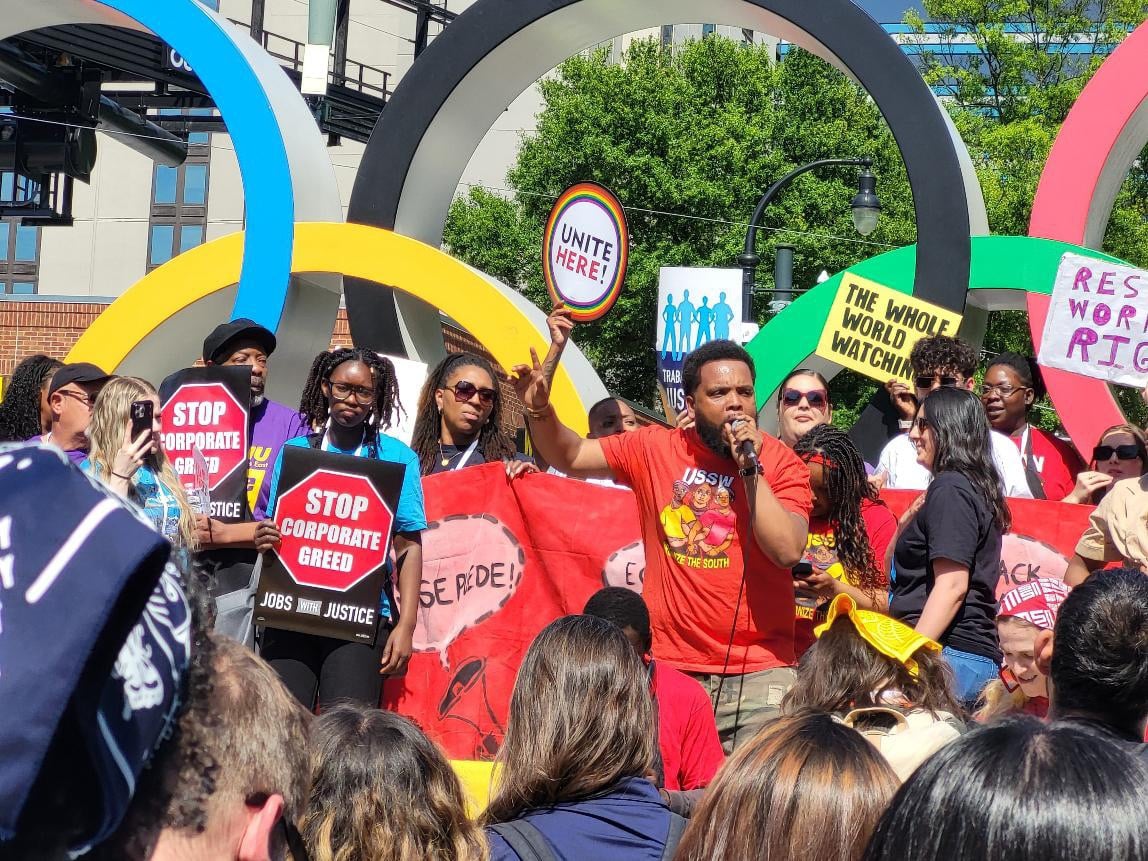
JWJ was trying to get established unions to join San Francisco’s May Day event, which focused on solidarity across movements. International Workers’ Day, or May Day, honors the workers who died in Chicago after an 1886 strike for an eight-hour day; it has been more commonly celebrated outside the U.S. than within it. However, in recent years, U.S. labor activists and community allies have sought to reclaim the holiday—and now regularly hold annual marches. In 2026, May Day protests were held in more than 500 cities. Participants included the National Education Association, the nation’s largest union.
This year, San Francisco held two May Day marches—one in downtown San Francisco, the other outside San Francisco International Airport. According to an account of the two marches in the San Francisco Public Press, “When thousands of workers, students and community organizers took to the airport and streets … they built upon more than a year of escalating efforts to mobilize public opposition to deportations by immigration agents, cutbacks of federal benefits and an economic climate that squeezes low-wage workers.”
The demonstrations brought together youth, immigrant workers, and a “really powerful group of tenants,” says Moreno. The airport march was held for a reason. In March, at the airport, a mother was abducted by ICE (Immigration and Customs Enforcement) agents in front of her daughter. “People were scared to go to the airport,” Moreno says, “and the workers at the airport had been in a fight for wages and fair contracts, so we decided to make a connection.”
According to Moreno, the marches also helped advance a two-month-old tenant campaign at 907 Valencia Street in the city’s Mission District, a historically Latine neighborhood. At the downtown San Francisco march, signs reading “907 Valencia Huelga de Renta” (“907 Valencia Rent Strike”) and “House the People” were prominent.
Moreno says that during the march, people stopped by the offices of Mosser Living, the corporate owner of 907 Valencia. According to Mission Local, the company owns 61 buildings within the city limits of San Francisco.
Tenants of the building have been on a rent strike since March 2, seeking to compel the owner to repair damage from a February 2025 fire and to address other maintenance issues. Moreno says the march helped jump-start negotiations: “After two months of striking, [the tenants] were finally able to get a meeting with their corporate landlord.” That meeting took place earlier this month.
Moreno adds that the San Francisco JWJ coalition—which is supported by two dozen local labor and community member organizations, including the Housing Rights Committee of San Francisco—has had “some wins, and there’s still a long way to go.” The goal, she emphasizes, is to build a common “collective identity.”
Organizing in the South
The decision to hold Jobs With Justice’s national conference in Atlanta was no accident. In 2024, Smiley, JWJ’s executive director, called for focusing organizing in the U.S. South, writing that “organizing efforts in the region that emphasize the democratic leadership and economic equality of Black workers and catalyze communities into action would not only lead to victories that would support the people of the South—it would also strike a blow against corporate control and authoritarian rule.”
A Bureau of Labor Statistics report notes that last year unions in the South gained 166,000 workers—more than a third of the total gains unions made. In 2025, unionization in the South climbed modestly—from 4.62 percent to 4.88 percent of workers.
While unionization levels remain far lower in the South than in the rest of the country, the South has seen an uptick in organizing in recent years. At the conference, various speakers addressed ongoing campaigns in the South, including efforts of the United Southern Service Workers (USSW) to raise Waffle House wages to $25 an hour and to improve working conditions.
What community support looks like varies by campaign. One way Jobs With Justice is supporting the USSW is by partnering with the W.E.B. Du Bois Southern Center for Studies in Public Policy at Clark Atlanta University to form the Advancing Black Strategists Initiative, the first labor center in the U.S. to be housed at a historically black college or university (HBCU).
The center trains labor organizers and authors research reports. Last month, a report from the center validated many of the workers’ claims, documenting that “workers face hostile environments, low wages and a lack of benefits.” For example, the study found that “some workers earn as little as $3.50 an hour due to tipped wage structures, while others earn between $17 and $22 per hour.” The labor center also acts publicly. For instance, Joseph L. Jones, executive director of the Du Bois Policy Center, spoke on behalf of Waffle House workers at a rally attended by hundreds of people on May 15.
Another campaign featured at the conference was the organizing of New Flyer, a bus manufacturer, in Anniston, Alabama. Organizing there was eased considerably by a neutrality agreement negotiated by Jobs to Move America (JMA), a national nonprofit active in Alabama and an organizing fellow placement host for the Du Bois Policy Center.
Marcus King, union president of Local 83700 of IUE-CWA (the International Union of Electrical Workers-Communications Workers of America) in Anniston, recognizes that the neutrality agreement—which kept New Flyer from actively opposing unionization—significantly eased organizing..
“That neutrality agreement was big,” King says, as it allowed pro-union workers to “start sitting in the break rooms … and talk to people.” King adds that the union still works with JMA on health and safety issues. Locally, the Alabama Coalition for Community Benefits, a coalition of about two dozen labor, faith-based, civil rights, social service, and environmental justice groups, has been a leading supporter.
King’s union local represents more than 600 workers. The union’s first contract, signed in 2024, included “pay raises ranging from 15% to 38% by 2026, restrictions on forced overtime, expanded vacation and paid time off, improved parental leave, the addition of Juneteenth as a holiday, guaranteed cost-of-living adjustments, and enhanced retirement benefits.” More recently, in May 2026, union locals joined forces to negotiate a national contract with the employer, including a partner facility in Louisville, Kentucky, that had just unionized in November 2025.
While New Flyer workers have benefited from community partnerships, King acknowledges that his own union local is still in the early stages of building infrastructure to meet community needs outside the plant. “We’re kind of learning to work in the neighborhoods now. I’m trying to get committees and things set up now,” King explains. “That’s our goal.”
King adds that he believes the gains his union achieves on its own benefit other workers because “people see our wins, and how strong we are, and how good we’re doing in our plants. … We can make this infectious” so others realize “you don’t have to just take whatever they give you.” The message, King says, is simple: Winning in the South is possible.
Renee Berry, another prominent locally based labor union activist at the conference, doesn’t hold an official union title but has been a de facto leader on the volunteer organizing committee at Volkswagen’s factory in Chattanooga, Tennessee. Berry has worked there since the factory opened in 2010. She recalls two previous union election defeats—once in 2014 and again in 2019. In both cases, the union lost narrowly—by fewer than 100 votes out of well over 1,000 votes cast.
In 2024, however, the union prevailed by nearly a 3–1 margin, making the factory the first non-Big Three (GM, Ford, and Chrysler) auto assembly plant in the South to be unionized. In February 2026, workers voted overwhelmingly in favor of their first contract with the company. Under that contract, which extends until 2030, workers received a 20 percent wage increase over four years. But Berry notes that wages were not the primary issue—job security and health insurance were.
As with New Flyer, community support helped the union gain company recognition. Berry credits Jobs With Justice, NAACP, and the local coalition CALEB (Chattanoogans in Action for Love, Equality and Benevolence), an “institutional coalition of faith communities, labor unions, nonprofits and community leaders working together to build power to affect change” led by area union locals and local churches. Barry says community support boosts morale, letting rank-and-file workers know that “you got these people in the community [who are] backing you.”
Following this first contract, initial union local elections were held in May. As with the New Flyer workers in Alabama, it is still early for the union to return the support it has received from community members. One of CALEB’s priorities is housing, including supporting the development of a community land trust. This cause might find considerable support among rank-and-file workers. Berry, for her part, notes that “the cost of living is getting ridiculous here.”
For the Volkswagen workers, the most important change so far, says Berry, is the shift in work culture. Members, she emphasizes, now “got somebody to have [their] back.” Already, the unionization of the Volkswagen plant is having spillover effects, with approximately 300 workers at Schnellecke Logistics, which does materials handling for the auto industry, including the Volkswagen plant, voting to join the union by a 2–1 margin. The multiple campaigns it took to get to this point, Berry says, are proof that you should “never give up.”
Linking Labor and Tenant Rights at the Federal Level
Paul Osadebe served as a civil rights attorney for the Office of Fair Housing and Equal Opportunity at the U.S. Department of Housing and Urban Development (HUD) from 2021 to 2025 and has been a union steward with the American Federation of Government Employees, Local 476. He remains active with the Federal Unionist Network (FUN), which seeks to connect federal workers across union and department lines.
Osadebe was fired last fall for filing a whistleblower complaint. He emphasizes that he speaks in his personal capacity and as a union steward—not on behalf of HUD.
Osadebe works at the intersection of union and tenants rights. He believes it is possible to break down the lines that divide federal workers from community housing activists. As he puts it, there are many ways “federal workers can partner with communities.”
Successful partnerships, he argues, need to be developed “at the early end.” In other words, Osadebe envisions workers and housing activists collaborating to develop strategies or policies they would like to see, rather than waiting until a rule is proposed and then responding with comments after the fact.
Alone, Osabede says, federal workers “can only do so much.” A responsive HUD, he elaborates, “relies on people out in the public to actually file complaints, to understand what their rights are, [and] to advocate for better laws.”
What is stopping this from happening in government under both Democratic and Republican administrations, Osabebe contends, is that while “there are lots of organizations that come up with great policies that would actually solve the problems we all face … the developers and the landlords, the banks, they have power. They have systems to get their stuff on the agenda.”
Bringing public voices into this agenda-setting process, Osadebe notes, is not easy; it requires disrupting the dominant ways federal housing policy is formed. To break in, he says, “It’s really important to have that connection between an organized workforce that is pushing toward housing justice, and then the people who are living in housing, who are living in communities.”
The potential of this approach is substantial. “Once [federal workers] get organized [in peer networks], we can go to communities who are organizing themselves and talk about their actual needs,” Osadebe says. Otherwise, you end up with the situation you have now, where lawmakers “hear one thing [in policy insider circles] and that gets whittled down—and that’s the policy that’s actually enacted.”
Once federal workers are organized into strong peer networks, Osadebe argues, they will be able to work more effectively with communities to jointly assess needs. “I think we can absolutely build that connection, because we’re all striving toward the same thing.”
Residents can also support workers. One project Osadebe is involved in is a web platform called Dear America. The portal—maintained by Jobs With Justice, FUN, and the nonprofit Branch4—provides a space for federal workers to anonymously share letters about the dismantling of civil rights within the federal government, with a current focus on HUD.
In one of the published letters, a HUD worker calls on the public to stand in solidarity with HUD workers and to act when HUD workers cannot. “Tell your stories of HUD stalling, closing, and refusing to act on your cases. Speak out about the discrimination you have faced publicly and ask the question ‘WHERE IS HUD?’ Oppose attempts to silence federal civil servants that speak out internally or externally. Amplify the stories of the workers that find the courage to speak out. Remind your elected officials that you demand free and universal protection from discrimination from the government you pay for. Join community organizations, unions, faith communities and any other groups that are committed to equal access to housing and work with federal workers that are fighting on the inside and the outside to protect your rights.”
Reconstruction or Restoration?
Movement work is often focused on local struggles, such as the tenant organizing and coalition work in San Francisco, the union locals in Alabama and Tennessee, and the activism of fair housing workers within federal agencies.
But what can hold such disparate movements together? Smiley of Jobs With Justice explored this during a JWJ conference panel with Deepak Bhargava, president of the Freedom Together Foundation, and April Verrett, president of the SEIU (Service Employees International Union), the nation’s second-largest union, with 1.9 million members.
In The Future We Need, Smiley and Gupta note that organizing forms that worked (or at least worked better) for workers in the mid-twentieth century require an upgrade—one that relies less on labor muscle alone and more on working in coalition with community groups, including housing activists, for the common good.
In Smiley’s conversation with Bhargava and Vernett, this logic was extended to a discussion of how to build solidarity in our politics. This, Bhargava insisted, ought to be a central goal of labor and tenant organizers. “What does a good worker or tenant organization do?” Bhargava asked. “It focuses people on what the real issues are. It unites them across lines of gender, race, sexuality, and gives people a vehicle to express what they care about.”
Bhargava highlighted a statement from LaTosha Brown, cofounder of Black Voters Matter Fund, released in response to the April 2026 U.S. Supreme Court decision in Louisiana vs. Callais, which hollows out Section 2 of the Voting Rights Act and greenlights race-based gerrymandering.
In that statement, Brown argued for an end to incrementalism and called on movement leaders to become “architects.” Bhargava emphasized the stark contrast Brown drew between “reconstruction” and the incrementalism of “restoration,” arguably an apt description of the Biden administration’s approach.
Verrett concurred: “We get scared by reconstruction or blowing it up. In so many moments in progress, we didn’t know what was on the other side.”
This year, in the Twin Cities, Vernett noted, decades of labor, tenant, and immigrant organizing built the base of solidarity that enabled Minnesotans to “be agile … and able to push back. It was those coalitions, partnerships, SEIU [Local] 26, teachers, grocery workers—without the community [organizing], that would not happen.”
And so, there is something to build on. Prior civil rights leaders, Vernett said, “didn’t know what freedom was, but they could dream of freedom. … They practiced radical imagination.” A similar radical imagination, she added, is needed today.
About the Author



Comments