


This article is part of the Under the Lens series
Innovations in Community Ownership
Top Takeaways
Mixed-Income Neighborhood Trusts (MINTs) are a form of community ownership designed to prevent displacement in appreciating neighborhoods.
MINTs purchase mostly occupied buildings and manage them as affordable rentals. Over time, some of the units are rented at market rate to help keep rents in the other units affordable.
A local trust stewardship committee sets the goals, priorities, and income mix for each MINT.
Low-income renters rarely benefit from investment in their neighborhoods. In the well-told story of gentrification, rising property values tend to displace longtime residents, making neighborhoods whiter and more affluent.
David Kemper, CEO of nonprofit Trust Neighborhoods, saw this dynamic over and over when he worked in affordable housing in New York City and met with grassroots groups to address the problem on the neighborhood scale.
“We just kept hearing again and again this kind of painful paradox,” Kemper said. “Making your neighborhood a better place not only did not make your life better—it actually makes your life worse.”
As the narrative goes, trendy neighborhoods become destinations for urban professionals and luxury apartments while legacy residents lose their communities and find themselves in areas with poorer schools and job opportunities.
Part of the problem, Kemper says, is that affordable housing tools like low income housing tax credits (LIHTC) don’t address the needs of rapidly changing neighborhoods. Often, disinvestment or blight in central city neighborhoods help pave the way for gentrification because low property values allow speculators to buy up swaths of land.
The question became, “How can we develop tools that help neighborhoods invest in themselves but do that in a way that doesn’t sacrifice affordability and belonging?” Kavya Shankar, Trust Neighborhood’s chief operating officer says.
Such a tool would need to give neighborhoods more control over their housing stock and create ways for residents to benefit from the economic growth.
Enter: mixed income neighborhood trusts (MINTs). Kemper and Trust Neighborhoods developed the MINT model as a way for neighborhood organizations to develop and operate mixed-income rental properties with community governance.
MINTs manage both market rate and affordable housing, with each trust determining levels of affordability and the proportion of price points in their portfolio.
Market-rate rents are meant to subsidize more affordable units in perpetuity. Since each community sets its own standards, MINTs are not beholden to strict restrictions for area median income (AMI) and can prevent displacement at different income levels. This can create a safety net between housing with strict income requirements and climbing rents set by traditional investors.
Kemper says the mixed-income model should combat displacement in a more nuanced way instead of saying, “You barely earn above our LIHTC unit [threshold]. We have to be the people that kick you out of the neighborhood.”
The MINT Structure
Trust Neighborhoods launched two MINT pilots in 2021, in Kansas City, Missouri, and Tulsa, Oklahoma. Since then, they’ve established trusts in Denver, Boston, and Fresno, California.
To be a good fit for a MINT, a neighborhood needs to be on the cusp of rising property values that threaten to displace existing residents. It also should have a community organization with existing infrastructure, potential to acquire a number of properties, and ways of raising capital.
To establish a MINT, Trust Neighborhoods works with an existing community organization like a neighborhood association or support collective. These community partners and Trust Neighborhoods each get one seat on the operating board, which answers to a Trust Stewardship Committee made up of community stakeholders and renter representatives. This committee defines the purpose of the trust, legally defining the MINT’s goals according to community needs, establishing a legal responsibility to do more than maximize profits.
With this structure, a MINT is essentially “a purpose-driven, for-profit real estate company, managed by a mission-based nonprofit” according to a case study by Purpose Built Communities, a national network of comprehensive community development initiatives, one of which supports the Tulsa MINT.

Using a mix of public and private funding sources, the MINT acquires properties and finds a property manager to oversee day-to-day operations. The MINT rents some of its homes at market rate, and some at lower rents, with an initial priority on stable rents that won’t displace existing residents.
While the private sector would raise rents and distribute profits to investors, Emily De La Guerra, operating board chair for Fresno’s Central Fresno Neighborhood Trust, says the trust stewardship committees of MINTs have discretion over how profits are used; typically they keep most profits in the trust to keep rents low.
Fighting Displacement
As rents rise, the market-rate rents in the trust should eventually help subsidize more affordable rents, but this doesn’t happen immediately. The model is designed to help neighborhoods get ahead of gentrification before it really picks up speed, so those market-rate rents aren’t so high to start with. At the beginning, a MINT’s market rate rents typically land on the high end of affordable, accessible to a household making around 80 percent of AMI.
When those market rates rise with property values, each MINT decides how they want to set their rents in response. The goal is to have a portion of units charge higher market rates to help subsidize more affordable units.
“As the values in the neighborhood increase you have the opportunity to charge those higher rents for some units with the goal of deepening affordability across the portfolio,” says Carson Bryant, director of the East Colfax Mixed-Income Neighborhood Trust (EC MINT) in Denver.
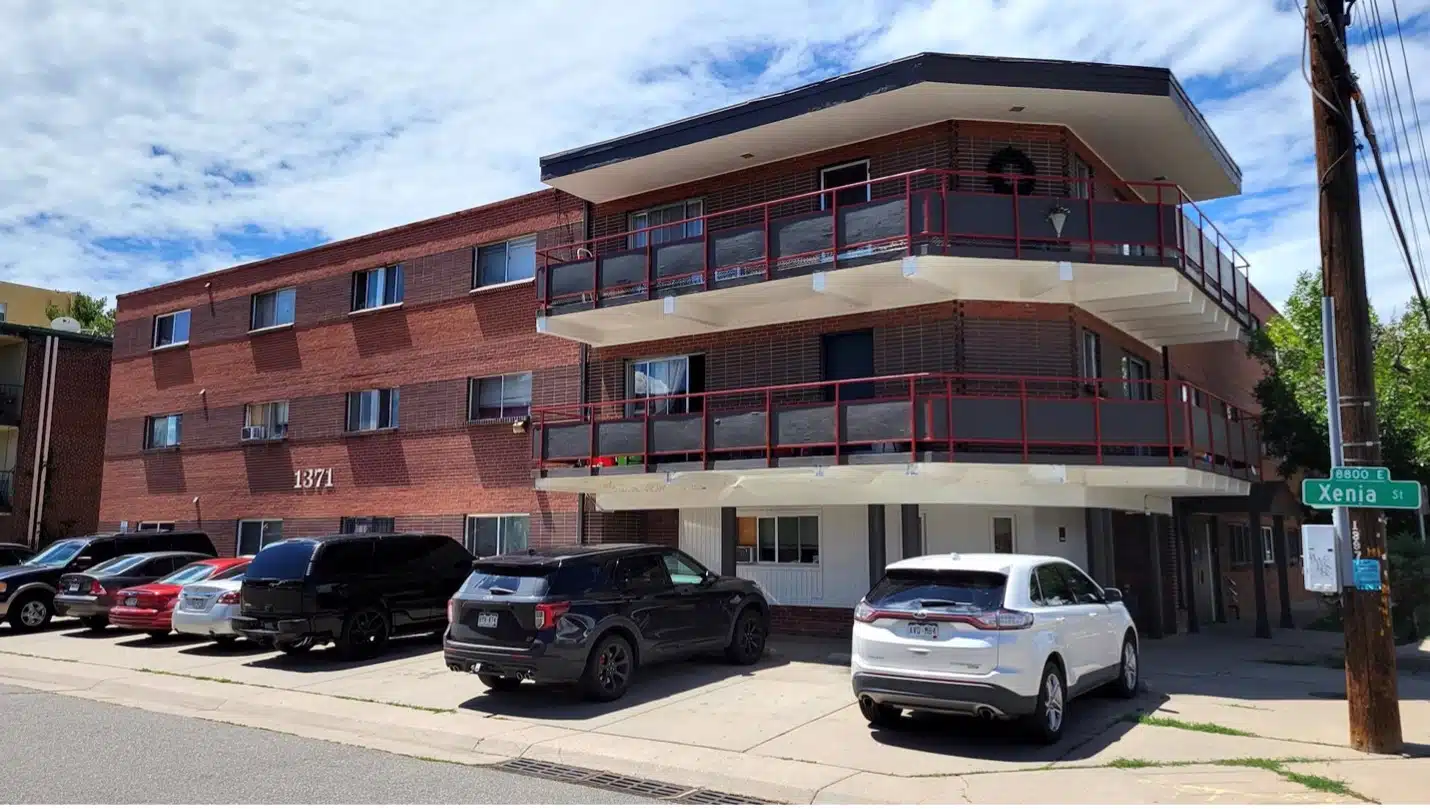
Right now, EC MINT has one building and has kept all residents’ rents stable. It’s affordable to households making at or below 50 percent of AMI, and households must meet income requirements to live there. In 10 years, EC MINT expects to shift about 30 percent of its units to serve households making 80 percent of AMI as they turn over, allowing the other 70 percent to remain more deeply affordable.
The MINT model is built to be flexible, with individual trusts deciding what is affordable for their communities. Trust Neighborhoods does not set requirements for the share of affordable units or the income levels they serve. So far, all active MINTs use local subsidies to support the operations of their affordable units—which can come with their own strings attached.
Such is the case for the East Boston Neighborhood Trust (EBNT), which was established by the East Boston Community Development Corporation (CDC) and tenant organization City Life/Vida Urbana.
East Boston CDC already managed affordable housing focused on fighting displacement. However, the city funding programs it had used to buy properties before were not enough when a portfolio of 114 units it really wanted to save were put on the market.
Tanya Hahnel, deputy director of East Boston CDC, says the MINT paved the way to reclaim the properties, which had been marketed to students. Because investor involvement had already raised prices, the sale price was too high to make it work without a mixed-income model.
With $12 million from the city of Boston and $8 million of philanthropic debt and equity, the East Boston Neighborhood Trust bought the portfolio with a $31.7 million mortgage.
Many of the existing renters were students, who as renters have a relatively high turnover rate, so EBNT has kept those rents at the market rate until the tenants move out. When the existing tenants do move, the units turn over with more affordable rents, and income restrictions. As of early 2025, EBNT had 18 percent of units renting to households at 100 percent of AMI. The rest are split between prices affordable to incomes at 50, 60, and 80 percent of AMI.
Hahnel told Shelterforce that she’s seen people who had been priced out of East Boston move back to the neighborhood by renting from EBNT.
Bryant says the EC MINT’s stewardship committee was working on a tenant selection policy that would lower barriers for prospective renters with bad credit, eviction history, or criminal history. He added that management actively tries to prevent eviction filings that would hurt tenants’ ability to find future housing.
“One of our purposes is increasing housing access—recognizing that we want to lower those barriers,” Bryant says. “We want to give people a second chance. We don’t believe that they should be stuck in this cycle of poverty and being denied their basic needs.”
Chad Bass, a resident of Kansas City’s Northeast Neighborhood Trust (NENT), has been surprised by the care and flexibility he sees in his property manager.
Bass has lived in the area for about 15 years, with two spent in a house owned by the NENT. Last spring, Bass lost his job and fell behind on rent after his car was stolen. He told Shelterforce he had to draw on his retirement account and unemployment but still couldn’t make expenses. He’s still paying back rent, but NENT’s management has been patient and assured him he won’t be displaced.
An alternative to absent landlords
All five MINTs that have been created so far are in diverse communities with large nonwhite and immigrant populations. The neighborhoods have naturally occurring affordable housing that tends to be older and may have been poorly maintained. Low prices prime the area for real estate speculation from investors that can buy up cheap property and rent it out for a profit.


Aging housing stock can also mean abandoned homes sitting unused—as is the case for the Lykins Neighborhood in Northeast Kansas City and Kendall-Whittier in Tulsa. Both Kansas City’s NENT and the Kendall-Whittier Neighborhood Trust (KWNT) set priorities to replace neglectful ownership as part of their trusts.
Before establishing the NENT in 2021, The Lykins Neighborhood Association of Kansas City had already undertaken an ambitious project to counteract blight caused by absentee landlords.
Beginning in 2018, the neighborhood association used the Missouri Abandoned Housing Act to rehabilitate blighted properties and add them back to the community’s housing stock. Fai Beal, a Trust Stewardship Committee member for the Northeast Neighborhood Trust, says they restored about 15 percent of the homes in the area.
Local reporting from the Kansas City Beacon found that the city’s “dangerous buildings” often sat in neighborhoods like Lykins, where 77 percent of residents are nonwhite and the median income is around $24,000.
According to a Trust Neighborhoods presentation, NENT has focused acquisitions on these neglected properties.
The same presentation says that 21 percent of properties in the Kendall-Whittier neighborhood are vacant. This presents an opportunity for both acquisition and impact, as KWNT can purchase empty homes at a good price, renovate them, and move families in.
KWNT’s parent organization, Growing Together, has programs supporting local Latine businesses, and KWNT works through them to hire contractors from the community for its renovations and maintenance whenever it can.
Kaitlin Garrett, executive director of Growing Together, says the KWNT board targeted acquisitions on a street that had had a string of break-ins to try to improve its safety. Since they purchased three homes on the street, she says, “the dynamic’s changed quite a bit.”
‘An art not a science’
Board members from MINTs in Tulsa and Fresno told Shelterforce that finding property managers who were aligned with both mission and budget posed a challenge for their trusts.
For KWNT in Tulsa, Garrett says, a property manager was the hardest partner to find.
“There’s not a lot out there,” she says. “You have to have somebody that’s mission aligned, somebody that’s familiar to the organization and that wasn’t truly just static in their processes.”
They also have to fit within the MINT’s bottom line.
Garrett told Shelterforce that KWNT found its property manager through a connection with a board member.
“We ultimately had to test that conflict of interest to make sure it was something manageable, and in our case, it was,” Garrett says. “This is where it becomes an art, not a science.”
De La Guerra, of the Central Fresno Neighborhood Trust, says finding the right property manager was the “biggest challenge” for her MINT as well.
“We really believe in community building and trust building,” De La Guerra says. “Finding a property manager that we can [for] one, afford, but also believes in that high service, high touchpoint management is difficult to come by.”
Beal told Shelterforce that NENT already replaced its first management partner for falling short of the stewardship committee’s standards for maintaining units and keeping them occupied.
The North East Neighborhood Trust now works with Integrity Capital Management, which focuses on affordable housing. Integrity works on renovating properties as well as managing them, says Beal, giving the company more skin in the game than typical property managers have.

Acquisitions
Of course, the COVID-19 pandemic drove up the cost of construction and renovation, and accelerated the rise of property values in neighborhoods with MINTs, making properties nearly everywhere harder to buy. Garrett says KWNT’s costs increased dramatically, tripling in some categories from what Growing Together and Trust Neighborhoods had projected in 2019.
She explained that cities with a relatively low cost of living like Tulsa saw an influx of people from pricier ZIP codes with the purchasing power to snap up property.
According to a case study from Purpose Built Communities, KWNT was aiming to reach 75 units—which it estimated it needed to be sustainable—in its first three years, but had acquired only 42 units by the end of 2024. This was just enough for KWNT’s property operations to break even, but did not cover staff costs. It is now closer to 50 units and KWNT expects the portfolio to become fully sustainable by 2026.
The Central Fresno Neighborhood Trust is also about halfway to its goal of 50 units.
Since the pandemic, Fresno has gone from a famously affordable California city to one of the most rent burdened in the country.
“You see a lot of private landlords who don’t want to sell or want to sell—but for a really exorbitant price—because they’re speculating that the rents are going to continue to increase,” De La Guerra says.
De La Guerra attributes this to regional migration in California from the pandemic and speculation that will only continue as the state plans a high speed rail hub in Fresno. This rail line will connect the Bay Area and Los Angeles, making the bay about an hour commute from downtown Fresno, De La Guerra says.
The Central Fresno trust’s costs have not been significantly higher than what organizers projected, but rising property values have made it harder to meet financial and mission-based goals, she says.
As a mission-oriented organization you want to buy it so bad because you feel terrible that people are living in this sort of condition. But it would have been financially irresponsible for us.’
Emily De La Guerra, Central Fresno Neighborhood Trust
One of Central Fresno’s goals is to turn low quality housing into high quality. As the MINT buys occupied properties, De La Guerra told Shelterforce, it will not raise rents for existing tenants, even after doing renovations. In some cases, the trust has lowered rents to ensure that families can afford to stay.
So far, all of the units Central Fresno has purchased have been occupied and 100 percent of its portfolio is affordable, with over half its rents set for tenants making below 50 percent of the area median income, according to a Trust Neighborhoods presentation. Eventually, the Central Fresco MINT will set some rents at market rates as units turn over.
“We expect that over time we’ll start to achieve some of those market rents that will sort of blend the whole portfolio together,” De La Guerra says. “But right now it’s been really important to us that obviously we’re not displacing families. The point of the MINT is to keep people stably housed.”
Knowing that the trust will not raise the rents limits its competitive edge in the open market for acquiring property, since private owners can offer higher bids because they will charge higher rents.
De La Guerra told Shelterforce that the trust had to walk away from a large prospective property with an affordable asking price after inspections. She says the owner had clearly been deferring maintenance and the renovations and repair needed put the building out of MINT’s budget.
She explained that the Central Fresno trust tried to negotiate down the price to accommodate repairs and the owner refused, expecting buyers to keep the building as it was.
“As a mission-oriented organization you want to buy it so bad because you feel terrible that people are living in this sort of condition,” De La Guerra says. “But it would have been financially irresponsible for us to buy it when you think of the MINT as a whole.”
Community governance
Kemper says people typically think of community ownership as a cost rather than a value. He wants to question that. Why would an out-of-state landlord be a better investment than neighbors who live a few blocks away?
In the realm of affordable housing, Kemper remembers working in New York City government and engaging in painfully slow public engagement processes. He says that taught him that residents don’t have a lot of real power.
In a MINT model, renters and tenant organizations have ongoing power via seats on the stewardship committee—and sometimes the operating board.
The East Colfax Community Collective (EC3) in the Denver metro area set its sights on a MINT after conducting a survey asking residents what solutions they thought would combat rising rents and substandard housing conditions, Bryant said. The East Colfax Corridor, which connects Denver with Aurora, Colorado, is home to many immigrant and refugee communities, making language access important for residents, so the survey was conducted in 11 languages.
The East Colfax MINT launched its first property of 23 units in September 2024 and has another 48-unit building under contract, with plans to close in early 2026.
Bryant told Shelterforce that the East Colfax Community Collective is a tenant power organization at its core, with roots in community organizing. As the MINT’s general manager, the collective has “a really strong sense of what the main challenges of community members are.”
Residents and committee members give regular feedback to property managers, and with the MINT’s founding task force and stewardship committee, East Colfax residents established a language access system which guarantees interpretation services for non-English-speaking tenants.
“Our project here is about stabilizing rents and housing stability and improving conditions. It’s also about shifting power dynamics because the world of real estate ownership and control has long been in the hands of the few,” Bryant says. “That has consequences for the people who live in these properties and live under the thumb of rising rents, slum conditions, things that are broken and never get fixed.”
About the Author



Comments