



This webinar explored some of the many ways that local and state governments can independently take create action to advance affordable housing and healthy communities. The four panelists discussed reining in corporate power and enforcing anti-trust laws, instituting public banking, passing reforms that reduced the costs of developing housing, and adjusting tax breaks to actually incentivize new affordable units.
The speakers were:
- Megan Miles, director of housing policy, city of Chattanooga
- Sara Myklebust, Bargaining for the Common Good research director, Action Center on Race and the Economy
- Lauren Strickland, executive director, Abundant Housing Michigan
- Trinity Tran, executive director, California Public Banking Alliance
The following transcript has been lightly edited for clarity.
Miriam Axel-Lute: Welcome, everyone. I’m Miriam Axel-Lute. I’m the editor-in-chief of Shelterforce. My pronouns are she/her. This webinar, Laboratories of Democracy, is wrapping up our spring series, Shelter in a Federal Storm, which was our response to people asking us, “Could you please report on what can be done at the local and state levels while the federal government is in chaos or, in some cases, actively perpetrating harm?” That series had 13 articles that covered a wide range of solutions, many already in action—and some not yet, but serious, practical ideas.
We have with us today four guests who are involved in four different kinds of solutions that were discussed in our series. We’re going to hear from them not only about what they’ve done, but also about the connections between them and why this is the moment to move forward with bold ideas. I’m going to start off by asking each of our great panelists to briefly introduce themselves and the state or local intervention that they’re here to talk about today. They will get more in detail on that after this round.

Megan Miles: Good afternoon. I’m Megan Miles. I am the director of housing policy for the city of Chattanooga. For those of you who may not be familiar, Chattanooga is a midsize city in Southeast Tennessee. We have about 200,000 people. It’s important to know that, for a long time, we were considered an affordable place to live. Chattanooga is growing very fast, and that growth is impacting our housing market. Since 2020, our home prices are up about 70 percent, and our rents are up about 50 percent. While this growth brings opportunity, it also is raising a hard question, which is, “How do longtime residents stay and thrive as our city changes?”
I am part of the city’s first-ever housing policy team, which was created by our mayor when he took office to address these emerging affordability challenges. I will say Tennessee does not necessarily make that easy. In Chattanooga, our affordable housing toolbox is limited. State law preempts many of the usual sticks, and we don’t have abundant tax revenue for carrots. We knew that we had to be really creative to unlock every tool that was available to us to incentivize affordable housing.
One of those is a familiar one, which is a property tax break program for developers called a PILOT, which stands for Payment in Lieu of Taxes. We’ve had one for many years, but our old version wasn’t creating the mixed-income housing that we needed, especially at the scale we needed to address our housing crisis. Instead of throwing it out, we decided to make it work better, and that’s what I’m going to be talking about today. Thank you.

Sara Myklebust: Hi, everybody. Sara Myklebust, as Miriam said. She/her pronouns. I am the Bargaining for the Common Good research director. BCG, [as] we call it for short, and ACRE, the Action Center on Race and the Economy, merged last year. I work out of ACRE. The primary thing that we focus a lot on [is] labor community partnerships through Bargaining for the Common Good. I’m the person [who] leads up our housing work. Since I started in 2019, we’ve been bringing folks together to think about corporate power. At ACRE and BCG, we want to think about what it looks like to look at economic and racial justice as they come together.
Almost all the time, our analysis shows us that it’s these big companies and wealthy folks, particularly white and male and cisgendered, that are driving what’s happening in our industries and geographies and our towns and cities across the country, and across the world—and the housing space is no different. When we’re thinking about what folks can do at the state and local level to take on what’s driving what’s happening in housing in our communities, we really look to how corporate landlords and other real estate players are the key folks that are fighting systemic policy solutions on the ground.
Organizing from tenants in communities, they’re trying to change how they’re experiencing what’s happening in their housing, as well as enforcement from local, state, and federal actors. They themselves are often enacting and driving what’s happening. What does that look like to take them on? Particularly at the local level, over the last few years, there have been some really innovative approaches, thinking about legal court cases and how they are funded through a lot of our public money, through subsidies and pension funds that have folks from the state and local level sitting on their boards as trustees, as well as enforcement of policies.
Engaging with those corporate landlords and making clear that when they are treating tenants differently—When they’re doing things that are driving systemic market problems, be it rent or the condition of homes, and what’s being built, how it’s being built, and how it’s being maintained—that we can engage with [them]. A couple examples of that: RealPage, which is a company that developed an algorithm called YieldStar that has been pretty well documented that it was [being used for collusion]. There’s multiple corporate landlords that were key players, and they were sued at the local level by multiple attorneys general. There’s also been policies across the country that have been passed around rent algorithms in general to try to change what’s happening there.

Lauren Strickland: Hi, everybody. I’m Lauren Strickland. I use she/her pronouns. I’m the executive director with Abundant Housing Michigan. We’re a 501(c)(4) nonprofit organization founded by folks who want to see Michigan out of our critical housing shortage. The way we attack this housing shortage is through land use and zoning reform. I hope to talk to you guys about some of the legislation that is on the table now and how we believe that this is the way to build a foundation to help us to crawl out of this situation that we are in. We are a statewide advocacy group. We advocate for legislation surrounding land use and zoning reform throughout the entire state of Michigan.

Trinity Tran: Afternoon, everyone. I’m Trinity Tran, she/her. I’m the cofounder/executive director of the California Public Banking Alliance and Public Bank LA. We have been laser-focused on building the blueprint for socially and environmentally responsible public banks here in California for years and working with our merry band of heroes with communities and local governments to get this really exciting emerging public policy off the ground. We’re in a moment right now where this conversation is really critical. We’re seeing, obviously, federal funding getting gutted on top of local budget deficits, on top of state deficits.
Many of the core funding streams in our communities have been impacted by this fall volatility, from affordable housing, social services, infrastructure. The question and the conversation [is] around how do we pay for it? What can we do at the local level to leverage public resources at scale to be able to build the things we need? That conversation is so relevant, so urgent right now. That’s what we’ve been organizing around. Right now, cities, counties, states are sitting on hundreds of billions of dollars in public funds. Right now, almost all of it flows to Wall Street banks. They use those funds to generate profit for shareholders while our communities are struggling with basic necessities.

We’re working to change that here in California. Our grassroots-led team passed the California Public Banking Act, which was the nation’s first law, allowing local governments to form their own public banks. We’re working with communities and local governments to get these banks off the ground. We’re also working on the CalAccount program, which, once it’s implemented, [will] be the nation’s first universal banking services program to provide zero-cost, zero-fee, zero-penalty bank accounts for all Californians. That’s going to be crucial, especially for the millions of unbanked [or] underbanked folks here in California who are locked out of the system.
That’s part of our system-changing work. We’re trying to move beyond just patching up the faults of the current system and building a new, evolved system that really works for our people and our planet. This is the moment to do this. With all of these converging financial pressures—from the federal level to the state level to the local level—this is the exact type of bold solution that we think is needed. [I’m] looking forward to digging into public banking a bit more in this webinar and why now is the moment for this fight.
Megan, tell us why the PILOT, or payment in lieu of taxes, program that you had wasn’t working before—and then how your more targeted approach works better.
Miles: Again, our PILOT program is a program that gives developers a property tax break if they include affordable housing in their projects. This may be something that is familiar to many of you on the call. It is not a new program; it’s a tool used by many cities across the country. Like in many places, we had a PILOT for a long time. The original version went through a couple of iterations, but the version we inherited was pretty simple. It basically said [that] if a developer makes half of the units in a project affordable to households earning about 80 percent of the area median income (AMI) or below, they could get a full tax break. On paper, that sounds pretty straightforward.
It was pretty easy to calculate, but in practice, what we found is it did not work very well—mostly because it was too blunt. It offered a fixed tax break for a fixed set of requirements, but it didn’t take into account where the project was [or] what it cost to build. It didn’t respond to the real differences in the housing market. What we found was that in higher-cost, high-demand neighborhoods, the incentive wasn’t strong enough to make affordable housing pencil out. We didn’t get any affordability there at all. Then, in weaker markets, the incentive was often more than needed. Eighty percent [of] AMI was often market rate in some of our weaker neighborhoods.
We were effectively paying for affordability in places where the market would have delivered it anyway. As a result, the program worked for a small number of nonprofit developers already doing affordable housing work [or] maybe building some small-scale projects—and for the occasional federally subsidized LIHTC project—but it didn’t really move the needle in the broader market. As our city was growing and expanding, we realized we were missing a major opportunity to ride that wave of development and bring affordable housing into some of our strongest and our most opportunity-rich neighborhoods. We added more than 12,000 new housing units since 2020.
We were growing, but we weren’t necessarily integrating affordability into that growth. Again, we don’t have a lot of sticks; we don’t have a lot of policy tools where we can require developers to add affordability, and we don’t have a lot of tax revenue where we can offer subsidies. We stepped back and thought, “We have this tool; how can we think about it differently? Maybe instead of an all-or-nothing incentive, we can think about how we directly tie this tax break to the actual number and depth of affordable units in a project.”
That shift in thinking led us to redesign the program into a more flexible per-unit system, which is the first in the country to actually tie the tax abatement to the cost of providing affordable units. Now, under this new program, again, instead of that all-or-nothing approach, developers receive a tax break based on how many affordable units they include and how deep that affordability goes. The deeper they go, the larger tax break they get. Because building costs vary by neighborhood, the incentive adjusts based on location. That flexibility is really important to developers.
They can structure a mix of market-rate and affordable units in a way that actually works for their financing instead of trying to fit it into a rigid threshold. Again, simply, if a developer lowers their rent to create affordable housing, they’re losing money, but this tax break helps cover that lost rent. The more affordable housing they provide, the more support they receive. We also made the system fully transparent. We have a public calculator on our website that shows exactly how that incentive is calculated. That helps make this relationship between public investment and public benefit a lot clearer.
In practice, what we’re seeing is that this more precise approach actually can unlock projects that wouldn’t have worked before. The first project that went through as a mixed-income PILOT is a 278-unit Class A apartment building that just broke ground on a former industrial site in one of our most desirable neighborhoods. It’s an area that had no income-restricted housing at all. Under the old system, this project would not have included affordability, but under the new structure, the developers realized that they can make the numbers work.
The developer had never built affordable housing before, but because they had this flexibility, they could structure that mix of market-rate and affordable units in a way that made the deal financially feasible. In the end, the project includes 42 affordable units, 32 at 60 percent of the area median income or below, which is about $45,000 for a family. From the city’s perspective, it’s a really great outcome because the site that previously generated about $9,000 a year in property taxes now generates more than $340,000, even with that tax break in place.
Again, it brings income-restricted housing into a neighborhood where it didn’t exist before: one of the most desirable and opportunity-rich neighborhoods that we have in our city. We’re really starting to see how this is working.
That’s so exciting. I look forward to seeing how that development proceeds.
Sara, you mentioned RealPage. Can you tell us a little more about that? What are some of the top ways, in your opinion, that state intervention can limit corporate power in order to have real effects on the affordability of housing?
Myklebust: Yes. Our analysis and that of many other folks that are looking at the industry, as I was saying, really demonstrates [this]. The folks at ProPublica in 2022, when they looked at RealPage in particular and the algorithm that they were using through a software called YieldStar, [they found] that not only are our corporate landlords doing a variety of different tactics for their own properties, but it’s also helping to drive all of the challenges that we’re experiencing in the market overall—affordability, etc.
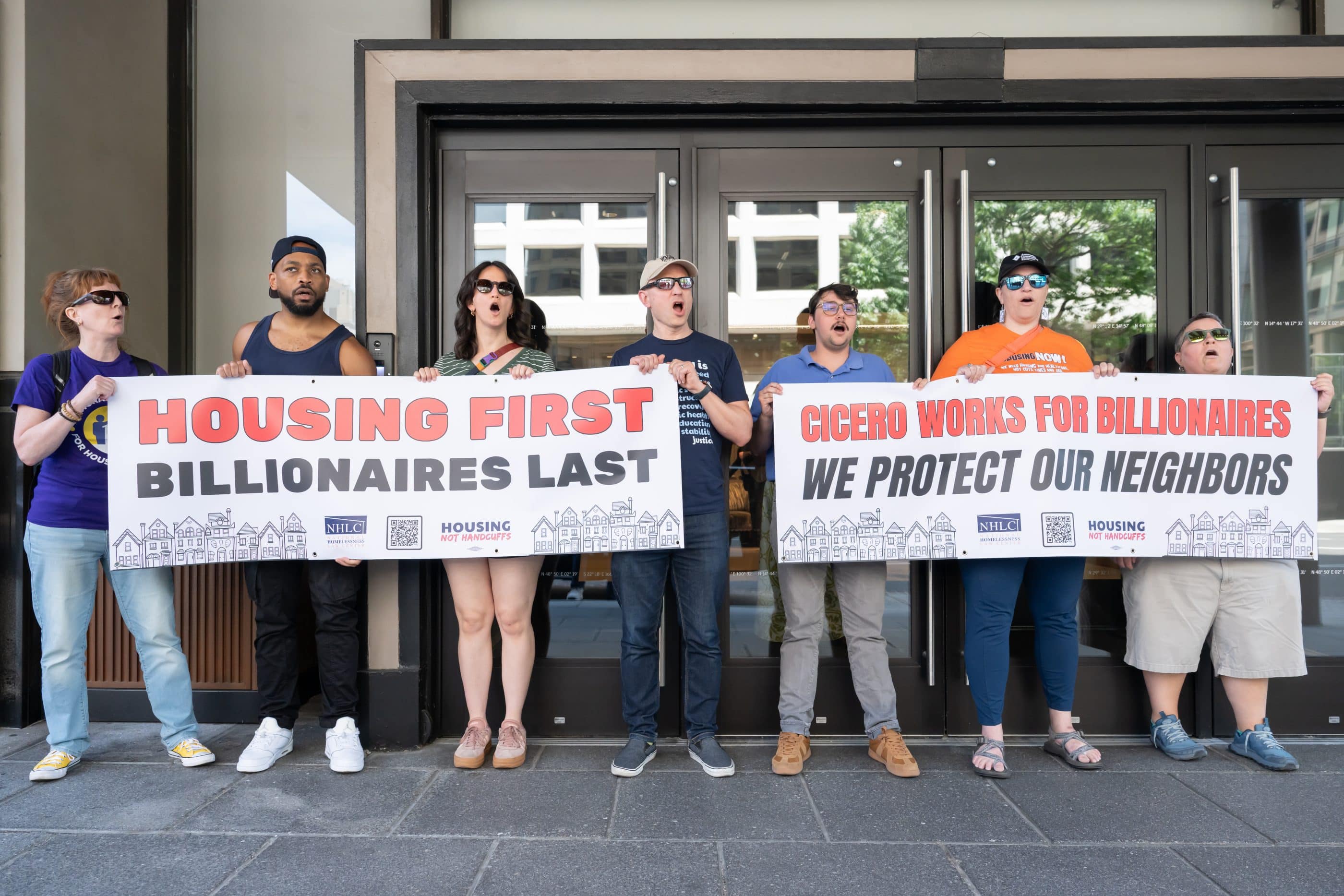
The DOJ [Department of Justice] did bring a lawsuit, but so did multiple other attorneys general and local folks across the country, against not just RealPage, the company that developed the software, but also about a dozen—in some cases more—corporate landlords that were a part of using that software. [They] made the argument that they were part of a price-fixing scheme to drive rents being much higher and unaffordable than they already would be. These are some of the companies and individuals that are some of the wealthiest in the world—billionaires, folks [who] are already making a ton of money—and were doing this.
Across the country, not only have there been lawsuits to push back against that type of behavior, but folks have also been passing local ordinances talking about rent and price-fixing and housing. Sometimes it gets preempted, as there’s some references to at the state level. Even the process of going through and exposing what the behaviors are and the ways that the companies are changing how we’re experiencing housing and accessibility of it is really important. The other piece that I would like to mention in terms of thinking about at the local level was in Minnesota.
Looking at enforcement mechanisms that already exist and the behaviors that some of these companies are a part of, sometimes it’s on rent, and oftentimes it’s on habitability as well. Tenants are saying black mold, lack of ability to have—Right now it’s hot across the entire country, their AC doesn’t work, access to water, cracks in foundations, all sorts of terrible stuff that is not being fixed in their homes. That’s becoming more and more the norm in the market overall, including with some of the big corporate players.
We found in single-family rental, which is a newer part of the rental market in Minnesota, one of the largest companies that was perpetrating that was called Premium Homes. They own a company called Progress Residential. Folks on the ground, tenants, and organizers documented a lot of the issues and problems that I was just describing, as well as many others that were happening in their homes in northern Minneapolis.
The attorney general in Minnesota ended up bringing a lawsuit around the conditions there. There’s real opportunity at the local and state level to be pushing back on these behaviors that are not just happening with individual companies, but they’re leaders in the market that are impacting more broadly what all of us are experiencing in our housing.
Lauren, let’s move a little bit over to Michigan now. Tell us the details about a couple of the bills—the ones you’re most excited about that have been or are being proposed in Michigan—and why they will be helpful for affordable housing development.
Strickland: Absolutely. First, it’s really important to note that in Michigan right now, we have this legislation on the table. It really shows just how critical this issue is that it’s a bipartisan effort. That’s something that I think is very important for our state to show that both sides of the aisle are coming together. It really shows just how critical of a moment we’re in when both sides of the aisle can really come together on an issue. It really shows that something needs to be done about this.
Right now, there is the Housing Readiness Package, which is a bipartisan-sponsored bill package. It has nine bills. It’s a pretty robust package, but it talks about everything from legalizing accessory dwelling units to lowering parking minimums to reforming site plan processes to limiting the amount of land use for residential sites, legalizing duplexes—all things that we know through studies and research that will help to make housing more accessible and thus more affordable in the state.
Some bills that we’re really excited about that have actually made recent progress are some single-stair legislation that will allow for multi-unit properties for single stairwell[s] instead of the need for connecting multiple stairwells. We’ve really looked into the safety of this. It allows for the upkeep of character of certain communities as well. I think all of these bills, at the end of it all, help to, like I said, make housing more accessible, but [also] actually help to create more housing. We are short [of] over 100,000 units in the entire state.
With that, we have to make development more accessible, not just for development—you think of the larger developers—but for the folks [who] have property that want to build a mother-in-law suite or for those [who] want to expand on their property. For the smaller developers that maybe have a hard time navigating the various amounts of local red tape and sometimes unpredictable types of local red tape, it really just helps to create a better and more palatable space for development here.
Thanks, Lauren. I know that the story that your colleague Joel [Arnold] told me when I was reporting on this really stuck with me—about the first time he did a development, or his organization did a development, and they had to provide dozens and dozens of parking spaces for a senior development where nobody drove. That stuck with me as one example of why the sorts of things that you’re talking about may be of interest to affordable housing developers specifically.
Trinity, tell us what a public bank is. How does it work? Why do we want them?
Tran: What the heck is a public bank? The simplest way to explain it is exactly what it sounds like: it’s a bank owned by the public. It’s accountable to the public. Profits flow back to the public, not to private shareholders on Wall Street. How it works in practice is, right now, our cities—like here in Los Angeles—collect taxes, fees, fines, and billions of dollars that our cities accrue. That money gets deposited into private commercial banks, your Wells Fargo, your Chases, Bank of Americas. Those banks use our money [and] leverage our money to make loans and investment to generate profit for themselves because, at the end of the day, they’re accountable to their shareholders, not to the public.
Our cities see almost none of that return. When cities need to fund public projects like building roads, schools, or affordable housing, they borrow money back from private investors on Wall Street. We’re paying close to another dollar in interest for every dollar that’s borrowed over time. Every time the city issues a bond to build a bridge, Wall Street banks then tax on fees to structure and sell those bonds. We’re paying not only on the cost of the project, but decades of interest on top of that. That’s billions of dollars that flow out of our communities year after year.
What we’re essentially doing is giving Wall Street a free loan with our public dollars and then paying [it] again to finance our own needs. That’s obviously not a good deal that works out for our community. What a public bank does is it essentially flips that. Our city deposits its funds in a bank that it owns. The bank then makes low-interest loans directly to support affordable housing projects, small businesses, green infrastructure projects, [and] community land trusts, and instead of profits going to a CEO’s bonus, they come back to the city. As long as you’re repaid, it comes back to the city to fund schools, transit services. That’s the stuff that we’re constantly told we don’t have money to pay for.
What we’re doing is essentially creating a permanent, revolving, community-owned source of capital that can be reinvested year after year after year. Where this gets really powerful—and what excites us about this movement—is we’re not just talking about moving the same dollar from one bank account to another. We’re talking about multiplying it. That is the power of a bank. That’s the power of a public bank that all banks have; it’s called fractional reserve lending, where every dollar deposited in a public bank can be leveraged up to 10 times in lending capacity. If the city deposits $1 billion, that bank can generate up to $10 billion in loans back to the community. That’s 10 times the impact.
One billion dollars can create $10 billion in lending. Ten billion dollars can create $100 billion in lending. That’s the power that we’re unlocking here. That’s essentially the lever that we’ve been handing over to private, commercial Wall Street banks every year. A public bank puts that leverage power back into our hands. This isn’t a new progressive policy idea. We have a public bank in the United States that’s 100 years old; it’s the Bank of North Dakota. It [was] founded in 1919. This is a 100-year-old bank that has withstood the economic crash of 2008. It’s one of the most stable, high-performing banks in the United States.
It doesn’t gamble on Wall Street. It invests in the people of North Dakota and the communities of North Dakota. It returns about, on average, 15 percent to 18 percent on investment back to the state. That’s hundreds of millions of dollars back into the state’s general fund. You’re talking about a state the size of the city of San Francisco. If we’re looking at California, you can imagine the power that we’re unlocking for an economy 60 times the size of the state of North Dakota. What we’re doing is amplifying the entire ecosystem. An important part about the public banking movement that gets overlooked is that we’re not competing with community banks and credit unions; this is about partnering with and empowering them.
This is the same way the Bank of North Dakota operates. It’s a banker’s bank. This is a wholesale bank; this isn’t a retail bank with a branch on every corner where you and I are going to go in and deposit our money there. This is for our city. We’re not competing with community banks and credit unions—we’re partnering with them. We provide the liquidity that smaller, mission-aligned institutions need so that they can do more of what they’re already doing in their communities. This is about amplifying and supporting the entire community-centered lending ecosystem. That’s the model we’re building in California.
As I shared in the intro, we passed the California Public Banking Act. The regulations were finalized in 2022. We have been working to get these socially, environmentally responsible public banks off the ground. We’re also working at the state level on a state-level public bank; it’s the work that we’re doing at the municipal level, but [it’s] bringing scale. That’s what is moving here. At the end of the day, this is really about taking control of money that’s already ours.
This is building public financial infrastructure that works for the people, that essentially takes private profit motives out of it so that we can build homes and schools and fix our streets and do the things we need that we don’t have funds for. This is an exciting moment for public banking as a policy, as a possibility, to fundamentally rewire how public dollars flow and who they serve—and what becomes possible when we take the power of money and finance out of the hands of private Wall Street banks and put it into the hands of the people where it belongs.
Trinity, you referred to this at the beginning, but you all have said a little bit about it in some way or another: What is it about this moment in time that makes it the right time for the intervention that you’re talking about? In this political landscape where things often feel a little difficult, shall we say, why are these interventions politically appealing, and what does the range of support behind them look like?
Tran: Yes, we’ve been plugging away at this for a minute. We’ve been doing that since 2018; 2017 [or] 2018 was when we first led the divestment movement here in Los Angeles, where we were trying to reroute funds that were supporting Wells Fargo Bank in particular because they were one of the main financiers of the Dakota Access Pipeline. We’ve been at this for a long time. We’ve been told that this is a fringe idea. It’s too radical. It’s too complicated. It’s impossible. The more that society moves, the more that we’re proven right that this is an inevitability of a system that’s really only served a small handful of people.
Obviously, when you zoom out, in 2008, you saw Wall Street get bailed out while families were losing their homes. The pandemic hit. You have communities, again, scrambling. LA wildfires just devastated our communities here last year. It really exposed just how fragile and inequitable recovery infrastructure is. Now, on the national level, you have federal investments that are getting shredded from housing and social services, social safety nets getting shattered. Everyone is trying to wring their hands and figure out what do we do from here. In this moment of all these compounding crises, this is a common sense and logical solution.
We’re spending billions of dollars every year on debt service and interest. That’s money that goes out the door and essentially doesn’t return. Every time one of our [cities] or one of its departments spends money, that’s money that leaves our communities. Why not figure out a way to recapture some of that and recirculate it back into our communities to be able to fund the things we need? It’s common sense. It’s practical. It’s logical. When you look at housing [and] the housing subsidies, development grants, all of that’s being gutted right now. On top of the state budget deficits, the local budget deficits.
As we’re constantly in budget deficits and figuring out how to fill revenues, this is the moment for this conversation about creating long-term public financial infrastructure rather than just incremental fixes. You can’t really patch a system or incrementally fix a system that’s being dismantled in real time. I think moments of crises [are] when people are inspired to be bold. Given the moment that we’re in and the volatility that we’re seeing from the federal level, this is the exact moment for this conversation. It’s structural intervention, and it’s local, it’s tangible. It gives us a logical path, a practical path, a stable path to be able to fund the things we need without having to wait on Washington and on Wall Street.
Nobody thinks that their tax dollars shouldbe making Jamie Dimon richer while our streets are crumbling [and] our neighborhoods are deteriorating.”
The political coalition that we built here in California is quite large. This is the grassroots that started grassroots. Now we’ve built support from progressive Democrats, housing advocates, climate, EJ [environmental justice] folks, small businesses, CDFIs [Community Development Financial Institutions]. We have labor on board. What’s exciting about this is [that] whatever initiative you’re fighting for—whether it’s housing, climate, small business, infrastructure—it all comes down to one very core or critical question, which is how do you pay for it? Where does the money come from?
The possibilities around unlocking billions of dollars out of our communities to pay for the things we need—that’s exciting to fix. That has helped us really galvanize a broad-based coalition. With all of these conditions converging, the idea [is] having a bank that is owned by our city, that’s accountable to our communities, [where] investments are made locally, the deposits are made locally, the decision-making process on investments are all made at a local level.
That local framing around public banking, I think, is just so powerful and captivating because at the end of the day, nobody thinks that their tax dollars should be making Jamie Dimon richer while our streets are crumbling [and] our neighborhoods are deteriorating. Regardless of who’s in the White House, there’s a real urgency to try to get public banks off the ground because we can’t keep waiting on federal solutions and the volatility there or [on] Wall Street profiteers to invest in our communities. We have to figure out how to build financial power at the local level.
Sara, do you want to follow up on why this is the moment for the work that you’re doing? It seems connected.
Myklebust: Yeah. Everything Trinity was saying in terms of describing what’s happening is—particularly at the end there, with Jamie Dimon and other folks [is correct]. Across the board, if you live in urban, rural areas, no matter what state—purple, red, blue, or what have you—[for] folks right now, it’s really expensive and really not great that the housing that’s being built and that’s being provided to us, and there’s not enough of it. The folks that are making money off of that, we know who they are. They have a ton more money than we do. Thinking through how can we change that system? How can we figure out?
Part of that is naming those folks and naming what they’re doing and making sure that people at the local and the state level are doing everything to change that system. I talked about some of the RealPage stuff. I also wanted to mention another piece of work that we’ve been involved with, which is looking at how pension funds are spent. Part of what we’ve also been exposing is how much of our state and local money coming that’s supposed to be being invested to make it a dignified retirement for state and local workers is actually going toward corporate landlords that are, in many cases, victimizing the same group of folks in the name of making more money for them for their retirement.
There’s opportunities. Public banking is listed in the piece that I put in [the chat], as well as other solutions. We could be putting our money in different things. If we’re state and local workers, that is our money. The folks that are making the decisions about where it goes, it’s just tragic in looking at that. Then in terms of the policy side that I mentioned earlier, really, across the board, there’s an agreement that we need to be limiting folks’ power to increase our rents astronomically just to line their pocketbooks. Then there’s no need for it.
Being able to step forward right now at the local and state level, where there are really bold folks that are leading things that are willing to do that and are willing to name the people and the companies that they head that are driving that. There’s never been, I would say, in my entire lifetime, a moment that is more primed for it or when it’s been more been needed. I don’t think I’ll probably be able to buy a house in my lifetime. I think that’s true of a ton of people in my generation. The reason for that has never been more clear.
I want to take this same question over to Lauren because, Lauren, you mentioned that you have a very wide breadth of support for what you’re working on. If we’re going to keep the bad actors from building housing in bad ways, you’re working on making it easier to build housing without having to resort to those things. Talk to us about the politics—about the coalition—why you have such a broad range of support there, and what it’s like to work with that group.
Strickland: Absolutely. Flat out, we have this broad range of support because folks are fed up. There’s just simply not enough housing. Like Sara said, she thinks she won’t be able to buy a house. That sentiment is true for so many people. Not just having access to housing, but access to the housing of their choice. I always call it, “What is your housing flavor?” In Michigan, and in so many other places nationally, folks just don’t have access to the flavor that they want. As families grow, as families increase in size, as folks age, people are pretty stuck in what they’re in right now. That’s never a good feeling.
I think that with that, that brings about what I always call the unlikely allies and alliances that are being formed which actually proves that we can work together to solve a common issue. I think Trinity said it best: When you’re in a crisis, you can make bold moves. When we talk about land use and zoning reform, it’s a pretty bold move to make. There’s the issue of local control and what that looks like.
This is really a critical time, and it’s really a time for local governments to collaborate with the state and the state to collaborate with local governments to come up with a solution that will allow for more housing development in places like Michigan that are completely underdeveloped. Our infrastructure is aged. We don’t have enough existing homes. We have homes that need to be torn down. With that—and to be able to keep up with growth and just keep up with where we are today, and what I like to call to stop the bleed—folks have to come together. We’ve been making strides in that so far—promising strides.
Megan, do you want to weigh in on why this is the moment to make changes like this?
Miles: Yes, absolutely. I’ll echo what others have said really eloquently, but this is a time where people are coalescing around this issue. I grew up in a small town in northeast Alabama. Housing was not something that I thought of as a concept, generally. You lived in housing, but it wasn’t a thing. I think, now, people are feeling it everywhere. This is not an issue that is urban. It is not an issue that impacts one side of the political spectrum. Every place I go, in Tennessee and other places, people are talking about affordability. There’s a recognition that this is really the number one crisis that we’re facing. We have to be bold and think about it differently. I think we have certainly felt that.
As the federal government potentially takes a step back … state and local and other actors have the opportunity to step up. We do have more power than we think we do.”
It’s given us momentum to create a lot of changes. I think I’ll echo what many have said here: There’s not just one way to address this issue. We’re talking about four really different solutions to this issue, and we have to think about it from all of those sides. In doing so, we’re able to build momentum around all of the different solutions. I will speak to this PILOT specifically. I think one of the things that really made a difference for us in selling this—and again, thinking about this at a really hyper-local level—was transparency. This was a tool that allowed us to more transparently share what the public benefit was and what we were giving up, what our public investment was.
I think when we were designing this program, we were thinking about it from the developer perspective. “How can we sell this? We can’t force them to build affordable housing. How can we sell this to a market-rate actor in a way that will make sense for them?” They really like this because they can now see, “This is what I’m giving up [and] this is what I’m getting in return.” One of the things I don’t think we anticipated quite as much is how much our city council and our elected officials would appreciate this transparency.
We take all of these projects through city council when we do these presentations. Because we have this calculator, it’s very easy, again, for us to say, “This is the cost. This is the real cost of building affordable housing, and this is how we meetthat moment.” That has really helped move these projects through. I think generally, yeah, there’s just a lot of opportunity here. Again, as the federal government potentially takes a step back, or we’re questioning what the status quo has been in affordable housing for a very long time, state and local and other actors have the opportunity to step up. We do have more power than we think we do.
Thanks so much. Our final question is to talk about the connections that you see between what you’re doing and what the other panelists have talked about. Public banking could be used to finance something that is happening in Chattanooga, for example. Anyone who sees those connections, do you want to talk a little bit about how all these seemingly fairly disparate things are connected?
Miles: I can jump in. Again, I mentioned [that] you have to approach this from so many different angles. We’ve thought about it from the zoning perspective. We also completely rewrote our zoning code last year, which hadn’t been updated since 1961. Many of the things that Lauren mentioned, like making ADUs allowed in all residential zones, updating our single-standard ordinance (that’s a building type that we’re able to do), making it easier to build missing middle housing across the city—all of that has been very important and part of this conversation.
From the public banking side, another thing that we have created in the last year is Invest Chattanooga, which is a public nonprofit that holds the city’s revolving loan fund. When we had the opportunity with ARPA [American Rescue Plan Act] funds—[when] a lot of cities suddenly got a lot of money that they had never had before—we had this glut of funding, and so Mayor Kelly set aside $20 million for a revolving loan fund.
We thought about all of the different ways that we could use this—the more traditional model—but following the examples of what Montgomery County, Maryland, has been doing, Atlanta Urban Development Corporation, we created Invest Chattanooga, which really operates like a public equity fund. We know in affordable housing, it’s not just [that] construction costs are high.
A lot of times, developers are working with slim margins, and that’s partly because the cost of capital is so high, as Trinity has mentioned. What we’re able to do with this is expect a lower return on that investment. We still get a return, and we put it in at the riskiest time. When a private investor might be expecting a 20 percent or 22 percent return, we’re looking for something much more moderate.
[There are] a couple of ways we can use that to create cost savings and create permanent affordability in these projects without having to use any federal subsidies. That is something we’re really excited about. [There are] a number of cities across the country. I think I’ve seen some in the chat that are looking into this model.
Tran: That’s really exciting, Megan. What you’re describing with the Invest Chattanooga city revolving loan fund, that sounds like a natural on-ramp to public banking. You’re actually building something that can scale up to a full-scale public bank, so we should talk. Where public banking connects with a lot of the panelists’ work is housing.
One of the biggest barriers to housing development isn’t really land or political will; it’s financing. How do you pay for it? How do you cut through that red tape? Developers trying to build affordable housing have to navigate through this complex capital stack of 12 to 15 or more different funding sources. It just hikes up the cost. It drags out the timeline.
How do you simplify and centralize that so you can get money out the door faster and cheaper? That’s where a public bank would be so pivotal where you can be able to provide low-cost, patient capital and streamlined financing. A lender whose mission is actually aligned with building housing and supporting that pipeline rather than maximizing profit and returns for private shareholders.
Lauren or Sara, do you want to jump in there on this?
Myklebust: Yes. I think on the backs of that—as I was talking about with the pension fund side in particular—being able to have that combination of public banking and then pension funds, thinking about how they can—State and local pension funds just in the U.S. have between $5 and $6 trillion, y’all. I’m just going to let that sink in. That’s not even federal workers and all that. It’s just in the United States.
It’s bigger than most economies in the world. Just like when we’re talking about—and Trinity’s describing—access to capital, a lot of that capital is going to the same companies that she’s describing because they’re taking off the top. They’re taking on various parts.
I’ve seen this graphic that shows like it’s looking at it as a pipe, and [there are] just leaks everywhere of all of these fees and things that are being taken out. Being able to combine where we have this money that wants to be doing things that are helpful for that same community of folks while still allowing them to retire with dignity and then enabling.
Our system used to look different, where we were able to do that, where we reinvested back into our own communities with our own money. That allowed us to have good schools, to build the housing that we need, and also to retire with dignity. Now, other folks have got that money and have taken it for their own purposes.
I think the other piece is, as we’re building out these different options and opportunities, it’s an opportunity to be really mindful of who’s trying to get access to. The history is the same actors that I’ve described—where we’re trying to keep them from doing the things that they were doing with their own money—will try to get access to some of the programs and things that have been described here.
Having safeguards to make sure that those folks are not taking what we intend to be helpful to really change the system and just perpetrate the same harms that they’re already doing. So, thinking about who are the top evictors, who are the folks [who] don’t have a certain level of habitability? There are lots of different ways that we can build in standards for knowing which are the actors that should be getting access to the funding and to the resources that have been described here and who really just shouldn’t.
Lauren, I know that one of the ways you guys talk about this is that some of the work that you’re doing should be making these developments less expensive on the front end, which then would also make the financing easier to get. If you want to talk about that briefly.
Strickland: Actually, that answers one of the questions that was in the chat. It helps to solve the simple supply and demand issue. If you don’t have enough housing, right, number one, building more housing obviously allows the market to reset and stop the bleed at the moment.
Also, as Megan said, construction costs are high nationally. They’re high in Michigan. When you look at reductions in minimum parking spaces, setback requirements, lot size requirements, all of these help to decrease the amount of construction costs.
Those will ultimately decrease the development costs, which will be passed down to the home purchaser or in rental costs. That not just makes housing more attainable because it actually allows for the legalization of the home to be built in the first place, but it ultimately creates a more affordable unit of housing.
While our organization definitely wants to see all housing types, we want to see affordable housing as affordable. I have a community and economic development background, so I understand as affordable housing is spelled out according to HUD [the U.S. Department of Housing and Urban Development], that’s one thing.
When we talk about just making housing accessible and affordable, that’s where we come from. When we talk about attainability and affordability, it’s not necessarily [through] the lens of what the HUD standard of max affordability looks like, although we want to see all types of housing exist in the market so that everyone has a piece of the pie.
That’s great. If I may tease the article that I spoke to Lauren for, one of the other things that really jumped out at me from Michigan was the point that it is much easier to go back to skeptical legislators and say, “We need this funding for affordable housing,” if you can also say, “And we’ve been doing this work to make sure that money will go farther because the constructing of the affordable housing is going to be cheaper.” That definitely jumped out at me.
Miles: I think something that we’ve seen in Chattanooga, thinking about the types of housing—because Lauren, I think you’re exactly right—we often focus on affordable housing at the lowest end of the spectrum.
When we look at our data, we’re seeing construction on both sides. It’s both: We don’t have enough affordable homes for the lowest income spectrum, but you also don’t have enough homes that are priced appropriately for people at higher-income spectrums. They are occupying more of that middle housing, and it’s constraining everyone down the line.
When we dig through the data and when we share that data, I think that, from a local level, that piece of education is really important. Another thing that we found when we looked at census data was that we had a 14,000-unit gap between one-person households and one-bedroom units. We didn’t have enough studio and one-bedroom units in the market that we needed.
This was something we shared with developers who were used to building three- and four-bedroom homes because they thought we’re a city with families and we need large homes. They didn’t realize there’s this whole untapped market available for these smaller units.
That’s also the place where I think the zoning reforms that Lauren is talking about are so critical. It’s not just for the lowest levels of affordability, but really creating options that can serve everyone, and then that expands what’s available across the board.
I’m going to turn to audience questions. I’m going to stay with Megan for a minute. There’s a couple of technical questions for you. Is there a minimum number of years that developers have to agree to keep the units affordable? Is there any concern that if you’re doing away with a minimum-number-of-unit threshold, that there might be a decrease in units delivered over time?
Miles: Yes. On the first question, the PILOT term is for 15 years, and there’s an option for it to be removed for another 15 years. If they receive a PILOT, they have to commit to that initial 15-year affordability at a minimum.
As to the second question we do require projects that are eligible for the PILOT. They have to have a minimum of 10 units. We’re already starting with a multifamily project. I think, really, with the PILOT, what we’re seeing is we’re trying to capture affordability in developments that would not otherwise offer it.
We allow the developers to pick and choose in terms of the level of affordability they want to include and the number of affordable units, but there’s also just a certain amount that makes sense. Most places aren’t going to go in for one unit because it’s not worth going through the entire application process and the political process to get approved for that.
I think for a lot of people, 100 percent of maximum abatement makes sense because that’s how you’re maximizing your return on this process. We haven’t seen, overall, a decrease in numbers of units that people are interested in including in this program.
I’m going to follow up myself, given your answer to the first question. . Those of us who’ve been doing this for a while know that 30 years is not very long. There’s an awful lot of units aging out that were financed through the Low-Income Housing Tax Credit. Has there been conversation about what happens after a PILOT is renewed and comes to the end of that second window?
Miles: Yes. I know that can be a challenge [in the] long term. I think it’s partly why Invest Chattanooga is really great, because they can serve as a long-term owner and ensure that affordability stays longer. For these projects, not yet. Really, again, we built the PILOT on a math problem. Per year, how much are you losing in that difference between market rent and affordable rent?
Typically, by 30 years, a development is going to be naturally occurring affordable housing. After that life cycle—oftentimes, at least—what we’re seeing is that those rents are naturally going to be more affordable. So far, that’s where we’re at.
This is a question for everyone: How would your solutions apply or work in rural areas?
Miles: The PILOT is something that a rural area can adopt. There’s the same legal mechanisms for cities in Tennessee as for rural areas in Tennessee. We talk to a lot of other cities across the state about what this can look like. I think there’s a lot of things.
Zoning is another opportunity, depending on what the specific area zoning rules look like. I think a lot of times, for rural areas, it’s capacity and having the people who can make these projects and these programs happen. I think things like this, or being able to share knowledge, or being able to share resources from municipality to municipality, is really helpful.
Myklebust: On the corporate landlord front and looking at companies and rural areas in particular, one of the fronts that’s been huge is manufactured housing. Private equity and other types of actors that are looking at residential as an opportunity to make as much money as possible have been going around at this point for probably at least a decade talking about buying up trailer parks, particularly in rural areas across the United States, and then dramatically increasing the rent when people cannot.
Hopefully most of the folks on this webinar know, but when you have a “mobile home” on a lot, it is not actually mobile; you cannot really move that. You’re stuck in a situation where, if someone buys up your park and then they choose to raise your rent—and a lot of these folks are on fixed incomes or otherwise just don’t have a lot of money—even if you’re raising [it by] $200 in rural areas, your rent for your lot, for your mobile home, maybe was $800. That’s a huge increase. Then there’s not money being put into maintaining that park.
That can very quickly deteriorate the situation for folks. That is primarily and predominantly in rural areas. Folks have been organizing to change that to see what kind of policies can be passed to be able to purchase their parks through processes [that] public banking would certainly be helpful with when those communities come together.
It’s super urgent, not just in urban areas, but also in rural areas, for people to be activated and changing what’s happening.
Tran: For public banking, how would public banking work in rural areas? Really well. We can point to the Bank of North Dakota for that example. It was actually started by farmers who were being exploited by East Coast New York banks. It’s built for rural agricultural communities.
You don’t necessarily need to be in a big, progressive coastal city to make this work. You just need political will and the state that’s willing to act.”
When you look at rural areas, they tend to suffer the most from banking deserts, where big commercial banks have pulled out because they’re not profiting. Their margins aren’t there. A public bank, because it’s not chasing profit can serve communities that the private market isn’t interested in or has abandoned.
The Bank of North Dakota model is actually perfect for [the] rural context. It’s a state-level bank that’s partnering with North Dakota’s community banks, credit unions, and CDFIs to extend credit to rural areas that otherwise wouldn’t have access.
You have farm loans and small business loans and rural infrastructure and affordable housing in small towns. You don’t necessarily need to be in a big, progressive coastal city to make this work. You just need political will and the state that’s willing to act.
Strickland: In the state of Michigan, we have over 1,700 local communities throughout the state. In having 1,700 local communities each of those communities [has its] own individual zoning laws, ordinances, or oversight. That can create a lot of challenges when it comes to level-setting zoning, especially as it pertains to residential growth. In that, we have the typical rural Midwestern towns that could benefit from these zoning changes as well.
We promote gentle density, but in [some] areas—some of the rural townships and things like that—they can [also] benefit from parking requirements, or especially the accessory dwelling unit (ADU) bill, for folks to be able to just develop on their own land and expand upon their own land for the purposes of just growing their own family. Making these changes to zoning codes definitely affects those areas in a positive way as well.
I know none of you are directly developing housing, but there are a couple questions in the chat about developing certain kinds of housing and how what you’re doing encourages [that]. Can you talk about quality of housing—habitability and how we make sure that the homes that what you’re doing are supporting are safe and not full of mold—and also, particularly, accessible housing for the large and growing number of people with disabilities, including chemical sensitivities? How do we bring that need into the work that we’re doing and make sure it gets addressed?
Miles: I can speak very broadly to this. With the PILOT program, one of the stipulations is that all of the affordable units that are included in a development have to be the same as all of the other units. You can’t come to us and say, “Well, we’re going to put 30 affordable units in, but they’re all going to be 600-square-foot studios.”
Otherwise, we’re going to have to be building two-bedroom, two-bath, 900-square-foot units. They have to be consistent in terms of amenities [and] requirements. All of that has to be the same. Then the city with the PILOT has the ability to go in and do internal inspections at certain points.
We have triggers if there are complaints for the quality of housing. We also have, at certain years, because of our PILOT the ability to go in and do those internal inspections, which, normally, at least in Tennessee, we are not able to do in that way.
That does help us ensure compliance. We have some pretty stiff civil penalties if those requirements are not followed. That’s the way that we enforce them.
Strickland: I think as far as safety from a zoning perspective—and this is when I say this is the part of the collaboration between all of those over 1,700 communities that I mentioned and the state—is that this level sets the zoning ordinances themselves, but it also allows for the local governments to take a look into how they regulate what residential zoning looks like.
Let’s say accessory dwelling units were legalized. Then that local government has to dictate how can they be used. Can they just be used for an extension of residential? Can they be used for rental property? What does that look like?
I think this is a very critical time for both state and local governments to take a look at how we regulate residential uses on a broader level, but still allowing for that accessibility.
This is a question for Trinity. Since everybody seems to be all on board here with “What you’re describing sounds wonderful, and we want it,” why don’t we see more public banks happening? What’s in the way? What are the barriers?
Tran: That’s a great question. Steve Dubb—your very own Steve Dubb—always asks me that every time he gets on the call. What’s taking so long? Where are public banks? At the end of the day, we’re dealing with a 400-year-old, very entrenched institution.
Nothing is more entrenched than the banking industry. It’s going to take more than a few years. Things are moving. It all comes down to political will and banking industry opposition. The moment you start talking about moving public dollars out of Wall Street banks, guess who shows up? Your American Bankers Association and the California Bankers Association. You’re talking about the world’s biggest lobby with unlimited funds versus grassroots organizations. This is Main Street versus Wall Street, but that’s what makes it exciting for us.
It comes down to there are a few things that it takes to make this happen, which is political will and constituent pressure. Legislators are risk averse. At the end of the day, this is a new emerging public policy idea. The Bank of North Dakota has been around for 100 years, but it’s been largely esoteric.
Banking and finance itself is a weird, wonky issue. Having to be able to break down what a public bank is, what finance is, how public finance currently works, that’s been part of the challenge of the movement. Also, what we’re working on is being able to demystify banking and finance and being able to communicate and educate policymakers on how this works, and how this is a practical, common-sense solution.
At the end of the day, policymakers are risk averse. When you’re talking about new, bold, revolutionary ideas and public financial infrastructure and creating a bank, people are weary of it. Then on top of that, you have bankers seeding doubt and misinformation to talk about the risk of banks, etc.
It takes an incredible amount of constituent support and education to get legislators at a place where they’re comfortable to have the conversation. A practical place to start is doing what we’re trying to do in California at the state level: a commission where you have the governor’s office, the treasurer’s and the comptroller’s office, and public policy experts having public conversations around this so they can talk through the benefits, the advantage, the risk, the analysis, etc. Being able to have that conversation at a state legislative level is really important to be able to make people comfortable with the idea.
Then building constituent support is really important because policymakers will move if labor is behind it, if housing advocates and climate advocates, and community-based organizations are behind it. Giving them the political cover to make these bold decisions is really important. You need political will [and] constituent support.
There are barriers to it, but it’s all solvable. Figuring out startup capital, the right governance and leadership, navigating the regulatory process. This is, at the end of the day uncharted territory. There’s the Bank of North Dakota, again, created 100 years ago, but that was an entirely different timeline, regulatory landscape, etc.
What we’re doing is uncharted territory. There are going to be hurdles, but [where] there’s a will, there’s a way, and you problem-solve and innovate along the way.
The challenges are difficult, but they’re operational challenges, and you can always figure out if there’s political will there.
The other question, I think, was, who makes the decision on whether to get a public bank off the ground? In California, it’s both. We’re working to create city and county, regional, municipal public banks, as well as state-level public banks. The framework that we created, the California Public Banking Act, created the legal framework for cities like L.A. and San Francisco to be able to form their own banks and charter their own banks.
What we’re working on now is capitalizing, creating a feasibility study, a viability study, all of the technical details for how a public bank would be economically viable at the local level. We need the local officials to move on that, but at the state level, we’re also working to bring scale [to] create a state bank that would impact large swaths of Californians.
You were talking about affordable housing projects, large-scale infrastructure projects. At the state level, we need legislative buy-in from the governor, the executive branch, to move that forward. The decision-making is both at the municipal level and the state level.
Then, per the California Public Banking Act, it does require both state regulatory approval, as well as FDIC [Federal Deposit Insurance Corporation]. There’s multiple levels of approvals, both from municipal government, state government, and federal.
There’s an audience question: We’re pushing for a public bank in Washington, too. However, community banks and credit unions are feeling threatened. I know you mentioned that before—that they shouldn’t feel threatened—but how do we overcome their fears?
Tran: That’s a great question. That’s exactly what we are working on as well. That’s been a very difficult hurdle: peeling off the loyalty of the credit unions. They traditionally have been under the umbrella of the big banks.
Being able to build trust with and educate community bankers and credit unions, CDFIs, that we’re not competing with you, this is a partnership. We’re not taking away customers. This isn’t a retail bank. We’re literally trying to figure out how we leverage public dollars so that you can do more of what you’re already doing.
How do we leverage public dollars to infuse capital on your balance sheet so that you can support the community and expand what you’re doing? That has been a challenge for us here in California really building that line of communication and that bridge of communication and trust so that we can partner and work together on this.
Currently, they’ve been largely oppositional to the public banking movement, even though it’s in their self-interest to support. The good thing is we’ve got Don Morgan, who’s the CEO of the Bank of North Dakota, who is just so incredible—such an incredible spokesperson and leader.
I know we testified at the Washington state hearings earlier this year. I’m excited to hear that you all are moving forward with a public banking working group and implementation plan, so super excited on that. We hope to be moving parallel at the state level on that.
There is a question about how we take the Opportunity Zones program and turn it for good, so that it is actually creating good for communities rather than siphoning federal money and tax breaks off to big developers.
Anyone want to offer any comments on that? While you’re thinking, I will just mention that Shelterforce’s [investigative] reporter, Shelby King, did write about this last year.
This is a very broad question that was in the chat, but in some ways, it ties together a lot of these things, which is any thoughts about social housing, which is a really big term, but encompasses a lot—housing that is outside of the speculative market, housing that is going to be affordable long term that has community control.
There’s a lot of conversation about how we get more of that. How does that intersect with the work that you’re doing—or how could it?
Miles: I think the work that Invest Chattanooga does is somewhat broadly under this idea of social housing in the sense that, again, you’re working as a public equity, public investor in housing. Ultimately, Invest Chattanooga maintains long-term ownership of that housing.
Because we have that public owner long term, we can maintain affordability as long as they are that owner, which is really exciting.”
Our current affordability requirements for that are for 20 percent of units to be at 50 percent of the area median income and below, and another 10 percent to be between 50 percent and 100 percent. Because we have that public owner long term, we can maintain affordability as long as they are that owner, which is really exciting.
It also changes the incentive structure because you want to—we’ve talked about quality a little bit— invest in higher-quality, better maintenance, better development upfront because you know that you’re going to be sitting with that asset [in the] long term.
I will say we don’t really use the term ‘social housing’ in Tennessee; that’s not our preferred way of talking about it. There are a number of different models of that. I think there are a lot of creative approaches to how the public can get more involved in long-term ownership of housing, whether it’s for [the] public, whether it’s for nonprofits. It’s an exciting time to be exploring those models.
Myklebust: I think as we’re working with tenant unions and other folks [who] are organizing, I mentioned manufactured housing and other spaces. [There are] a lot of folks [who] are analyzing what’s happening in the housing market, and the actors that I’m describing, and expect there to be some sort of real upheaval in terms of a crisis or whatever else, where there are potentially going to be properties that are up for sale and things like that. Thinking about how is that an opportunity to move some of those properties into social housing [or] community ownership or otherwise, and how are we positioning large amounts of capital to be able to be accessible to groups of folks [who] want to do that. That it doesn’t end up a reenactment of what we’ve seen with the Great Recession and then the creation of the single-family rental market. Not that it didn’t exist before, but to the degree that it does now with private equity and other actors potentially in multifamily or manufactured housing or otherwise.
How are we, I would say, thinking about not just trying to build social housing and creating those opportunities, but with our existing housing stock, making sure that we’re taking advantage of the crises that may come?
Or even if it’s not a large-scale crisis, the fact that there are investor cycles where they’re not looking to own it long term necessarily, and being able to shift what it looks like overall. I think that would be huge.
I’m going to give everyone an opportunity to just leave us with one last thought.
But first, if you want to support the work that Shelterforce does—please consider giving us a donation. We make all our content available for free so that it is accessible to the people who need it doing that work, but it is not free to produce.
Lightning round, can everyone just go around and leave us with one last thought, one thing that you want everyone listening to walk away from this webinar?
Strickland: Yes. I just want everyone to leave this webinar understanding where zoning came from, why zoning exists in the first place at its core. When you understand that, you’ll understand that updating zoning ordinances and making shifts in legislation as it pertains to zoning is not such a radical idea, especially if it can help solve the housing shortage or housing crisis.
I would just challenge everyone to really do some research [into] why zoning came about. It came about to really keep folks out. Now, we’re in a position, coming full circle with issues in zoning, that it’s continuing to keep folks out.
Now, it’s keeping the folks that it wasn’t even meant to prevent to keep out, out. I would just challenge everyone to do some research on that and support all of your local organizations in your respective states that are doing this work.
Miles: I think going back to the title of this webinar, Laboratories, this is a really exciting time to be in housing. It feels sometimes very overwhelming and that there’s no way we can combat what’s going on here.
Actually, because of the scale of the crisis and the constrained environment in which we’re working, it is a time to try a lot of things. It’s really a yes, and? You can’t just focus on one thing. You really have to be thinking at all scales and multiple levels and willing to be creative, willing to push boundaries.
I think this is not just a time that we can rely on the federal government to step in and solve the crisis as maybe we have in the past—or even states. Speaking from a super-local level, there are still a lot of different things that we can do to address this crisis. There is opportunity to move forward.
Myklebust: We did some research on who’s driving what’s happening in housing across the country, the associations in real estate and residential housing. Trinity mentioned the Wall Street side, and that exists, and housing as well.
Know who’s telling the story about what’s happening in housing and what we need—and it’s not our communities. They have tons of resources, and they’re out there to make as much money as possible. Really thinking about what is actually happening, and being clear on who’s driving what’s happening right now.
As we’re thinking about our laboratories, making sure that those folks aren’t at the center and don’t have access to the resources, and they’re not driving the conversation about what we should do, because they have for so far too long, and really profited from it.
Tran: I’ll wrap by sharing something that someone said to me earlier this year, which was really incredible—that in moments of crisis, you can’t roll up your sleeves and wring your hands at the same time. This is the moment for political boldness.
If we want a different future, we have to build the institutions that will one day make the old systems obsolete.”
This is a moment for community action, for communities to start the conversation, start the process, to figure out how do you leverage public dollars to be directly responsive to the needs of the people? Especially since all cities and states are staring down the barrel of deficits.
This is a common-sense, practical solution to build public financial infrastructure, to cut borrowing costs, save money, and generate revenue to fund things we need without raising taxes. This is about our local governments.
Like aligning public dollars with public priorities, because at the end of the day, we don’t have to accept a financial system that extracts from us. Another way is possible. If we want a different future, we have to build the institutions that will one day make the old systems obsolete.
Thank you. I can’t think of a better way to end. Thank you so much to all of our panelists and all of our attendees for your great questions.
About the Moderator

Comments