


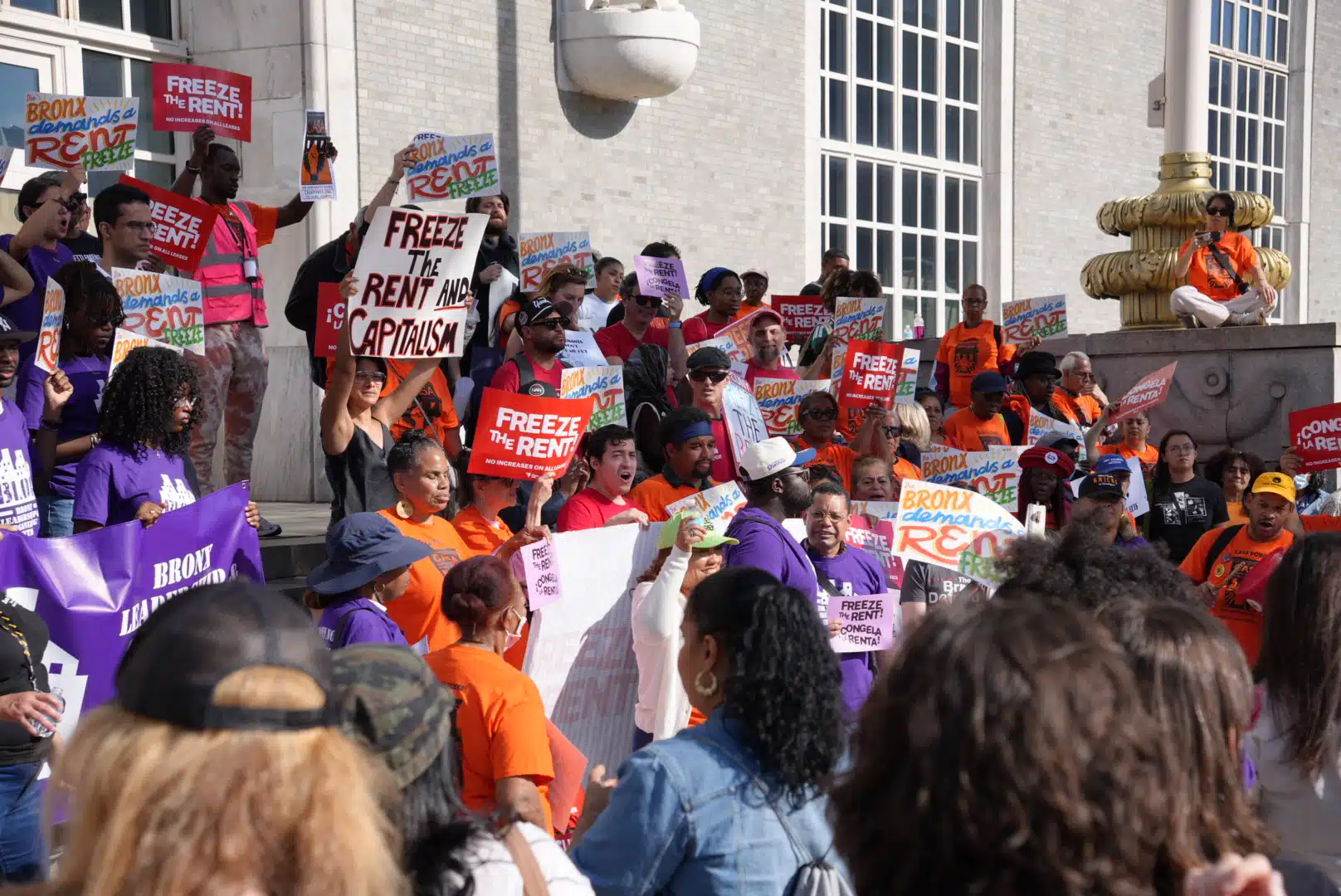

The June 8 meeting of the New York City Rent Guidelines Board (RGB) began with some 40 tenants in attendance, scattered amid dozens of empty chairs in the auditorium at Hostos Community College. By the time the first hour ended, the room had filled with advocates wearing matching T-shirts emblazoned with the logos of various pro-tenant groups, holding up hand-drawn posters and a banner that was eventually unfurled to demand a rent freeze.
They were a familiar sight at RGB meetings, as were their complaints. Tenants spoke about their financial hardships, exacerbated by skyrocketing rents, and fumed about the disrepair in their buildings. They spoke of mold, rats, lack of heating, front doors that won’t lock, and stolen packages.
As is typical of these meetings, a few landlords took the microphone, and a landlord calling for a rent hike was met with a chorus of boos as he testified that he was facing rising expenses and needed to raise rents just to break even.
Organizers knocked on the doors of hundreds of rent-stabilized buildings and collected signatures from over 20,000 tenants last year in an effort to elect Zohran Mamdani and secure a four-year rent freeze. In February, to fulfill that campaign promise, Mayor Mamdani appointed six new members to the nine-member RGB. They include new Board Chair Chantella Mitchell, a program director with the New York Community Trust; Sina Sinai, former data director for the Bernie Sanders 2020 presidential campaign; Lauren Melodia, an economist at the New School’s Center for New York City Affairs; and Brandon Mancilla, a labor leader with the United Auto Workers.
With a rent freeze now closer to becoming a political reality, the question of what effect, if any, it will have on the conditions of rent-stabilized buildings is coming into focus. While landlords often cite the distress of rent-stabilized buildings as the main reason for calling for rent increases, recent reports have complicated the narrative that most buildings in the rent-stabilized stock lack operating funds.
Assessing the Distress Narrative
There are about one million rent-stabilized apartments across New York City. Because rent-stabilized units have been deregulated for decades, most buildings with rent-stabilized housing units also have market rate units in the mix.
About 47 percent of all rent-stabilized units are in buildings built before 1974 where at least 90 percent of units are regulated, according to the NYU Furman Center. The organization identifies these buildings as more vulnerable. Many landlords purchased rent-stabilized buildings before reforms passed in 2019 that made it more difficult to deregulate rent-stabilized units. Banks provided inflated loans to predatory owners that could only be paid back if the units were deregulated. Some of these landlords now hold substantial debt that can’t be repaid through current rents. Yet recent research suggests most of the city’s rent-stabilized housing stock is healthier than landlord lobbies have suggested. A February report from the Community Service Society of New York found that distress in city buildings was more closely associated with renters’ income than with rent stabilization.
The report found that both market-rate and rent-stabilized tenants frequently reached out to the city for repairs, but rent-stabilized tenants were more likely to seek help, “likely because rent regulation offers tenants greater security of tenure.” Market-rate tenants were more likely to face retaliation for seeking help, the report said.
The report also found that “Sixty-three percent of low-income market tenants reported that their most pressing issues were not addressed quickly or at all by their landlords,” compared with about half of low-income rent-stabilized tenants.
“Overall, tenants in regulated and market-rate apartments reported the same level of repair needs,” the report found.
A report from the credit rating agency Moody’s found that a five-year rent freeze would only cause about 6 percent of multifamily loans across the city to be at risk of default by 2030.
Landlords often argue that rent stabilization forces them to jack up rents in market rate units. Yet in all the scenarios Moody’s examined for this set of loans, landlords raised market-rate rents in their units by only 3 percent. For context, the average year over year rent growth in NYC was 4.4 percent in May 2026, according to CRE Daily.
The Moody’s report examined whether net operating income would fall below debt payments for those loans. Buildings in which more than 90 percent of units are rent-stabilized were at the most risk.
In May, the city’s Independent Budget Office released a report titled Demystifying Distress, which found, “The majority of rent stabilized buildings do not show poor conditions generally, or notably worse conditions on average when compared to non-stabilized building conditions.”
In rent-stabilized buildings—especially those built after the 1974 rent stabilization law—conditions were the same or better than in non-stabilized buildings.
The report also found that while distressed buildings were concentrated in the Bronx and Upper Manhattan and had lower rents, the level of distress was comparable to that of the non-stabilized housing stock. In fact, about 66 percent of rent-stabilized buildings have fewer hazardous violations per unit than non-stabilized buildings. Non-stabilized buildings were more likely to have at least five hazardous violations per apartment than stabilized buildings.
Buildings built before 1974 in the Bronx, Upper Manhattan, and Brooklyn were much more likely to be included in the city’s enforcement plan for emergency repairs than non-stabilized buildings.
Some analysts are less optimistic about the outlook for rent-stabilized buildings.
Mark Willis, senior policy fellow at the NYU Furman Center, says the math does not work out for a rent freeze because of landlords’ operating costs.
In an email, Willis says when rents don’t increase in proportion to inflation or operating costs, “Owners who are not ready to give up ownership of the building have no choice but to first cover property taxes and any mortgage obligations, even if it means having to skimp on maintenance.” He says a rent freeze would lead owners to abandon rent-stabilized units, which would decrease the city’s affordable housing stock, a subject of constant debate in recent years.
But deregulation has been the main driver of lost affordability: More than 300,000 rent-stabilized units in the city have been deregulated between 1994 and 2019, according to a report from the Association for Neighborhood & Housing Development (ANHD), an organization representing nonprofit housing developers. The number is comparable to the total number of housing units built in the city in the last 15 years.
“It’s a much smaller subset of units and buildings that are in distress, and where we should be looking at meaningful interventions,” Peter Estes, one of the report’s authors, told Shelterforce/Next City.
ANHD analyzed the subset of rent-stabilized buildings most at risk of default: pre-1974 buildings without tax exemptions in which 75 percent or more of the units are stabilized. It found that nearly half of apartment units within this subset show some sign of “speculation or irresponsible ownership.”
Estes said he and his co-author found buildings where the purchase price was much higher than what could be recouped in rents. Some had been included on the New York City Department of Housing Preservation and Development (HPD) speculation watch list.
According to ANHD, a wave of predatory landlords bought rent-stabilized buildings in the years leading up to and during the 2008 financial crisis, leading to a spike in deregulations. According to the report, these developers “made splashy, risky purchases. Spending far more on buildings than current rents would justify, they scooped up buildings with plans to kick out tenants and raise rents.” In 2009 alone, 18,500 units were deregulated, the report found. Landlords got rid of tenants through “the denial of services, frivolous eviction cases, construction that made units unlivable with noise, dust,” and other forms of harassment, researchers wrote.
“While a subset of rent stabilized properties likely face genuine distress, many appear to be doing just fine. And a large number of those in trouble have landed in that predicament precisely because they gambled on a speculative strategy and lost,” according to the report.
It’s a narrative that tenant advocates have been amplifying at RGB hearings.
Marcelo Lopez, a member of the Democratic Socialists of America who said he is a lifelong rent-stabilized tenant, also questioned the risky loans corporate owners have taken out.
“[Landlords] have nothing to say, as many people have mentioned, about Signature Bank or about Pinnacle Realty, who put bets … on the fact that they could displace people faster than the law would be able to catch up with them.”
Tenant advocates have aggressively criticized Signature Bank’s lending for years, and when the bank collapsed in 2023, they pointed to its risky loans made to predatory landlords as one cause. Similarly, when LLCs associated with Pinnacle CEO Joel Weiner filed for bankruptcy in 2025, tenants pointed to the prominent New York real estate company’s history of predatory financing and deregulation.
“Landlords continue to push for a blanket rent hike, but tenants refuse to reward them for long-term neglect or bail out their bad bets,” New York State Tenant Bloc Executive Director Sumathy Kumar said in a press release from the organization.
But more than in prior years, some tenants seemed to acknowledge that some buildings may be underwater financially. They attributed this not to rent stabilization but to landlords taking out loans at high interest rates in hopes of evicting tenants—what one tenant called a gamble.
“Landlords made investments that were risky—in other words, a gamble. The gamble failed, and you know what happens to us working-class folk when we make a bad gamble? We eat the loss,” said William Alicea, co-chair of the Bronx Working Families Party. Alicea said he is a Mott Haven tenant and that his mother is disabled, lives on a fixed income in rent-stabilized housing, and faces annual rent increases.
He asked the RGB to go even further than a rent freeze:
“A rent rollback would help stabilize so many families that already have to worry about rising utilities, food, childcare, healthcare, and gas prices.”
Proposals for Protecting Rent-Stabilized Buildings
How can New York help landlords of distressed buildings without abandoning the case for a rent freeze? City officials and housing developers have proposed a range of solutions.
ANHD recommends that the city “robustly” fund the Neighborhood Pillars program and relaunch the Third Party Transfer program, which is meant to take properties with unpaid fines from owners’ hands and sell them to nonprofits. It also suggests exploring “reductions or exemptions from water and sewer taxes” for some rent-stabilized buildings.
The Adams administration relaunched the Neighborhood Pillars program in 2025, which offered up to $380,000 per apartment unit in low-interest loans to mission-driven for-profit owners, nonprofit owners, or minority and women-owned businesses to rehabilitate distressed buildings.
In 2023, the Adams administration introduced “Unlocking Doors,” a pilot program that offered up to $25,000 per unit in reimbursements to rehabilitate 400 rent-stabilized units. The program later provided up to $50,000. Landlords participating in the program would be required to rent the units to low-income tenants with CityFHEPS vouchers, which are used by people exiting homelessness.
According to Gothamist, only one landlord had applied for the program as of September 2025, but then opted not to take the money. Landlords who spoke to the publication cited the program’s requirement to rent to voucher holders and the requirement that they pay for repairs up front and be reimbursed later.
ANHD has recommended improving the program by providing money upfront instead. But Estes says there isn’t much of a push from the landlord lobby to do this.
“The current narrative from the landlord lobby is that it’s impossible, it can’t be done, it’s not worth it … rather than a spirit of partnership,” Estes says.
The housing trade group New York Housing Conference suggested in a November 2025 report that any rent freeze include a “$1 billion financing program for projects at risk of default to restructure debt.” It also suggested reducing water bills, renewing the J-51 tax abatement program (one of the few mechanisms the city has to create new rent-stabilized apartments), and exempting “preservation financing programs from any new labor requirements,” a proposal at odds with Mamdani’s approach.
The city and advocacy groups are also becoming more serious about other rising costs, such as insurance. Insurance costs for buildings with rent-stabilized apartments have increased by more than 10 percent in just the past year.
As one solution, ANHD suggests funding Milford Street Captive Insurance, an affordable insurance company created by affordable housing providers. In May, Gov. Kathy Hochul provided a $2 million loan to the insurance company. In Mamdani’s recently released Block by Block plan, the city pledged to invest $100 million in a low-cost insurance program that will cover 100,000 homes by 2030.
Assuming that a percentage of the housing stock has debt coverage from speculative loans that is a greater burden on landlords than operating costs and maintenance, there is another option the city can pursue: buying the buildings.
Among tenants and housing advocates, this solution is increasingly being pushed as an alternative to rewarding predatory landlords who engaged in speculation.
“We have to really think about transparency and holding bad landlords accountable for past actions and ensuring that we’re not just throwing public money at these actors who have harassed tenants, displaced tenants to raise rents, and who have a broader financial cushion,” Estes says.
Two months before Mamdani appointed her to lead the Office to Protect Tenants, Cea Weaver proposed such a solution to rampant speculation. “Thanks to its scale, its lack of a profit motive, and its taxing power, the City can intervene to stabilize volatile markets,” Weaver wrote.
In the Block by Block proposal, the Mamdani administration specifically referenced rent-stabilized buildings “at risk of financial and physical distress,” and said it would “work with vetted, responsible landlords who can immediately stabilize and improve portfolios under new ownership.” An important tool for implementing this is the Community Opportunity to Purchase Act (COPA). Adams vetoed COPA during his final days in office, but it has been reintroduced in the city council. With a supportive mayor and 27 cosponsors, it is likely to pass. But the relatively small subset of buildings in extreme distress require immediate help, and acquisitions, whether through bankruptcies or the landlord selling the property, take some time to pull off.
In an email to Shelterforce/Next City, a spokesperson for Housing Preservation and Development (HPD) said that the agency can support buildings in disrepair with real estate tax exemptions and with subsidies. The spokesperson said buildings transferred to new owners through the Third Party Transfer program and any future COPA law would only be eligible for funding after the new owner takes over.
In Block by Block, the Mamdani administration also said it would “aggressively” use the 7A Program, which puts buildings in the hands of a court receiver that accepts rent and makes repairs. The program has been underutilized in recent years, advocates say. HPD told Shelterforce/Next City that there are 27 buildings in the program with another 14 pending as of June.
Nancy Espino, a Bronx tenant who attended the June 8 RGB hearing, tells Shelterforce/Next City that she recently moved into a rent-stabilized studio apartment after living in the Parkchester neighborhood. Her landlord was charging her more than $1,200 in rent, but after reviewing her rent history, Espino realized she should only be charged $978. So she requested a rollback from the state government. She is still waiting for a written confirmation that her rent will be reduced. She says many people in her building have told her similar stories of being overcharged.
She’s skeptical that the landlord of her large building needs the rent to cover operating costs. She says other tenants told her he has been skimping on repairs for 20 years.
Speaking before the RGB, Espino said, “If a landlord is refusing to make the tenants whole while receiving rent from us, why should they be entitled to rent increases?”
“Thank you, and appreciate your time, but the Bronx is still burning,” Espino said.
This story was published through a collaboration between Shelterforce and Next City. Next City is a nonprofit news outlet that publishes solutions to the problems that oppress people in cities, inspiring social, economic, and environmental change through journalism and events around the world.
About the Author


Comments