



Update Since Publication
On June 23, the Massachusetts Supreme Court struck the rent control measure from the ballot because it included a clause exempting religious institutions from rent control. In response, tenant advocates are still pursuing rent stabilization legislation in the statehouse. A compromise measure had been gaining supporters, even among some in the real estate industry. The legislative session ends July 31. If the legislature does not act, advocates vow to carry on with their campaign, including possibly launching an initiative petition without the exemption clause in 2028.
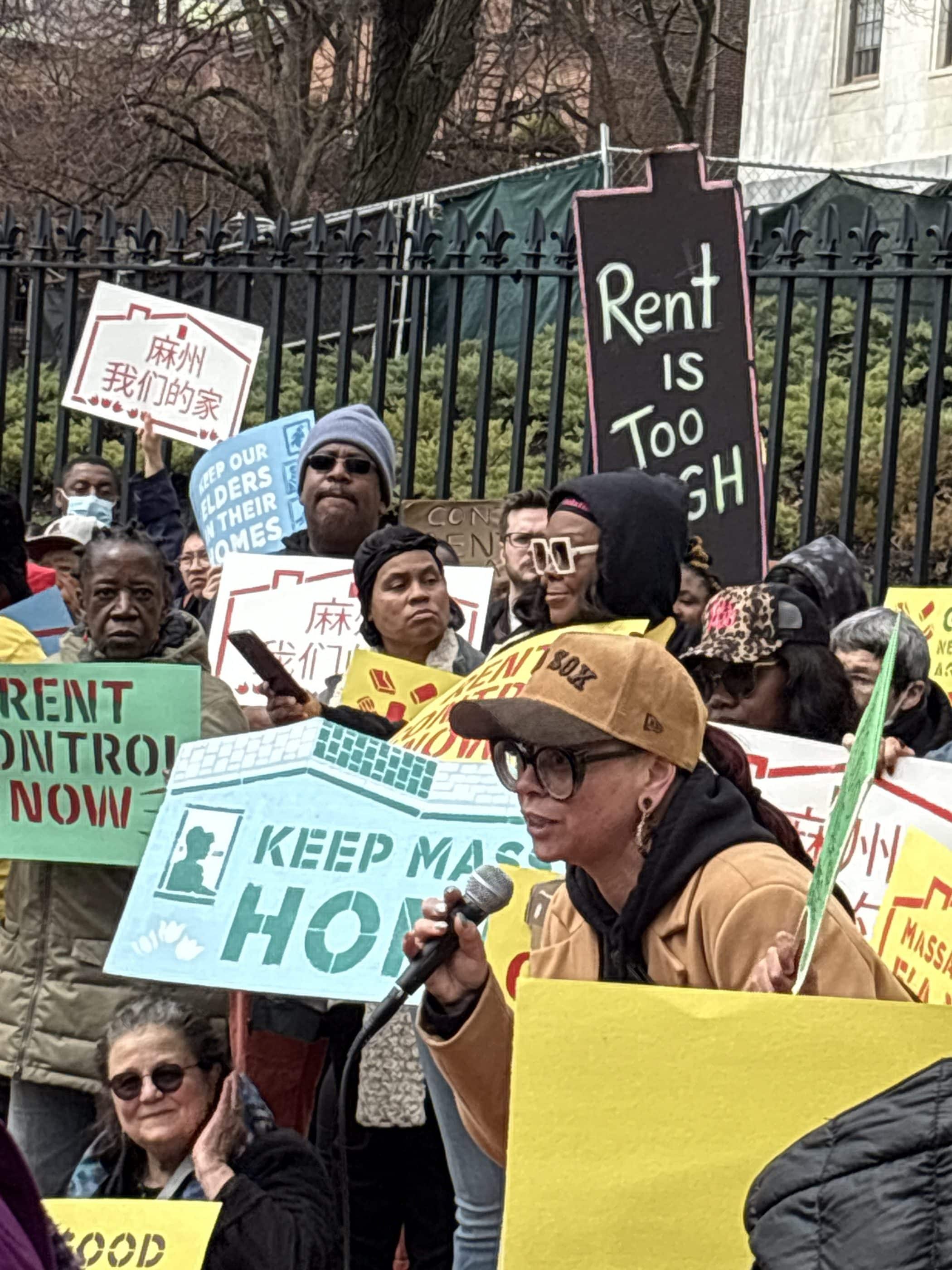
Addressing hundreds of housing activists in front of the Massachusetts State House in Boston in April, Annette Diaz, an East Boston tenant, said rent control was not just a “theoretical” matter to her.
Diaz explained that the monthly rent for her apartment had climbed by “over $750 in less than a year,” the result of three increases in rapid succession, which have strained family finances and made budgeting extremely difficult. Landlords, she added, should not be “allowed to raise rents without limit for profit.”
Switching to Spanish, Diaz added, “Necesitamos control por renta. Es la hora.” (“We need rent control. It’s time.”)
Experiences like Diaz’s have powered a statewide campaign that has already gathered more than 124,000 signatures to put a measure on the November 2026 ballot that would limit annual rent increases for most units to either 5 percent or the rate of inflation, whichever is lower. The measure would exempt rentals in owner-occupied buildings with four or fewer units, such as Boston’s ubiquitous triple-deckers. It would also exempt any new building from rent control for its first 10 years of occupancy.
State Rent Control History
In 1970, tenant organizers in Massachusetts won the right for cities with populations over 50,000 to adopt rent control. Boston and the nearby suburbs of Brookline, Cambridge, Lynn, and Somerville quickly did so. As recently as the early 1990s, Boston, Brookline, and Cambridge still had some form of rent control.
In 1993, however, state landlords formed the Massachusetts Homeowners Coalition to qualify a ballot measure to end rent control statewide. In the 1994 election, when Republicans regained a majority in the U.S. House of Representatives for the first time in 40 years, Massachusetts Question 9—the rent control repeal measure—narrowly passed by a margin of 51 percent to 49 percent.
The effects were soon visible: A January 1998 study commissioned by the city of Cambridge found that average rents on previously rent-controlled apartments had climbed by 54 percent over three years. Units that had not been covered by rent control also increased in price, albeit less rapidly; a 2000 New York Times article reported that these rents went up 31 percent over five years. Displacement followed. As Cambridge tenant activist Bill Cavellini wrote in Shelterforce in 2001, “Single professionals began to replace families with children, which forced at least one school to close. Cambridge neighborhoods lost long-term residents: leaders, coordinators and centers of community networks.”
A New Rent Control Movement Emerges
In recent years, rents in the state have continued to climb. In state legislative testimony, Phineas Baxandall of the Massachusetts Budget and Policy Center said that between 2020 and 2024, rents in Suffolk County, which includes Boston, increased by 28.5 percent, 34 percent above the rate of inflation. In Worcester, a working-class city, rents also increased rapidly, up 32.8 percent, 55 percent above the rate of inflation. The largest increase was in Essex County (home to Lawrence, Lynn, and Salem), where rents increased by 35.3 percent, 67 percent above the rate of inflation.
More and more people in Massachusetts are seeing high rent increases. … That’s what led us to launch the ballot initiative.”
Carolyn Chou, executive director of Homes for All Massachusetts
One factor has been the rise in investor ownership. For instance, one study found that the proportion of triple-decker (or triplex) purchases made by investors had increased from about 1 in 4 in 2004 to roughly half by 2018.
Another factor is that existing affordable housing is becoming unaffordable faster than new affordable housing is created. A December 2025 report by the Massachusetts Association of Community Development Corporations noted, “From 2012 to 2022, 163,000 low-rent (under $1,400) units were lost” statewide and recommended passing “laws to protect tenants, such as rent stabilization and just cause eviction, to make it more difficult for speculative purchasers to acquire [naturally occurring affordable housing] properties and raise rents beyond an affordable level.”
Carolyn Chou, executive director of Homes for All Massachusetts, which is leading the rent control campaign, notes that the current rent control movement coalesced in the early days of the pandemic, when tenants organized and succeeded in getting the state to pass “the strongest [eviction] moratorium in the country.”
Chou adds, “This is our fourth session in the statehouse working on this bill. … More and more people in Massachusetts are seeing high rent increases. … That’s what led us to launch the ballot initiative.”
Understanding Campaign Mechanics
In Massachusetts, qualifying a petition for the ballot is a two-stage process. First, petitioners must collect 74,574 signatures (3 percent of the votes cast in the last gubernatorial election). Tenant activists exceeded this hurdle.
Then the legislature has a chance to pass legislation itself, avoiding the need for a statewide ballot measure. If the legislature does not weigh in by May 5, petitioners must collect another 12,429 signatures (an additional 0.5 percent of votes cast in the latest gubernatorial election) by early July—a process that’s now underway.
At the statehouse rally in April, Noemi “Mimi” Ramos, executive director of New England Community Project, emphasized that the legislature could act. “We are here because the legislature can pass rent control tomorrow,” she noted.
Chou adds that housing organizers have been willing to compromise on details. As she puts it, “For us, this is not ideological; this is really about winning material improvements for our communities.” Although the May 5 deadline has passed, if the state legislature passes a bill in June that coalition members deem favorable, the coalition could withdraw the ballot measure since the additional signatures are not due until July 1.
One possible compromise, Chou explains, would be a local option bill. Such a bill would not implement rent control statewide, but it would enable any city in the state to pass rent control without needing to obtain approval from the state legislature.
A compromise proposal was formally floated by rent control advocates on May 31 and publicly announced on June 2. In addition to making rent control a matter of local choice rather than a statewide law, the compromise proposal, provided by organizers to Shelterforce via email, offers other major concessions:
- The limit on annual rent increases would be inflation plus 5 percent with a cap at 10 percent (instead of inflation with a cap of 5 percent).
- Landlords could raise rents when tenants moved.
- Buildings would be exempt from controls for 15 years after construction, instead of 10 years.
- The law would establish a process allowing owners to seek rent increases above the annual increase cap for extraordinary capital improvements or tax increases, with documentation, neutral review, clear standards, and timely decisions.
Might the legislature enact such a measure? Massachusetts is a famously liberal state. Currently, Democrats hold 35 seats in the Massachusetts State Senate compared with 5 for Republicans. In the House, Democrats also have a commanding 132–25 majority (one seat is held by an independent, and two seats are vacant).
But the legislature has shown few signs of moving. Chou says one reason is that “there are more landlords than renters” in the state legislature. She also notes that the movement for rent control has to struggle against a “dominant narrative that we just need to build our way out of the crisis.”
Time is short. As Chou points out, the legislature would need to pass legislation by July 1, as afterward the coalition is locked into backing the ballot measure. It remains far from certain whether the legislature will act.
What Comes Next
The campaign ahead will be challenging. Chou says she expects opponents of rent control to spend up to $30 million against the ballot measure.
In March, the Greater Boston Real Estate Board, with the Center for State Policy Analysis at Tufts University, released a study claiming that, if implemented, the rent control law would reduce property values by 14 percent after 10 years. Since the state tax system relies heavily on property taxes (73.1 percent of Boston’s revenue), such a decline in property values could force cities to either raise tax rates or cut services.
What the study doesn’t explore is the potential ripple effects on cities of expanded affordability and stability for tenants, not to mention the enhanced affordability for homebuyers that comes with putting the brakes on climbing property values. A recent report by PolicyLink notes, “Multiple longitudinal studies of rent control in New Jersey, as well as other studies nationwide, have found no negative impact on construction rates.”
Backing the rent control measure is a broad coalition of more than 50 organizations, notes Chou. This includes “faith organizations, other grassroots organizations, and labor unions [such as] SEIU [Service Employees International Union] [and] the teachers’ unions. … The pressure has been building over the years. … Every session, we’ve gotten stronger.”
Rent control, Chou acknowledges, must be supplemented with other programs to ensure a long-term housing supply. “Our long-term vision is a housing system that centers people over profits,” she says. “So, we are interested in long-term conversations about social housing and other housing models.” However, she adds, the coalition sees some form of rent control “as key to solving the housing affordability and displacement crisis.”
Chou says Massachusetts rent control advocates are making two key arguments. First, rent control “can be complementary to building more housing.” Second, “Building more housing alone is not going to do what we need for working people.”
About the Author


Hi.My humble opinion about increasing the rent,this is not the American dream that we wanted,this is a nightmare that I assume we all want to wake up.Thank you
Thanks for this article! The “return” of rent control is long past due… We have just experienced the longest span of time since World War ONE without any kind of rent control in Massachusetts (or elsewhere in the USA). I have written up a detailed history of this experience (from 1920) centered in Cambridge’s political and social context but also covering Boston and vicinity. This exists as a PDF document which I am happy to share with anyone who asks. Just write — [email protected]
This ballot question or legislative actions will destroy communities across Massachusetts public. We are already struggling with the many new taxations that the state has created. By reducing the value of these rentals and passing that cost onto individual homes is outrageous We need to cut spending reduce the tax rates so affordable housing will flow.
Rent control can be exploited by owners and tenants alike, so I think it should come with provisions that property upkeep by both the tenants and owners is a must. A landlord that doesn’t believe they are getting good value rents tend not to maintain their the property and tenants fail to keep both the inside and outside of their home a mess which negatively impacts the value of the entire neighborhood.
I never lived in an apartment under rent control but I had a friend that did, she really needed it in the beginning but later didn’t recite the help but was able to live a better life with it. So provided the property is kept up by all parties the home prices shouldn’t drop too much, grow slower than it grows now, which is better for stability.
Rent control absolutely reduces supply, stops new housing from being built, and raises rents in non-controlled units. Red states with no rent control have far lower rents than the Boston area because they build more. San Francisco and NYC have rent control and look where it got them.
The rent is adjusted by the market itself. When properties fail to be rented out, the landlords will be forced to lower the rent. Rent control by the state makes no sense in this environment where the interest rate is high and the landlords are sandwiched between high mortgage payments, increasing RE tax and skyrocketing HOA fees, each of these factors important enough to cause expropriation.
The people here that are asking the state legislation to save them, are inviting a bigger risk in their lives, i.e. the big corporates and the state to control which are exactly the ones causing this artificial crisis.