


This article is part of the Under the Lens series
Innovations in Community Ownership
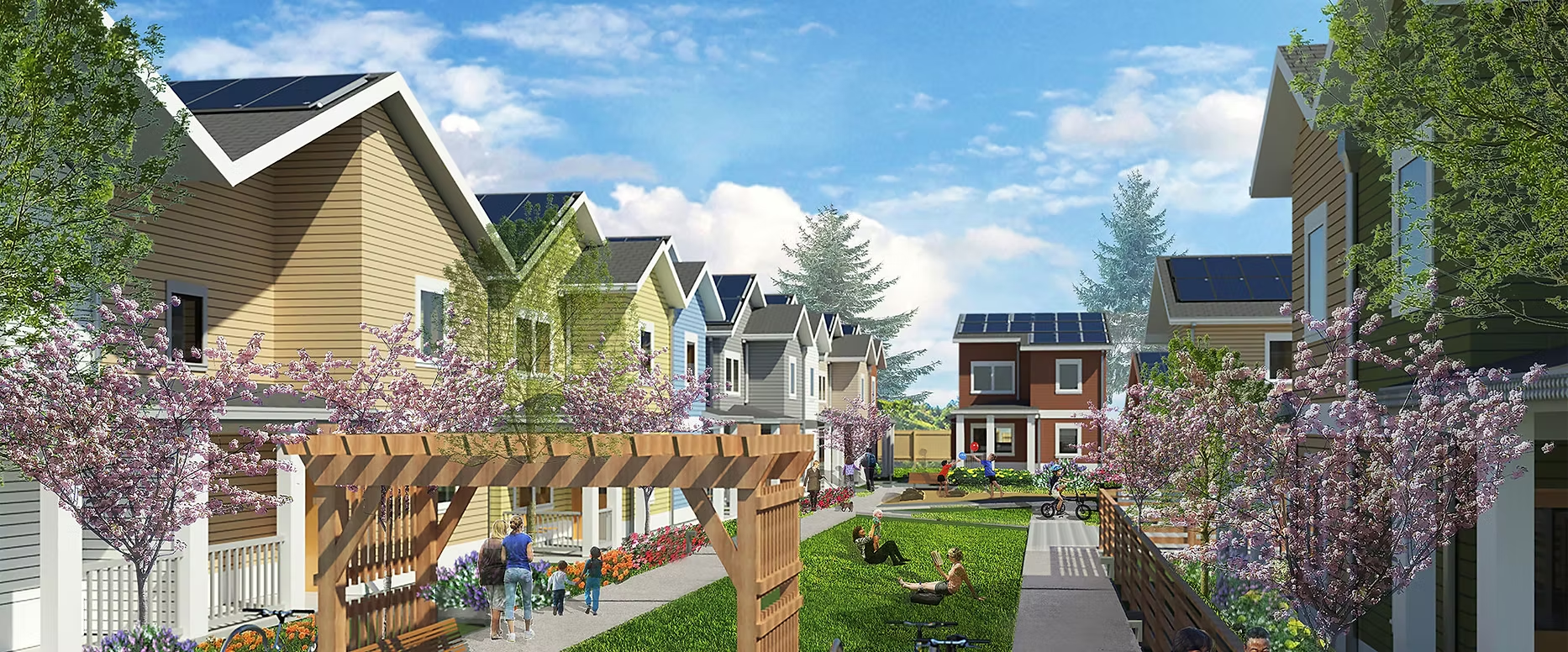
On June 28, 2024, Homestead Community Land Trust held a ribbon-cutting event for a new neighborhood of 18 duplex and cottage-style housing units: The Southard. The event marked the end of a grueling seven-year development cycle that resulted in the nation’s first residential project to achieve both net-zero energy consumption and Salmon-Safe certification. The Southard is also noteworthy for enabling dedicated housing for individuals with developmental disabilities and using the sale of market-rate homes to make the project financially feasible.
Homestead Community Land Trust was founded in 1992 by a group of 12 community activists fighting displacement in Seattle’s Central District, a historically Black community that developed due to redlining. From a single home in the Delridge neighborhood, Homestead has grown to encompass 257 permanently affordable, owner-occupied homes, as well as a resident-governed Section 8 development with 32 units of rental housing.
In 2017, Homestead began the development process for a piece of land it purchased in Tukwila, Washington, a suburban community of 22,000 that sits just outside of Seattle. Like many other communities across the country, Tukwila faces a housing shortage, and in the next 15 years, its population is predicted to grow by nearly 50 percent, according to a 2021 report published by the city.
Designing for Sustainability
From its inception, The Southard “was always intended to be a demonstration project for what Washington state called ultra-high energy efficiency development,” says Homestead President Kathleen Hosfeld. The homes are outfitted with solar panels, energy-efficient appliances, high-performance windows, low-flow water fixtures, and enhanced insulation—all designed to achieve net-zero energy use, which qualified the development for $650,000 in ultra-high energy efficiency grant money from the Washington State Department of Commerce.

Homestead had also made early investments in stormwater infrastructure, supported by county stormwater grants, due to the site’s poor drainage. As the development neared completion, Homestead renamed it from Riverton Park to The Southard, in honor of the late Patti Southard, an environmental policy leader in King County. Patti’s sister, Ellen Southard, was active with an organization named Salmon-Safe, which provides certification designations to developments that practice responsible water management, protecting water quality and salmon habitats.
Ellen Southard helped secure King County’s Water Works grants to pursue Salmon-Safe certification by adding landscaping features like rain gardens and bioswales to help filter toxins and reduce runoff. These features complemented the net-zero energy design, making The Southard the first U.S. development to achieve both distinctions.
Disability Housing: A Rare Inclusion
Another innovation at The Southard is the integration of housing specifically for adults with intellectual and developmental disabilities (IDD) into the development (though not the CLT). The housing shortage acutely affects this population, as the 4.1 million people with disabilities who receive SSI cannot afford a market-rate apartment in any housing market in the U.S. Two homes at The Southard, each housing four residents and accommodating rotating caretakers, are owned and operated by Parkview Services, a nonprofit focused on inclusive housing.
The collaboration between Parkview and Homestead began during the early planning stages. Homestead had sold single-family homes to families with a disabled person in the household before, but this was their first time co-developing housing with Parkview from the conception phase. “We started talking about this project,” Hosfeld recalls, “and instead of it being homes for people with household members with IDD, Parkview Services said, ‘Hey, can we do these adult family homes?’ And we said ‘Of course.’”
The benefits of this arrangement, says Marc Cote, the executive director of Parkview Services, extend to both parties. According to Cote, in 2017 Washington state gave funding preference to rental developments over homeownership projects, with the former eligible for a maximum of $3 million from the state while the latter was only eligible for $600,000. “So part of the collaboration was that Parkview could bring more money to the [Southard],” says Cote. Part of the benefit for Parkview was that Homestead would donate the land to them. On top of the savings in acquisition costs for Parkview, the land donation strengthened Parkview’s application to the Federal Home Loan Bank for funding, helping them to secure $320,000 for the project. “If we hadn’t had . . . the donated land, then we would not have gotten those funds,” Cote says.
Parkview provided accessible floor plans for the homes that would be serving their residents—featuring things like single-story layouts instead of two-story homes with stairs.
Parkview owns both the land and buildings for the two group homes, and the market-rate unit owners also own both land and buildings. The remaining buildings are part of the community land trust. The Southard Homeowner’s Association is composed of all the building owners in the Southard subdivision, including market-rate units and those that sit on CLT land, and Parkview, which holds two HOA votes. Parkview also can appoint one seat on the CLT board of directors, and maintains a strong role in the community.
The Difficult Path to Innovation
While The Southard is a success story, its path to success was anything but smooth. “It was a super challenging site,” says Hosfeld. Homestead first purchased the land in 2017, envisioning a 24-unit development. However, Hosfeld says that in 2017 Washington state, public subsidy caps for homeownership projects were low, which made public funders hesitant to fund projects larger than 11 units.
“We went through a couple rounds of struggling with funders [who were] trying to break the project into two parts, but it was a greenfield site that needed all the infrastructure put into place at once,” she says. Having two building phases would have incurred additional holding and labor costs that would have made the project financially infeasible.
Homestead had to make each of the funders understand why all the homes needed to be built all at once and not in two stages. “That, in and of itself, took a good two and a half years to work through,” Hosfeld says. In the end, they were successful, but it cost Homestead valuable time.
Zoning posed another set of challenges. The Southard’s location fell within Tukwila’s single-family zone, a classification that didn’t fit the duplex and cottage housing model. “It just was really tough to fit it into our single-family zone,” admits Nora Gierloff, Tukwila’s director of community development. A development agreement was negotiated to reduce minimum lot areas and setbacks, reclassifying the site to “single-family cottage.”
Then COVID hit.
The pandemic exacerbated all these problems, and the permit process, which was expected to take six months, stretched into 18 months, inflating costs by $750,000 to $1 million due to labor and material price spikes, as well as ballooning holding costs.
Fourteen of The Southard’s units are duplexes, and the city of Tukwila would sometimes assign two units in the same building to different permit reviewers. This meant that two different permit reviewers were looking at houses that were sharing a wall. “They would come back with different feedback on the plans, and our architect had to harmonize the feedback on each plan with two different reviewers, because whatever changes needed to be made on one side would have to be made on the other,” Hosfeld explains.
When asked if this typically occurred in permit reviews, Gierloff said it wasn’t common and might have had to do with short staffing, turnover, or vacation scheduling. “It was a difficult project at a difficult time,” she says, and “a process we’d never used before. We learned a lot, but it was painful on both sides, and I apologize for that.”
Adding to the difficulty, hidden connection fees blindsided the project near completion. “We generally find that permitting fees are disclosed pretty well, but you can be ready to turn on the light switch or connect to the sewer and suddenly be surprised by the connection fees that will be charged,” Hosfeld says. “Jurisdictions can help by waiving fees . . . or at least disclose them up front.”
Since The Southard’s construction, Tukwila has made several procedural changes to make development more efficient. “There was a procedural change that did happen to the design review process, changing that from a discretionary review body to an administrative decision,” says Breyden Jager, an associate planner for the city of Tukwila. “So no longer would a public hearing be required for this with a review body that were to interpret the standards amongst themselves and then vote on whether or not the project could be approved. Now it’s an administrative director’s decision going through each of our existing standards and determining whether a project meets them or not.”
Design standards can be very vague, sometimes being as open to interpretation as simply “fitting the character of the surrounding neighborhood.” This means that developers and a locality’s design review board could lob designs back and forth several times, dragging out timelines and driving up costs for the developer. “The design standards moving forward will be required to have objective criteria such as facade articulation every 30 feet, or this type of modulation in the facade or a color and material change every so often,” says Jager. “Those types of things introduce a level of certainty for architects when designing a project that give them an idea of what may or may not be approved prior to even submitting [their plans], rather than relying on a ‘harmonious’ or a ‘natural aesthetic,’ or these other sort of nebulous terms that they will attempt to comply with, but can’t really be sure if their project complies with until they’re at the hearing.”
With regard to building permits, Gierloff says the city began to put more emphasis on cross training in order to get more standardized responses. “We’ve done a lot to try and institutionalize a common approach. We’ve created a lot more handouts. Every time we have a problem, we do try and sit down to figure out … how we can keep this from happening again.”
A Hard Choice: Selling Market-Rate Homes
Despite securing extensive grants and partnerships, the pandemic-era delays and inflation created a financial squeeze. As a result Homestead is expecting to have to sell 5 of the 18 homes at market rate unless it can secure additional grants or funding to sell them all at an affordable rate. Residents of these market-rate homes will still be part of the Southard’s homeowner association, but they will not be part of the community land trust or the ground lease. This means not only that these units will be more expensive, but that if the owners choose to sell the homes later on down the line, they can do so without any resale price limitations.
James Yelen, the director of technical assistance at Grounded Solutions Network, says that while he is unaware of other instances in which community land trusts have sold off properties at market rate to offset the cost of developments, such sales may increase in occurrence with uncertainty of funding from the federal level. “I think that folks are considering how they can cross-subsidize with market rate units. Perhaps this will be something we hear more about, especially if federal funds and other sources become more scarce,” he says, but adds, “I do think it comes with several questions about not just the technical feasibility, but also how do you make sure that it’s remaining true to the mission and aligned with the stewardship aspect of what the community land trust is trying to do.”
While the Southard’s five market-rate units are not subject to resale price limitations—since they will no longer be part of the CLT once sold—Homestead said that it will not sell any of the market units to investment companies to be rented out. “We want them to be owner-occupied the same way our permanently affordable ones are,” Hosfeld says. The governing documents of the homeowners association do establish Homestead’s right of first refusal to purchase units not subject to the ground lease when they come up for sale, though without resale restrictions it is likely that such a future purchase will entail much higher purchasing costs.
Legacy and Lessons
In breaking new ground on several fronts, The Southard offers lessons for local governments, funders, and housing providers: flexible zoning, early collaboration, transparency in permitting, and creative financing can make ambitious, sustainable, and inclusive affordable housing possible, even in the face of immense time and financial pressures.
About the Author



Thank you Brandon for taking the time to do your research and write this article. Although the Southard development wasn’t easy to pull off, Homestead did a great job of not giving up and in the end developing a great neighborhood. Not many people know about the great work that Homestead does to produce affordable homeownership opportunities in the greater Seattle area, we need to continue to spread the word about what Homestead is doing not only to be able to secure more funding but also to give people hope that they too can one day own a home. Thank you again Brandon for writing this article! I’m hoping you can write another article soon about our soon to be completed Condo buildings on Phinney ridge!