



This article is part of the Under the Lens series
Shelter in a Federal Storm: State and Local Housing Solutions for a Time of Federal Hostility
If you live in Boston or New York City, you probably wouldn’t call last winter warm. But as record snowfall and frigid temperatures rocked the Northeast, the Western United States was unseasonably warm. This contrast has been linked to climate change.
In unpredictable weather, access to both heating and cooling is crucial—but often prohibitively expensive. The National Energy Assistance Directors Association estimates that the winter of 2025–2026 cost families an average of $976 to heat their homes, a nearly 8 percent rise over last year. In the Northeast—the region with the highest heat bills—families spent an estimated $1,162.
Predictably, low-income families are hit hardest by these hikes. According to the Department of Energy, the average family earning below 80 percent of area median income (AMI) spends 6 percent of its income on energy, compared with an estimated 2 percent for other households.
But when support was needed most, the federal government largely turned its back. The Trump administration proposed eliminating the Low Income Home Energy Assistance program in 2026. Although this effort ultimately failed, the administration has proposed the same in its FY 2027 budget proposal. In addition, the Greenhouse Gas Reduction Fund, a multibillion-dollar Biden-era investment meant to benefit low-income communities through green energy projects, has been caught in legal purgatory since the Environmental Protection Agency shut it down last year over claims of fraud.
In other words, planning to receive climate and energy funding from the federal government is a bad bet right now, whether that’s funding meant to help low-income families save on their bills or projects to make homes more energy efficient. Amid that uncertainty, state and local programs around the country are stepping up. Multiple cities, including Minneapolis and San Francisco, partner with their local energy utilities to help low-income residents access savings or meet climate goals. “At the bigger-picture level, it’s difficult to give a comprehensive answer on how common these models are nationwide,” explains David Ribeiro, director of local policy at the American Council for an Energy-Efficient Economy, in an email to Shelterforce. “Braiding and stacking funding and combining that with a navigator program is an effective model, and one that more cities may want to consider in the future.”
Climate Smart Homes: Delaware
The Climate Smart Homes Program was formed through a partnership between Energize Delaware, an initiative of the sustainable energy nonprofit Delaware Sustainable Energy Utility and the nonprofit New Ecology, Inc. In addition to creating energy-efficient homes with low monthly utility costs for low-income residents, the program provides the technical assistance contractors need to build to high green standards.
The pilot project for the program was the redevelopment of Bennett Street in Wilmington, Delaware, which built new homes across two blocks. Residents in the 32 newly constructed units must earn less than 80 percent of AMI and are expected to pay under $100 per month for their utilities. Some of the units are managed by Woodlawn Trustees, a Wilmington-based affordable housing nonprofit, while the others are managed by a local Habitat for Humanity chapter. Twenty-eight of the units are complete; the remaining 4 are still under construction.t
The Climate Smart Homes Program is not reliant on federal funding; it’s funded by the Regional Greenhouse Gas Initiative. This multi-state program sets a total cap on carbon emissions for its member states and requires power plants to pay at auction to emit certain amounts of greenhouse gases. The resulting funds go to climate projects like this one. Over time, the cap steadily decreases, lowering the region’s climate footprint.
Drew Slater, executive director of Energize Delaware, says that changes under the Trump administration didn’t affect the rollout of this program. “We don’t want to see anybody be discouraged by … national news about energy efficiency or renewable energy. There are still local solutions,” he says.
The program can provide $17,000 per home to cover the higher upfront costs of meeting green standards, says Norm Horn, associate director of New Ecology. The homes are designed to be extremely energy efficient: they’re all-electric, with airtight windows, heat pumps, effective insulation and sealing, and mechanical ventilation systems. These modifications also make homes healthier for residents. “This is a tight urban neighborhood. … We have a lot of big, busy roads nearby. We have some industrial uses nearby,” says Horn. “Because the house is air-tight, it’s also going to be pest-tight. It’s going to be smoke-tight. It’s going to be bug-tight.” Additionally, Horn says, the insulation reduces moisture in the buildings, preventing mold.
Slater says they may add renewable energy features, such as solar panels, to the completed Bennett Street homes to offset their energy use completely.
Construction is still underway or planned on some projects, Horn says. But as of now, while Energize Delaware is “hopeful” that more Climate Smart Homes will be funded in the new fiscal year, the future is uncertain, according to Slater. The main challenge he cites is interestingly not funding, but “getting developers interested.”
“Anything new is always going to be difficult, especially in construction, which is a field that’s not known for its willingness to change quickly,” says Horn. But despite these hurdles, Horn says, once New Ecology gets builders in the door, it’s surprisingly easy to help them understand and build to new standards.
[Related Article: What Makes Affordable Housing ‘Green’?]
Boston Energy Saver: Massachusetts
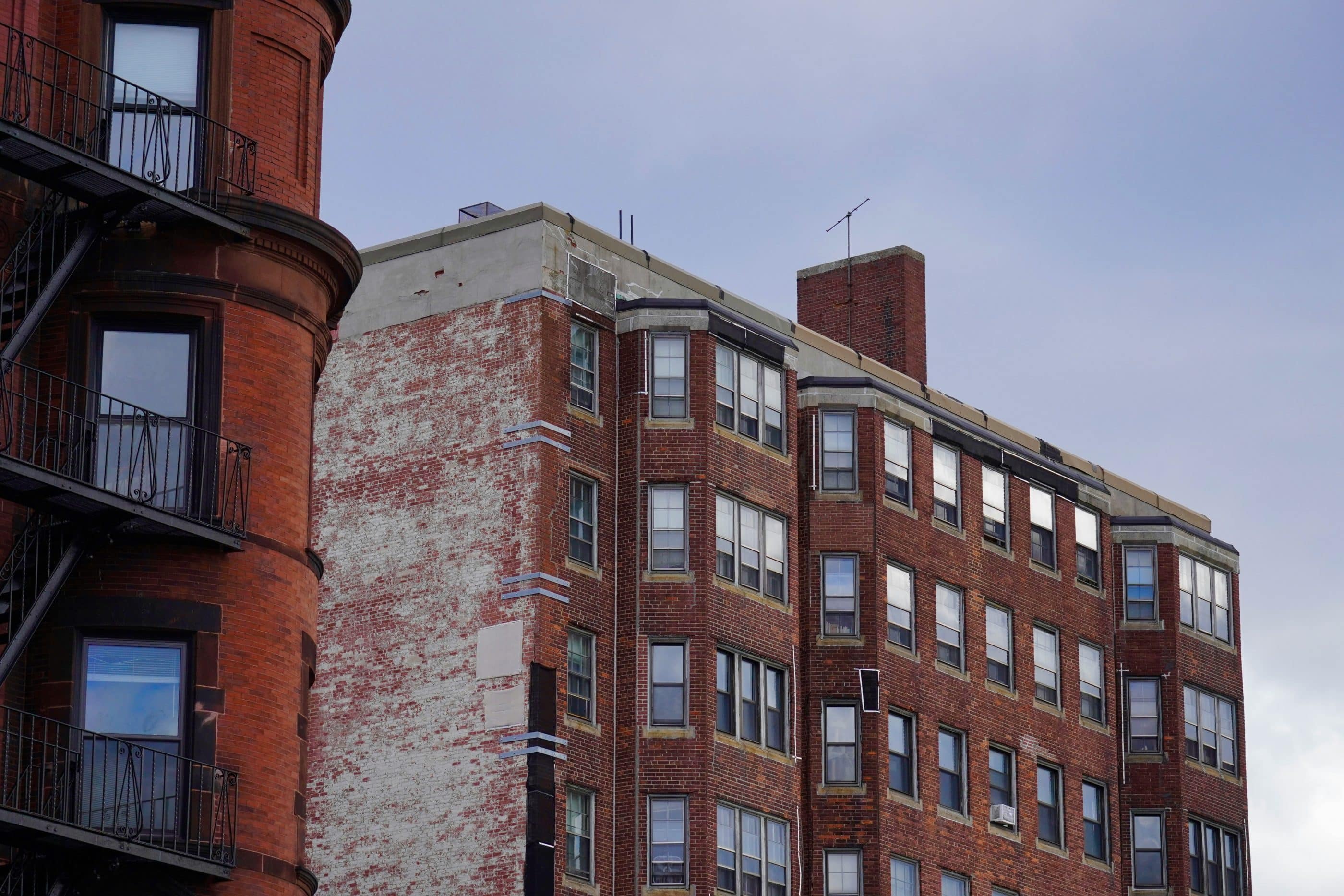
Boston Energy Saver is a city-run program launched in October 2025 that connects renters, homeowners, and business owners with existing tools to help them upgrade their homes and lower their energy bills. According to Brooks Winner, director of community energy programs for the city of Boston, the program started because utility companies Eversource and National Grid reached an agreement with the city to advance decarbonization efforts. Reducing building emissions is made complicated by the high proportion of renters in Boston (around 64 percent) and an aging housing stock (nearly half of Boston’s homes were built before 1940).
“[Eversource and National Grid] basically said, ‘Okay, we think we can spend $150 million over the three years of this budget and plan between 2025 and 2027,’ and the city said, ‘If you commit to that, we’re going to start this new program. We’re going to help people in Boston—residents, renters, homeowners, small business owners—navigate your programs and succeed, where in the past they have sort of fallen through the gaps,’” Winner says.
Boston offers several programs to help residents upgrade their homes and cut down on their utility bills. These include Mass Save, which provides energy assessments for homes and buildings and financial assistance for energy upgrades; the Energy Saver Home Loan Program for financing green upgrades such as heat pumps and solar panels; and the Homeworks Green Loan Program, which covers green home repairs for residents making under 135 percent of AMI.
But the city had a problem: low uptake.
“We were pretty astonished by the low participation in discounted electric and gas rates,” says Joel Wool, deputy administrator for sustainability and capital transformation at the Boston Housing Authority. “[Each] different program requires a lot of paperwork and a lot of bureaucracy to get through. So the more that we can streamline these [application processes] across agencies and programs, I think the more that we can deliver results to ultimately serve, in this case, Boston neighborhoods, but [also] really low-income people generally.”
“As generous as the incentives are here in Massachusetts, the programs can be complicated to navigate,” says Winner. Boston Energy Saver aims to remedy this and create greener buildings while addressing the cost-of-living crisis. “The cost of housing is not going down, but we can save people on their utility bills by helping them make smart choices about upgrading their buildings or getting onto the right programs,” Winner says.
The wrong programs include an array of overpriced third-party providers that often masquerade as the real thing. It’s a well-documented problem in the state that has led to calls for legislative change. According to Hessann Farooqi, executive director of the Boston Climate Action Network (BCAN), which is one of the city’s collaborators for the Boston Energy Saver program, it has also complicated the organization’s work: Some consumers are hesitant to trust BCAN when it tries to connect them with energy programs.
Winner says that an early “tester” of the program was the Boston Neighborhood Community Land Trust (Boston Neighborhood CLT), which owns 11 buildings. Some of those buildings still use oil heating, which is expensive. “If your building is heated with oil currently, Mass Save will help you install a clean energy replacement,” such as a heat pump, Winner says. Those changes “should lower energy costs for residents immediately, and [Mass Save will] do that usually at no cost to the building owner.” The city worked with the CLT to identify which buildings are best suited for upgrades.
Meridith Levy, executive director of Boston Neighborhood CLT, says the organization has been upgrading its buildings, including installing heat pumps and solar panels, and that navigating the various programs can be complicated. When the organization worked briefly with Boston Energy Saver last summer, it found the “one-stop shop” model helpful. Boston Energy Saver was “able to, for example, pull people together from these different agencies into a single Zoom room, and we made a lot of progress just in one meeting, as opposed to having to go to all these different groups at different times,” Levy says. Before Boston Energy Saver, the CLT participated in a pilot program for retrofits to triple-decker homes through the Massachusetts Clean Energy Center. “We were one of the first, so there were moments [when] it was sometimes clunky. … I’m not criticizing it; I’m just appreciative that there’s this entity now that might be able to help smooth some of that out for future projects,” Levy says.
These types of programs help organizations reduce reliance on fossil fuels, but they’re also an opportunity to make clean energy upgrades available to everyone—regardless of income. “Oftentimes, energy investments are a privilege or a luxury for people who have discretionary income that they can invest in this, where they might not see the return for 20, 30 years,” says Levy. “So that means it creates a divide, right?”
Cost savings for residents vary—after all, they depend on how inefficient a home was to begin with. A pair of condo owners in East Boston, Winner says, switched to heat pumps from electric resistance heating, an “old, inefficient kind of heating where you’re basically using the same process that a hair dryer would use to heat up an electrical element.” The owners expect to save about $1,000 annually on heating. Last winter, the state’s utility companies offered residents with heat pumps lower rates, with estimated savings of about $70 to $140 per month.
In February, the Massachusetts House of Representatives approved a $1 billion cut to Mass Save, which is funded by fees on monthly utility bills. The decision is controversial. According to Mass Save data, the program generated approximately $3.6 billion in benefits for consumers in 2025, including nearly $760 million for low-income residents—but it cost over $1.1 billion.
Meanwhile, changes to federal climate funding are already affecting Massachusetts families, says Farooqi. Energy Innovation, a think tank that studies energy and climate, estimates that the budget changes in the omnibus 2025 tax policy reconciliation bill will increase energy costs for local families by $100 annually by 2030 and $120 by 2035. This shift is expected because the bill is likely to reduce Massachusetts’ energy generation, in part by overturning energy tax credits. But, Farooqi says, “there are lots of ways in which we can bring down the costs that we pay for these things as a whole, in a way that requires us to subsidize less in the first place.”
Energy efficiency retrofits, he says, are currently done building-by-building—at a rate that’s far too slow. The Building Electrification Institute found in 2024 that Mass Save’s rate of progress meant it would take a full century to service all of Boston’s low- and middle-income homes. Retrofitting a street of buildings at a time would make these upgrades much more efficient and reduce transaction costs. “These are things that we can do without having the federal government involved,” says Farooqi. “We can get this done now.”
Editor’s Note: This article was updated to attribute David Ribeiro by name, in addition to by organization.
About the Author


Comments