



This article is part of the Under the Lens series
Shelter in a Federal Storm: State and Local Housing Solutions for a Time of Federal Hostility
Mary Smith needed to move quickly to avoid finding herself and her teenage son in a shelter yet again.
She had found a landlord through a Kansas City newspaper ad who would rent her a house. But after three months, everything started to fall apart. Roaches and rodents appeared, electricity and water service became unreliable, and the kitchen cabinets began falling down.
“It was just really a living hell,” Smith says.
Smith complained to her landlord, but she says nothing improved. During that same period, Smith fell behind on rent after losing her janitorial job. She tried to catch up using her unemployment benefits, but ran out before she was able to. Although Smith’s landlord had not been providing a habitable apartment, he still took Smith to eviction court for nonpayment. (Calls to Smith’s landlord for comment were not returned.)
Smith sought help from legal nonprofits, which connected her with the Heartland Center for Jobs and Freedom, where she obtained legal counsel. That assistance helped her win both her eviction case and a counterclaim against her landlord. She was awarded nearly $65,000 in damages across the two cases.
“I was relieved because I knew that I could move forward without an eviction being on my record, making it hard for me and my son to find somewhere else to live,” Smith says. “We didn’t have to be homeless and go back to a shelter.”
An Issue Grown Even More Urgent
Amid rising costs of living and a shift away from Housing First policies toward punitive approaches to homelessness, there is renewed urgency to protect people from evictions nationwide. Housing courts and landlord-tenant laws are typically local matters, so housing advocates and state and local jurisdictions are going into defensive mode, trying to figure out how to provide sufficient resources and legal protections for tenants. “It’s definitely a role for state and local governments,” says Michelle Gilbert, legal and policy director at the Law Center for Better Housing in Chicago (LCBH).
More than 1 million people in the U.S. were evicted in the past year, according to data from the Eviction Lab.

Rising housing costs and a shortage of housing for low-income renters have increased pressure nationwide, leading to higher eviction rates, says Nada Hussein, a state and local researcher at the National Low Income Housing Coalition. Nearly half of U.S. renter households are cost-burdened, meaning they spend over 30 percent of their income on rent. Hussein notes that renters are often unaware of their rights or of safeguards that protect against—or soften the impact of—evictions.
“You’re talking about a crisis of the first degree,” says John Pollock, coordinator of the National Coalition for a Civil Right to Counsel (NCCRC).
Since President Trump took office for the second time in 2025, his administration has been pushing forward a seemingly pro-eviction agenda: attempting to revoke assistance for mixed immigration-status households unless those not receiving assistance move out; revoking 30-day eviction notification requirements; cutting or disrupting funding for homeless permanent housing programs; and talking about building detention camps for those who are homeless.
At the state level, too, some tenant protections have been rolled back or preempted. In Texas, Senate Bill 38, which took effect on Jan. 1, expedites the eviction process for people deemed to be illegally occupying homes—a law housing advocates have described as undermining already-weak tenants’ rights in the state. And in Kansas, a bill is currently being discussed that would roll back tenant protections for renters who receive federal rental assistance.
Under these conditions, what can local governments do to reduce the number of evictions?
Right-to-Counsel Programs
One of the main tools for reducing evictions is the right to counsel (RTC), which has been adopted by 27 jurisdictions (5 states, 20 cities, and 2 counties) as of March 2026. Under the U.S. legal system, defendants are guaranteed a right to a lawyer in criminal court but not in civil court, including housing court. RTC laws attempt to fix that, at least for those most in need. The first RTC program for tenants was passed in New York City in 2017; many others were passed after the start of the COVID-19 pandemic.
Tenants have historically faced significant disadvantage in securing legal representation in eviction court. In 2024, on average, only 4 percent of tenants had legal counsel compared to 84 percent of landlords, according to the National Coalition for the Civil Right to Counsel (NCCRC).
In 2022, a pilot program—spearheaded by the Law Center for Better Housing (LCBH, formerly Lawyers Committee for Better Housing)—to provide free eviction defense for low-income tenants was launched in Cook County, Illinois, which includes Chicago. As of 2024, according to an independent evaluation, 92 percent of participants avoided a formal eviction, and of those who wanted to do so, 58 percent of private tenants and 62 percent of subsidized tenants were able to stay in their units.
The Cook County program emphasizes collaboration between city and county governments, the court system, and private nonprofit legal aid providers, says Gilbert of LCBH. “It’s not only about getting attorneys for defendants but it’s also about making eviction court more fair,” she adds, noting that the program tries to explain the complex legal language that tenants might not be familiar with and to ensure tenants are given enough time to defend themselves.
In other jurisdictions with RTC programs, results have also been dramatic, says Pollock: Filings have decreased and outcomes have been more favorable to tenants.
“The courts are just starting to change their attitude, treating tenants with more dignity and respect, giving them a chance to make arguments if they want to,” Pollock of the NCCRC says.
While RTC has been effective, it is not a “silver bullet,” he notes, emphasizing the need for local and state governments to step in to help reform the entire system, whether it’s passing more tenant protections or leveling the playing field in court between tenants and landlords.
Changing the System
Eviction moratoriums are being discussed in cities with high ICE activity, though none have been passed yet. While providing emergency rental assistance is one of the surest ways to prevent evictions, there are other tactics local governments can pursue. In Minnesota, state lawmakers are considering a bill to expand the type of nonprofits that can issue eviction-blocking letters if they have raised money to help tenants cover their rent. (Previously, only government agencies could do so.) This would increase the impact of mutual aid fundraising as payment procedures are organized.
Short of a full right-to-counsel program, court watch programs monitor the fairness and legality of housing courts. These programs have been implemented at various times in states such as Indiana, Nevada, New York, and Texas.
In New York City, the New York Housing Conference is urging the state to create a new diversion initiative to speed up the distribution of emergency aid for tenants facing eviction from subsidized affordable housing.
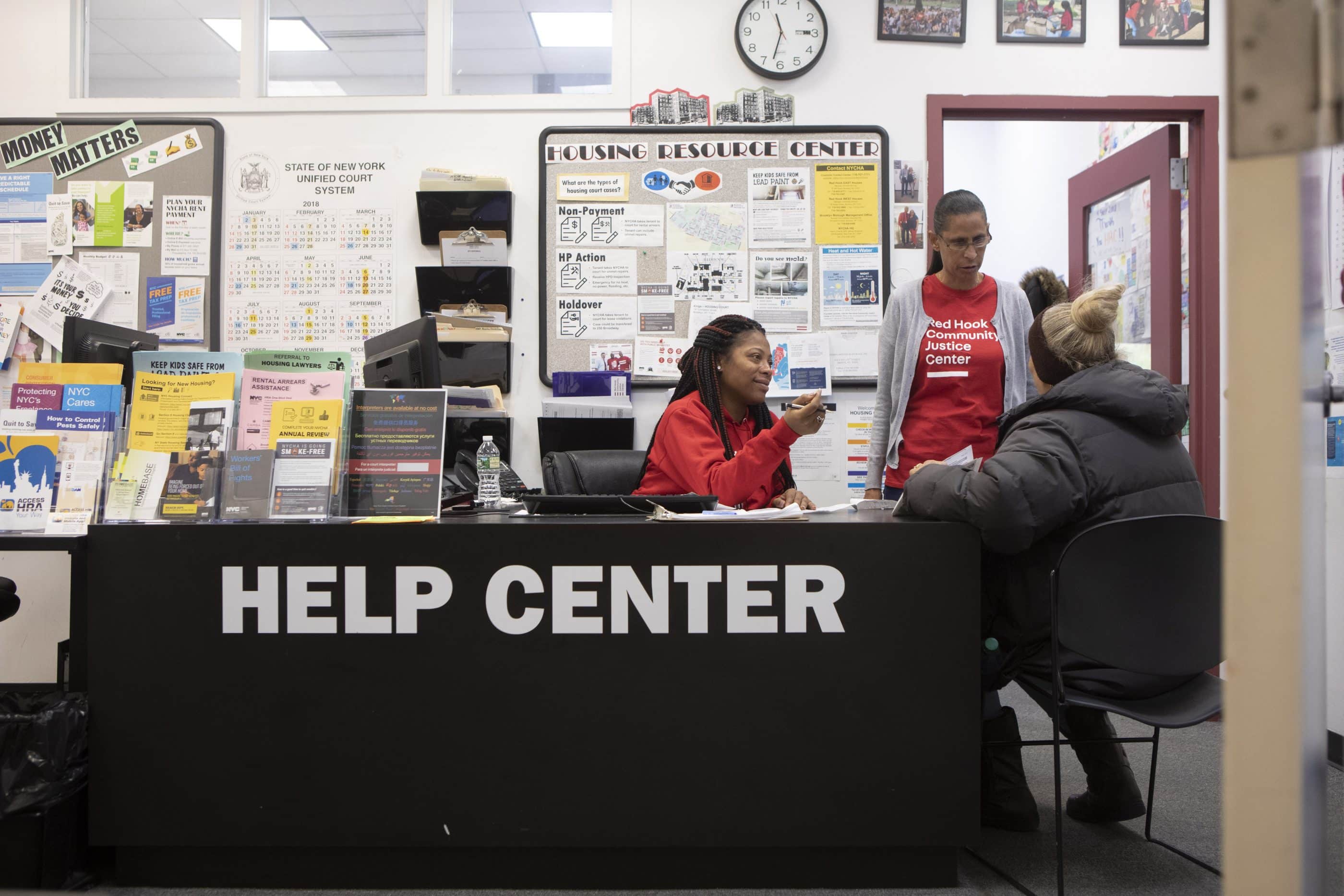
Also in New York City, the Center for Justice Innovation has been leading neighborhood-based courts across the city since 2001, including community courts in Harlem and Red Hook. These courts have community hubs that help tenants navigate the court process and connect them to resources and legal services. Much of the staff are often from the community they serve, making them feel more approachable, and many of the projects and resources onsite are embedded in the community.
“We’re providing wraparound services but in a very person-centered, holistic kind of way,” says Jessica Yager, senior director of housing justice initiatives at the Center for Justice Innovation.
These community courts often work in partnership with existing courts, but they operate with a different atmosphere. “There’s space [and] time for people to tell their own story,” Yager notes. “People are treated with respect at every point throughout the system.”
In 2019, less than 1 percent of Red Hook housing court cases received a ruling in favor of the landlord just because a tenant failed to show up in court or respond to legal papers, compared to 14 percent in the downtown Brooklyn housing court, according to the Center for Justice Innovation.
Community courts also consider more than just the legal outcome. “How do you help people have a softer landing?” Yager asks. “You can’t avoid all evictions. So, when you can’t avoid the eviction, how do you help people not end up in a situation where, literally, the marshal is coming and throwing their stuff onto the street? Because that’s the very worst possible scenario.”
Jurisdictions that have implemented ways to reduce evictions have seen significant effects on their judicial systems. For example, adopting right-to-counsel programs has not only increased coordination among service providers but also reduced duplicated efforts; expanded tenant education and outreach; and changed court culture to one that empowers tenants to advocate for themselves and expects judges to take the time to follow a formal, evidence-based dispute resolution process.
“There’s a shift in the way that tenants experience the legal system because of that access bridge that’s created,” says Emily Benfer, professor of law at George Washington University.
Eviction defense is not only an individualistic gain. When tenants successfully challenge their evictions with the help of legal resources, the cases can have ripple effects, leading to case law that protects tenants statewide, not only in the city with a right to counsel.
Upfront Costs, But Long-Term Net Savings
In states and cities prioritizing eviction prevention, these efforts have not only curbed eviction rates but also helped governments save money. When people are evicted, they often need to lean more heavily on social safety nets, including housing assistance, unemployment benefits, medical care, and, if they have children, potentially foster care. They are also at increased risk of having more interactions with the police. “[Eviction is] very traumatic for the families that have gone through it,” Gilbert of LCBH says.
“It perpetuates a negative cycle that’s destructive and harmful to health and well-being, and that people feel the weight of for the rest of their lives,” Benfer notes.
Eviction is also expensive. A 2025 cost-benefit study in Phoenix by consulting firm Stout found that for every dollar invested into an eviction right-to-counsel program, the city could save $2.58—money that would have been spent on other social safety net responses made necessary by displacing tenants. Within five years, it is estimated that a $24.8 million annual investment into an eviction right-to-counsel program would generate an estimated $64.1 million in savings for the city of Phoenix.
“Cities and states lose when people are evicted in a way that’s preventable,” Pollock says.
Although these programs save money, the savings are diffuse and come over time, and the costs are upfront, so funding them can be politically challenging. Many programs tackling evictions nationwide were launched with federal funding early on during the pandemic, mainly through the American Rescue Plan Act. That funding has since dried up, says Andrew Aurand, senior vice president for research at the National Low Income Housing Coalition, and jurisdictions now must come up with other ways to fund these programs.
In Maine, the state’s eviction prevention program is funded through the legislature’s general appropriation funds. In Florida, a stamp tax generates revenue for the state’s Sadowski Housing Trust Fund and the Local Government Housing Trust Fund, a portion of which is allocated to housing assistance programs, including emergency rental assistance through the State Housing Initiatives Partnership.
Not all efforts have borne fruit. In Massachusetts, a house bill introduced in 2025 that would have allocated $2.5 million to fund a statewide tenant representation pilot program has stalled in the state legislature. A New Jersey assembly bill to dedicate $20 million for the creation of a statewide right-to-counsel program in certain eviction proceedings died in committee.
“The challenge, of course, politically, is getting [these bills] passed [and] getting them implemented,” Aurand says.
Advocates remain optimistic that tools like these can help people stay housed. For tenants like Smith, they made all the difference.
“I could not have done it by myself,” she says. “I would have been out in the creek without a paddle.”
About the Author




Great article to listen. Thanks