


This article is part of the Under the Lens series
Innovations in Community Ownership
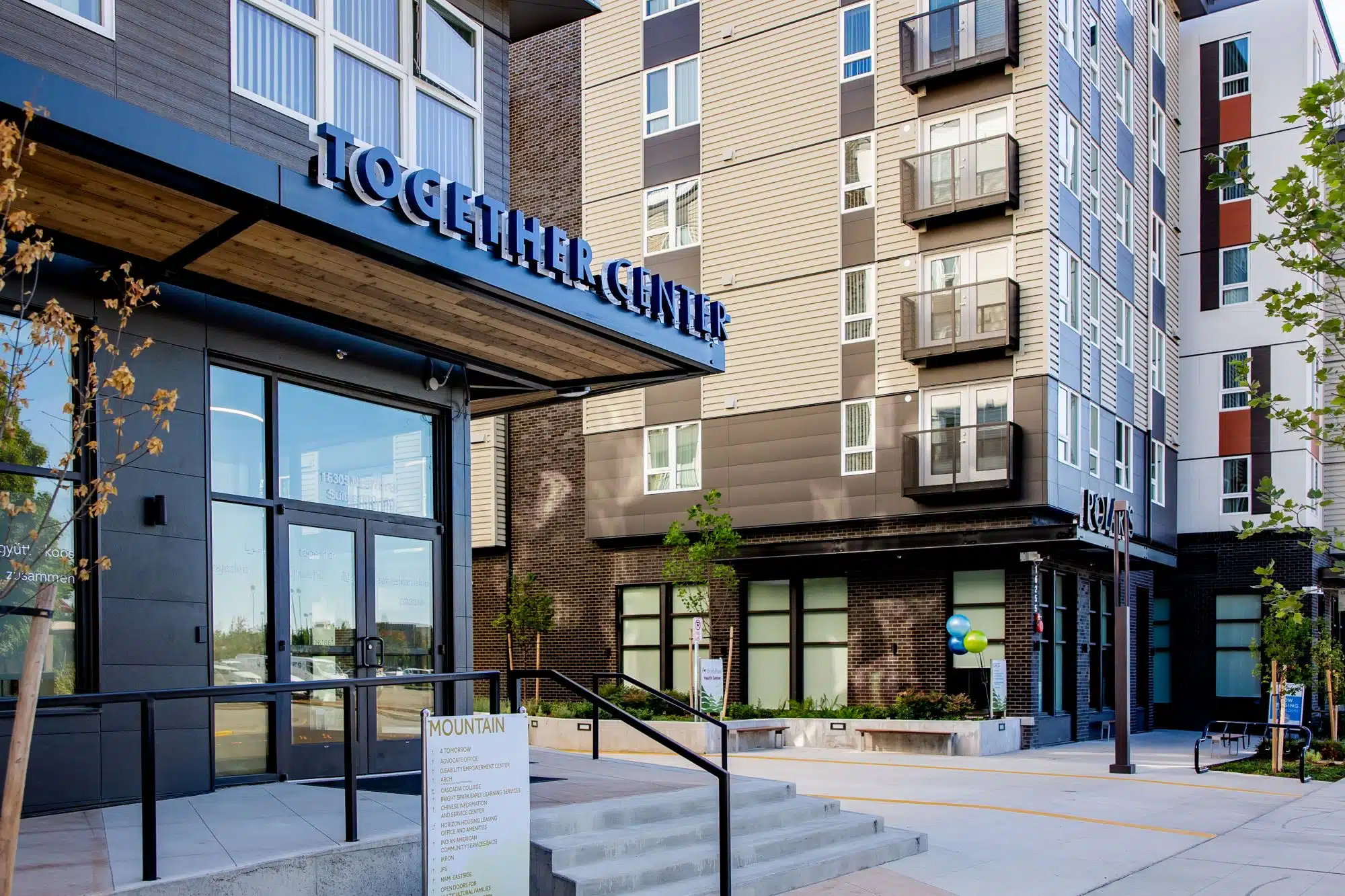
Together Center, a human services hub in the heart of Redmond, Washington, is home to over 25 nonprofits and 280 units of housing for a range of working families. More than 500 people live on campus, including over 250 children who are growing up in a community built for belonging. The campus features a conference center, public art gallery, coworking lounge, and community kitchen, all designed to make support more welcoming and human connection more possible.
The Birth of a Nonprofit Hub
Together Center began in an unassuming strip mall in 1991. Four human services organizations—Friends of Youth, Hopelink, Youth Eastside Services, and HealthPoint—joined forces to purchase an underutilized strip mall and retrofit it for nonprofit use. At the time, such a venture was a radical concept. Nonprofits were accustomed to operating in silos, and to not owning their own spaces. They were often stretched thin on rent and disconnected from peer organizations.
Sharing space would enable collaboration, reduce overhead, and eliminate the burden of navigating multiple service locations for clients. People could walk in needing housing support and leave having also scheduled a health care visit, signed up for job training, or enrolled in counseling—all in a single trip.
The participating organizations formed a nonprofit corporation—Together Center—to own, lease, and manage the services hub.
The onsite nonprofit organizations pay rent that is at least 25percent below market to Together Center. All onsite partners send a representative to the monthly Together Advisory Council meetings where information, updates, resources, and events are shared among the group. One person from the advisory council is appointed to the Together Center Board of Directors to represent the nonprofit partners at the board meetings and report between the council and the board of directors.
In 2017, Together Center finally paid off its mortgage, making the land nonprofit owned. By 2018, 18 providers were operating on-site, serving tens of thousands of community members annually.
However, the strip mall structure was deteriorating. It wasn’t ADA-compliant. Repairs were growing increasingly expensive. And with Redmond experiencing a tech-fueled population boom, demand for nonprofit space near transit and where services are needed was outpacing supply, and nonprofits were being priced out of Redmond. On top of the building conditions, Together Center’s hub in its current state did not have enough space for service providers who needed offices in that area.
The Together Center’s 2.4-acre parcel in downtown Redmond was now worth nearly $18 million. For a nonprofit with just two staff members and less than $250,000 in reserves, the asset represented a windfall, and a dilemma. Should we sell and relocate? Redevelop? Partner? Or preserve the site as-is?
The Together Center Board of Directors made a bold decision: they wouldn’t sell. Instead, they would maintain land ownership and transform the campus into something more. The campus would be redeveloped to increase capacity, improve accessibility, and include something the region desperately needed—affordable housing. The need for housing was being raised by our partner organizations and in past stakeholder engagement work.
Together Center’s board and staff knew, however, that we did not have the knowledge, experience, or desire to get into the business of financing, owning, and operating affordable housing directly. So, we began thinking about and planning for partnerships and an ownership structure that would allow us to redevelop the site into a human services and affordable housing campus without Together Center becoming a housing organization.
Before entering into partnership, Together Center defined its lines in the sand:
- The land must remain under nonprofit ownership. The board was firm about keeping hold of the land in order to ensure long-term stability for residents and nonprofit partners and prevent displacement, as well as to continue to build financial equity and visibility for the organization itself.
- Current nonprofit tenants must be guaranteed a path back.
- The new space must serve more people, more effectively.
These principles didn’t just inform the project—they anchored it. We stayed true to those three non-negotiables even when doing so made the operating structure and legal agreements significantly more complicated.
As the board looked to the future, it became clear they needed new leadership to take the project forward. In 2018, they hired me as CEO. With my background in managing shared nonprofit spaces in San Francisco and New York, I knew the project would require not only technical skills, but empathy, adaptability, collaborative decision-making, and strategic persistence.
At the same time, the board began evolving. It added new members, not just for their professional qualifications, but also for their mindsets. The board sought out people who could problem-solve, navigate ambiguity, and uphold the values at the project’s core. Board committees were formed around key domains: legal, finance, design, communications, and fundraising. Gaps were filled by volunteers, consultants, and advisers. We took what I call an “ultramarathon hurdling obstacle course” mindset, meaning each challenge was treated as a hurdle to clear rather than a reason to stop the race.
Finding the Right Development Partners
In 2019, Together Center issued a Request for Interest (RFI) to affordable housing developers. Unlike a traditional RFP, which outlines strict specifications, the RFI invited creative proposals aligned with the nonprofit’s goals and lines in the sand. This flexibility allowed for genuine collaboration and resulted in three strong contenders.
Eventually, Together Center selected a joint proposal from Inland Group—a for-profit housing developer—and Horizon Housing Alliance, a nonprofit with a mission to create and operate deeply affordable housing. The partnership was deliberate: Inland, a vertically integrated company, brought financing savvy, capital, and risk tolerance; Horizon brought mission alignment and long-term affordability expertise.
[RELATED ARTICLE: From Empty Spaces to Community Places: Why Nonprofits Belong on the Ground Floor of Affordable Housing]
The resulting plan called for a mixed-use development: a 49,000-square-foot nonprofit services hub along with social spaces, on the ground floor, with 280 units of affordable housing above it. The rental apartments would be family-oriented, with over 60 percent of units being two- and three-bedroom units. Affordable rental units at larger sizes are particularly hard to find in this area, and many of Together Center’s nonprofit clients serve families and youth who might need them. The entire project would be built on ground and air rights leased from Together Center, which allowed for retained ownership of the land.
Navigating Legal and Structural Complexity
The legal structuring of the project was as innovative as the development itself. It involved:
- A 50-year ground lease from Together Center that confers air rights to build affordable housing on floors 2–6, to Horizon Housing Alliance and Inland Group.
- Prepaid lease agreements with the housing developers to avoid long-term debt for Together Center. We used some of these up-front payments, as well as funds raised from our capital campaign, to build out the ground floor for the nonprofits.
- A mixed-use condominium owners association was formed for the three owners of the campus buildings (Together Center and the two housing partners) to govern shared responsibilities, services, and expenses for long-term operations of the campus.
- Affordability covenants to guarantee long-term housing affordability.
Initially, the legal process was rocky. The first law firm struggled to navigate the project’s unconventional approach. So Together Center found legal counsel that had experience in affordable housing and community-driven land deals. This decision would prove pivotal, as the project’s legal integrity was crucial to securing funding and finalizing development agreements in a timely manner to take advantage of all financing tools available.
Scaling Fundraising from Zero to Millions
The project’s total cost was $106 million, and Together Center’s share for its ground floor space was $12 million. This was uncharted territory. Before 2020, Together Center had never raised more than $75,000 in a single year.
We launched the “Together Strong” capital campaign just as the COVID-19 pandemic took hold. Many organizations were postponing this kind of campaign at that time, but we were aware that inflation and supply chain issues could make delays catastrophic and decided to make a full-court press.
We emphasized transparency and invited all interested community members into the journey as collaborators, not just check-writers. Though it wasn’t a quick sound bite, once we were able to tell our story of a community land asset owned by a trusted, long-standing community organization using its equity in that land to build a new campus for human services and affordable housing, people were excited to give and/or be an ambassador for the project.
The other piece of the puzzle that resonated with community members was the “by nonprofits, for nonprofits” model that Together Center uses for its regular operating expenses. Approximately 80 percent of Together Center’s annual revenue comes from below-market-rate space rentals to nonprofits. Together Center fundraises local support for the remaining 20 percent of to keep rents low and provide collaborative programming on site.
By the campaign’s end, we had raised over $8.8 million from individual donors, corporations, foundations, and public agencies. The balance of Together Center’s $12 million share came through the pre-paid ground lease fund. Notably, the Together Strong campaign reached its goal to build out the ground-floor human services hub without incurring debt.
Building Through Crisis
The pandemic wasn’t the only disruption. A 140-day concrete drivers’ strike in 2022 delayed construction and strained timelines. Meanwhile, 18 nonprofit tenants had to be temporarily relocated, which was no small feat during a global health crisis. Clinical spaces, mental health offices, and shelter programs had to continue operating in temporary trailers and rented offices, often with customized buildouts.
Every time the team hit a hurdle, they embraced the “ultramarathon hurdling obstacle course” mindset and found a way forward. The development partners—Together Center, Horizon Housing Alliance, and Inland Group, along with architects and contractors—met weekly, adjusted schedules, and doubled down on their shared mission. This wasn’t just a construction project; it was a communitywide effort. All along, Together Center continued to meet with our nonprofit tenants to design a place for belonging with light-filled, easy-to-use, client-focused, and flexible spaces for the ground floor hub.
The Ribbon Cutting—and What Came Next
In September 2023, Together Center celebrated the grand opening of its new campus. The ground floor now houses more than 25 human services providers in modern, accessible, energy-efficient offices. Shared amenities include:
- A large conference and event center for nonprofits only
- A community kitchen
- A coworking studio and a drop-in lounge
- An art gallery for local community artists to display their work
- Multiple indoor and outdoor gathering spaces
Above the service hub, 280 units of affordable housing rise five stories. Most units are family-sized and deeply affordable. There are 80 units for people making 30–50 percent of the area median income and 200 units for people making up to 60 percent of the area median income.

Together Center remains an independent 501(c)(3) organization and the landowner, ensuring long-term mission alignment. Through a condominium owners association, the three partners operating on site share expenses for common items such as landscape, security, parking garage, elevators, and trash removal. Each partner pays their share of these expenses based on their total square footage owned on the campus. The housing is managed by a local property management company with whom we work closely on site.
And because of its financial model, Together Center operates debt-free—an extraordinary outcome that frees future resources for programming and innovation!
Lessons for Nonprofits Everywhere
Together Center’s experience offers many takeaways for other organizations seeking to rethink their use of land, space, or capital development.
1. Define Your Non-Negotiables
Before you draw blueprints or pitch funders, clarify what matters most. Together Center’s early commitments to land ownership and nonprofit return rights kept us aligned through every twist and turn.
2. Build Leadership That Can Navigate Complexity and Ambiguity
Emotional intelligence, adaptability, and collaborative spirit are important as technical skill. The right leadership team can make or break your vision.
3. Treat Partners as Co-Creators
Together Center didn’t just hire developers, we built relationships. Trust, shared values, communication, and mutual respect carried the project through tough times.
4. Be Honest About Your Limits
When we didn’t know something, we said so. When something wasn’t working, like our initial legal team, we pivoted. Asking for help is not a weakness; it’s strategic.
5. Fundraise with Transparency and Courage
You don’t need a donor Rolodex to raise millions. You need a story, a community, a strategy, and a team willing to learn. Invite people to create and build with you. Many nonprofits would not have put a shovel in the ground until they had raised most of the money needed for project completion. To make this project happen before costs rose further, our housing partners promptly applied for Low Income Housing Tax Credits and received an allocation. In order to take advantage of all credits allocated, we had limited time to raise the rest of the money and put the housing units into service. That firm deadline meant we had to move quickly—more quickly than we were used to—if we wanted to make the project happen. Fear can kill a project, and often does. But Together Center took smart risks and spoke honestly with stakeholders and funders about the realities of financing and the need to raise money more quickly than many campaigns. We offered many hard-hat site tours so people could see the buildings literally rising out of the ground.
6. Perseverance Wins
Setbacks will come. What matters is how you respond. Together Center’s “ultramarathon hurdling” mindset kept the project alive and thriving.
7. Think in Decades, Not Years
Too often, nonprofits plan in short cycles. Together Center’s 50-year ground leases and long-term ownership structure ensure stability for future generations.
A New Chapter
Today, Together Center is buzzing with activity. Families live upstairs, and we have over 500 residents altogether. Nonprofits are serving and collaborating downstairs. The organization itself has shifted from being merely a landlord to being a convener, community builder, and a model inspiring other landowners. Together Center’s success has allowed faith communities, cities and other jurisdictions, and other nonprofits to consider activation of their land differently. In addition to writing and speaking widely about the project, we offer regular tours and talks to encourage more public-private partnerships and innovative social-purpose real estate projects We continue to strengthen collective power through the active collaboration of diverse people and organizations working on one site.
The complexity has grown and so has the impact. With the new campus for human services and affordable housing complete, we are looking forward to using it to advance our mission further. We are sparking connections through people-focused spaces for nonprofits and the communities they strengthen. We are actively building a community of purpose and belonging, and creating intentional partnerships for transformative, collaborative solutions to social problems. We continue to reduce barriers to access and help people find help when they need it. We continue to envision healthy, housed, and thriving communities for all; and we are doing our part to work toward that vision.
Together Center’s story is a clarion call to other nonprofits: you don’t have to settle. You don’t have to sell. You don’t have to wait for someone else to build the future. With courage, clarity, and community, you can do it!
It’s not easy. But it’s possible. And it’s worth it.
About the Author



I have visited the site and was present for its grand opening. It really is a marvelous achievement.