



UPDATED July 21 | On June 24, a sweltering hot day, Assemblyman and Democratic Socialist Zohran Mamdani became the presumptive winner of New York City’s Democratic party nomination for mayor. With 43.5 percent of the election’s first-round votes, he clinched an insurmountable seven-point lead over former Gov. Andrew Cuomo. The final ranked choice vote showed Mamdani winning 56 percent of the vote and Cuomo winning 44 percent of the vote.
“We have won because New Yorkers have stood up for a city they can afford. A city where they can do more than just struggle,” Mamdani said in his victory speech on June 25. “One where those who toil in the night can enjoy the fruits of their labor in the day… Where rent-stabilized apartments are actually stabilized.”
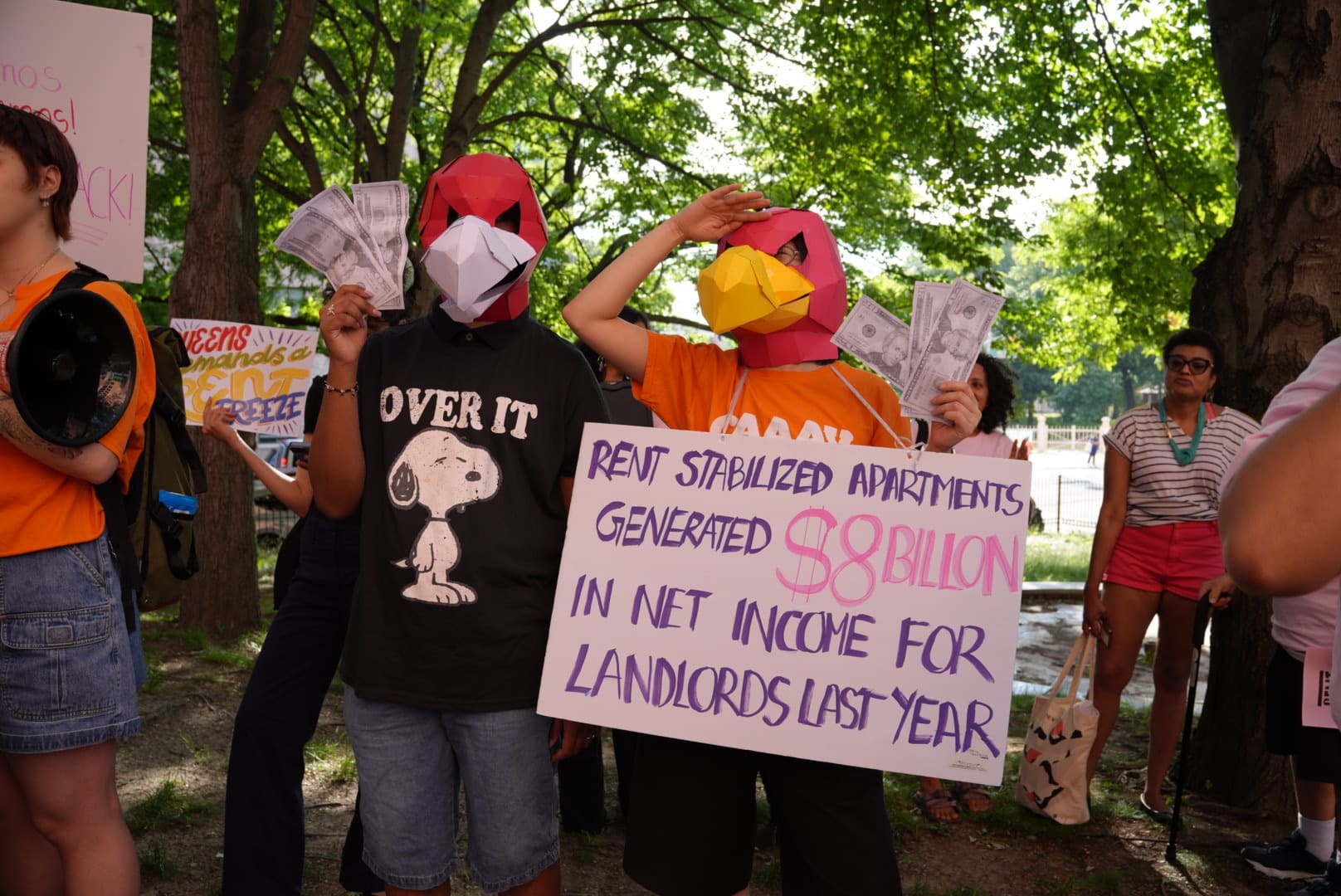
The campaign was historic for many reasons, among them that Mamdani sought the votes of rent-stabilized tenants with an explicit promise to freeze rents, and organizers supporting Mamdani connected in-person with tens of thousands of rent-stabilized tenants before the primary.

“I don’t know any example in recent memory of tenants organizing at this scale,” said Ritti Singh, an organizer with the New York State Tenant Bloc, the day after Mamdani’s win.
The New York State Tenant Bloc is a 501(c)(4) formed by Housing Justice For All, a statewide coalition of advocates for tenant-centered policy. Tenant Bloc launched a “Freeze The Rent” campaign in February and endorsed Mamdani in May. He was the first mayoral candidate to support a rent freeze and the only candidate to support a four-year rent freeze, which he made a pillar of his campaign.
The Tenant Bloc campaign targeted rent-stabilized housing developments across the city, knocking on doors, explaining the positions of the different candidates, and asking them to rank Mamdani first and fellow mayoral candidate Brad Lander second. Organizers say that they collected over 20,000 petitions from hundreds of rent-stabilized buildings across the five boroughs.
The win was celebrated by tenant activists across the country as proof that tenant-centered politics can win elections.
[RELATED ARTICLE: Top 6 Tenant Protections Renters Are Fighting For]
“Leading with the rent is actually a huge part of the story about this election,” says Tara Raghuveer, director of the Tenant Union Federation, a national coalition of tenant unions formed last year. “I think it was an observation that many of us had in the lead-up to the last federal election: the rent was higher than it had ever been, and tenants are paying more and more for the worst conditions they’ve ever endured, and across party lines that emerged as a key, if not the key, economic issue.”

The premise of Tenant Bloc’s Freeze The Rent campaign is that renters make up the majority, 69 percent, of New York City residents. And 42 percent of rental housing is rent-stabilized.
The Tenant Bloc began organizing in October, with an official launch in February. They didn’t begin talking to tenants about candidates until May, organizers say, giving them months just to talk to tenants about a rent freeze rather than a specific candidate.
“If people are really fed up with the status quo and moving to the right, or if people are going to these classic strong man politicians who aren’t going to do anything for them, campaigning on the most important issue of their lives, the biggest cost to them every month has the ability to change how they’re going to vote,” says Singh, who knocked on doors during the campaign.
The message was received loud and clear by Mamdani’s main opponent in the November general election, current Mayor Eric Adams, who will be running on an independent ballot line. Adams announced June 30, hours before a meeting of the Rent Guidelines Board (RGB), that he was “urging the Rent Guidelines Board to adopt the lowest increase possible.” He said he was doing this because “one of the largest costs on kitchen tables each month is rent.” Adams still attempted to draw a distinction between him and his opponent, Mamdani, saying that the idea of freezing rents was “short-sighted” and would “risk worsening already deteriorating housing conditions.”
While electoral canvassing often involves knocking on the doors of strangers based on sometimes outdated lists of potential voters, the Tenant Bloc was instead able to plug into tenant associations that have been around for decades, including tenant associations at storied developments like Stuyvesant Town-Peter Cooper Village in downtown Manhattan and Lenox Terrace in Harlem.
As a result of the Tenant Bloc’s strategy of convincing primary candidates to promise to freeze the rent, they ended up with a slate of seven candidates pledging at least a one-year rent freeze and only two major candidates, Andrew Cuomo and Whitney Tilson, who promised none.

Singh says tenants were often persuaded when they learned Andrew Cuomo has received millions of dollars in real estate donations. “People are like, ‘Oh my God, I supported him. He was going to stand up to Trump. I supported him because he’s a strong man who protected us through COVID,’” she says of conversations with tenants.
Delsenia Glover is a long-time tenant activist, former state assembly candidate, and lifelong Harlem resident. Glover, who is Black, expressed concern about the number of Black people who have left Harlem in the past 10 to 15 years as a result of high rents. She says Adams’ rent increases on rent-stabilized units exacerbated this.
Speaking in March while working with the Tenant Bloc on the rent freeze campaign, she said she had been receiving a positive response from tenants.
“Nobody says, ‘Oh, no thank you, I won’t sign that,’” she said.
RGB Raises Rents, Despite Hopes
Rent-stabilized tenants and organizers held out hope that Mamdani’s decisive win would sway the Rent Guidelines Board to freeze the rent at its June 30 meeting, despite most members having been selected by Adams. But the board voted 5-4 to raise the rent by 3 percent for a one-year lease and 4.5 percent for a two-year lease.
The energy from Mamdani’s win was on display at the meeting, as more than 100 tenants gathered outside El Museo del Barrio in Harlem for a rally. Local news trucks were parked outside and camera crews were set up as tenants rallied and cheered for a rent freeze before entering the museum’s auditorium.
The board’s votes often have a raucous audience of tenants in attendance, drowning out all pro-landlord speakers with boos and hushing to hear the two tenant representatives on the board. At last year’s vote, Assemblymember Mamdani was among those arrested protesting outside with tenant organizers. He did not appear at the vote this year.
One tenant board member, Adán Soltren, used his speaking time at the meeting to excoriate the board’s planned rent increase.
“This is not normal,” Soltren said, “When you see human suffering, it is not normal to take actions and directly add to their suffering.” Soltren said that while property taxes may have increased, tenants’ wages have been depressed. He said the board had “cosigned unaffordability and abject poverty.”
Mercedes Escoto, 67, is a tenant and an organizer with the NYS Tenant Bloc who attended the June 30 vote. Escoto receives a pension from the city and says that since her fixed income is not increasing, raising the rent makes it more and more difficult to afford basics. She pays $1,700 for a two-bedroom unit.
“Food is going up. Con Edison [utilities], rent. I will not be able to afford it any more. I’m having problems affording the increase that we had last year,” she says.
Escoto says she’s going to fight for a four-year rent freeze. “The city has abandoned us … housing is a human right. Why send us to the shelters if it’s a human right?”
Why the Mayor Can Freeze Rent
The Rent Guidelines Board is ostensibly a neutral committee that determines rent increases based on data on rent-stabilized apartments, including the condition of the buildings, the profits of landlords, and the wages of tenants.
But every member of the guidelines board is appointed by the mayor, and it is no secret that rent increases are largely guided by whoever is residing in Gracie Mansion. Under Mayor Bill de Blasio, rents were frozen three times, in 2015, 2016, and 2020. The total rent increase on stabilized units during his eight years in office was 6 percent. Under Mayor Adams, rents have increased by 9 percent since 2022.
Landlord lobbyists, including the New York Apartment Association, have argued that rent increases are the only way to boost operating income and address deferred maintenance in rent-stabilized apartments.
In 2021, NYU’s Furman Center released a study about the impact of the Housing Stability and Tenant Protection Act, a 2019 housing law that closed loopholes that allowed landlords to deregulate units that were rent-stabilized. It found a decrease of repairs in buildings, but also a temporary reduction in evictions immediately after the housing law passed.
In April of the same year, the Furman Center released a report recommending targeted subsidies for low-income tenants and anti-rent gouging measures that would set “a relatively high cap on all landlords’ ability to increase rents.” (As Los Angeles County residents learned after this year’s fires, however, anti-gouging policies require political will and significant resources poured into enforcement.)
The Rent Guidelines Board’s own data paints a more lucrative picture for landlords; between 2022 and 2023, net operating income for New York City landlords of rent-stabilized units increased 8 percent, adjusting for inflation. On average, landlords of rent-stabilized units profited $626 per unit per month. The percentage of buildings with rent-stabilized units where the rent rolls did not cover costs decreased to 9.3 percent, the first decrease since 2016.
And the picture has not been looking good for tenants: In another report released in April, the RGB found that residential evictions rose by more than 22 percent in 2024. Average inflation-adjusted wages decreased .4 percent between 2023 and 2024.
Elisa Martinez, a tenant organizer with the New York State Tenant Bloc who lives in a rent-stabilized Washington Heights apartment and attended the June 30 Rent Guidelines Board meeting, was skeptical that landlords who raise rents are doing so to make repairs.
“It’s clear that money isn’t going to repairs,” Martines said. “It’s going to brand new sports cars, and PACs, and funding a campaign that will keep our rents high and we see right through that.” She said that burdened landlords have programs available to them to fund repairs.
Convincing Other Candidates
It took time for the Tenant Bloc to get other primary candidates on board with a rent freeze, and ultimately most candidates endorsed a one-year rent freeze with caveats. Brad Lander, who the Tenant Bloc asked voters to rank second on their ballots, spoke at a May housing forum at NYU with fellow mayoral candidates Scott Stringer and Adrienne Adams in attendance and said he wanted a depoliticized RGB that made decisions based on data.
Speaking to Shelterforce/Next City ahead of the June 30 Rent Guidelines Board meeting, Lander was unimpressed by Eric Adams’ post-election endorsement of a lower rent increase. “After appointing people who insist on rent increases every year, [Adams] can pretend to say that he would like them to choose the lowest amount in the range. But it’s already a rigged game,” he said.
When asked by Shelterforce/Next City about his past position that the board should not be politicized and make neutral decisions, Lander said, “I support reform of the RGB in Albany that would make it less Kabuki theater. I do believe that looking at the data is wise. We want to keep the rents as low as possible consistent over time with making sure the buildings are well-maintained and heat’s provided.”
In a widely circulated video last March, the Tenant Bloc confronted Zellnor Myrie, one of the mayoral candidates, over his refusal to endorse a rent freeze.
“I understand why people feel that that is the litmus test and there are some candidates in the race that have agreed to that,” Myrie said, before asking the tenants to take into account his past accomplishments on housing. Myrie was elected to the Senate in 2018 in part based on his advocacy for tenants and drafted a Tenants Bill of Rights while legislative director for a member of the New York City Council. As he invoked his values and the way he grew up, a tenant activist interrupted him to say, “Nobody cares about your values. What you do is what we care about.”
Myrie eventually endorsed a one-year rent freeze, along with candidates Brad Lander, Scott Stringer, Michael Blake, Adrienne Adams, and Jessica Ramos.
“It’s surprising that more folks weren’t on board in the beginning,” Singh says. “On the other hand, it’s surprising how many folks were on board at the end.”
Rent as politics
Fundamentally, organizers have used the Democratic primary to test the idea of renting as a fulcrum of electoral politics in cities. Since last year, the Tenant Union Federation has argued that the Democratic party is ignoring a crisis of affordability and that doing so could hand the presidency to Donald Trump.
Mamdani’s victory over Andrew Cuomo seems to prove the flipside of that equation: If a political party takes the daily costs of voters seriously and presents bold solutions, they can win over large shares of the electorate.
“It was not so long ago that the rent and housing were sideline issues,” says Raghuveer. “Now it’s really almost impossible to ignore because of the scale, depth, and breadth of the pain.”
A June survey of 819 likely Democratic primary voters by Data For Progress found that housing was the most important issue to them. A poll released in April found that 83 percent of Democrats and 78 percent of New Yorkers supported a rent freeze on rent-stabilized units. A May poll from Emerson College of likely voters similarly found that housing affordability was the most frequently cited issue to address.
Despite calls from several candidates to depoliticize the Rent Guidelines Board, Singh says tenants already understand how the system works and want a politician who will use it to ease their pain.
“There’s over 2.4 million rent-stabilized tenants in New York, and the last four years their rent increased. Before that, they had a mayor who froze the rent three times. People understand that rent is political in New York City, which I think is true everywhere,” Singh says. “The rent crisis is not natural…it’s because of many, many policy decisions that elected officials have made for a long time to favor landlords and the real estate industry.”
The NYS Tenant Bloc plans to keep tenants coming out against future rent increases and in support of other tenant priorities.
“This is permanent infrastructure for tenant organizing at scale, and we want to be able to use that to build direct pressure on our landlords to be able to fight for repairs, to be able to fight for fair rents,” Singh says.
Raghuveer, who is based in Kansas City, believes that a Mamdani win can set a model for a type of tenant-centered politics that can succeed in other cities and nationally.
“We can and will use the victory from New York to add fuel for the fire of these types of fights across the country, both at the ballot box and otherwise,” she says.
As of now, Mamdani will face Eric Adams and Andrew Cuomo, both running on independent lines, in a general election fight this November, along with GOP candidate Curtis Sliwa and former assistant U.S. attorney Jim Walden. Wealthy backers of Cuomo’s failed primary campaign are now weighing who to spend their money on. Democratic leaders have toed a line between hitching on to the enthusiasm that Mamdani has brought out and giving voice to Islamophobic attacks on him.
While there’s plenty of room for the general election to go to another candidate, Mamdani’s primary win was decisive, a fact that surprised even Mamdani and his supporters.
“We were like, maybe he’s gonna win, we’re gonna find out like a week or two from now. So now we’re like, Whoa. We have to think about this immediately,” Singh says.
Kristian Bailey, 33, is a rent-stabilized tenant who was hoping that Mamdani’s win would put the Rent Guidelines Board on notice. Bailey is a lifelong New Yorker who grew up in the St. Albans neighborhood and is now living in Harlem, where he and his roommate pay a combined $2,660 a month in rent.
Waiting in line to enter El Museo de Barrio before the vote, he was deciding whether to sign a one-year or two-year lease renewal in the coming weeks. Since Mamdani has pledged to freeze the rent, it wouldn’t make sense to sign a two-year lease with a rent increase.
“I feel that they know that they need to give us something right now,” Bailey said. “People are very upset about cost of living in the city generally. Zohran’s campaign speaking to rent freeze, public transit, food—it speaks to people’s needs.”
When asked if he felt the RGB and the Adams administration were scared after Mamdani’s win, he said, “I hope they’re scared.”
Editor’s note: This article has been updated to correct that the NYS Tenant Bloc plans to organize against future rent increases, not against rent freezes.
This story was published through a collaboration between Shelterforce and Next City. Next City is a nonprofit news outlet that publishes solutions to the problems that oppress people in cities, inspiring social, economic, and environmental change through journalism and events around the world.
About the Author


I don’t live in NYC, but I would not vote for this politician. In my opinion, he is divisive and promises policies he can’t deliver as a Mayor and many that, ultimately, would hurt the community, if he could enact them. Housing needs supportive policy and funding but we have to look at the whole platform. “The eye cannot say to the hand I don’t need you. “