


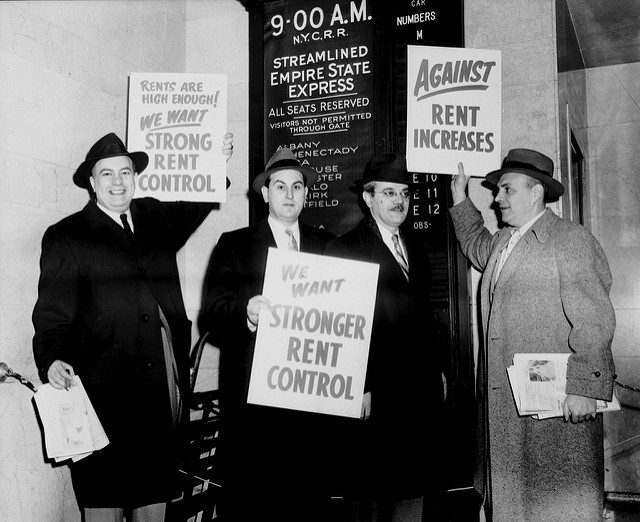
1950s photo of men protesting. Photo by Kheel Center, CC BY 2.0
Rent control campaigns are surging powerfully throughout the United States as rents rise and housing crises become more extreme. At the same time, mainstream economists and pro-landlord groups are recirculating anti-rent control rhetoric and misleading studies to discredit rent control and the real struggles that tenants face every day.
Rent control provides enormous benefits to tenants who have it: it guards against displacement, restricts rents from profiteering landlords, and has minimal budgetary implications. Nevertheless, the arguments keep coming from groups who seek to undermine the tenant resurgence: they say rent control keeps new housing from being constructed, and that the central solution to the massive issues of affordable housing, homelessness, gentrification, and displacement is new construction.
A recent paper published by the National Bureau of Economic Research argues that rent control protects current tenants but passes increased costs on to imaginary future tenants. It also argues that rent control takes available rental units off the market because tenants stay longer in their apartments, and landlords are incentivized to take advantage of loopholes in the laws (and they do when they can) to increase their profit.
The original goal of rent control was to protect tenants from profiteering landlords, and it has the result of community stability and anti-eviction protections. Community stability through long-term rentals should be a goal for strong neighborhoods, not a problem.
The paper’s argument also falls short because it leaves out the greatest threat that exists to affordable housing and tenants across the country: landlords’ and developers’ unlimited pursuit of profit, and the extent to which their substantial political power has allowed them to alter and preempt rent laws in ways that serve their own interests.
It is true—and proven every year by the Rent Guidelines Board in New York City, which oversees and determines rent increases for rent-regulated apartments—landlords still make a profit operating rent-regulated housing. In fact, landlord profits increased 10.8 percent last year, as they have for the past 11 consecutive years, even after two years of rent freezes. Anti-rent control policies, which movements across the country are mobilizing to fight, serve landlord profit and real estate’s political influence above all else.
Rent control became a common sense solution during the Great Depression, but anti-regulation economic agendas—and the policymakers and elected officials who pursued them—worked hard to make it politically impossible for decades. For many renters across the country, current housing conditions mimic those of the Great Depression: extreme rents and rent burden, rising homelessness, and displacement. And nationwide, new affordable housing construction is not meeting the scale of the crisis.
Rent control, however, is a solution that matches the scale of the crisis, and is why thousands of renters in diverse housing markets are organizing for it. If mass rent control where to be enacted across the country, rent costs for millions of people would stabilize, and evictions and homelessness would go down, with virtually no cost to taxpayers.
Take the example of New York City, which features the largest system of rent regulations in the country, housing 2.5 million New Yorkers and encompassing 1 million apartments. Rent regulation is the largest source of affordable housing for low-income New Yorkers, and is one of the reasons that New York City has been able to remain home to communities of color, immigrant communities, and low-income and working-class people.
The legal pretense for this elaborate system of rent regulations is that the market is in a state of “housing emergency,” defined as a rental vacancy rate under 5 percent. Although these protections are expansive, providing rent-regulated tenants with guaranteed lease renewals, limited rent increases, and an additional layer of regulatory protection against harassment and overcharges, they are still weaker than they should be.
The weakness stems from numerous “poison pills” inserted into these laws over the years by landlord and developer lobbies. Alongside the loopholes that threaten the benefits of rent regulation is the construction of so-called affordable housing that in recent years has mostly missed the mark for where the greatest need lies. Once again, this occurs because powerful for-profit developers are shaping the city’s affordable housing policies, not because of the city’s rent regulations.
There is a real question of who will be able to survive and operate in this housing market. This crisis is a political one, created by the real estate industry and the elected officials who support their agenda. And because the crisis is political, the solution must also be political. Profiteering landlords are not going to give up their goal of making as much money off of low- and moderate-income tenants as they can, so common sense solutions to protecting our communities against extreme rents, evictions, displacement, and gentrification are our only hope.
As this fight continues, whenever you hear (or read) anti-rent control arguments, ask the question: who benefits from banning rent control? And who is hurt?
About the Author



Thanks for the brief but pretty thorough look at rent regulation. May we strengthen what we have now in NYC.
Jackie Peters