


 How might a municipality leverage its resources and influence to better support its families?
Hawai'i County, specifically the Office of Housing & Community Development, has leveraged its influence to bring partners together to address that issue, and supports the Ho'owaiwai Network as a vehicle to deliver programs and services to the community. As mentioned in a past post, ho'owaiwai is a Hawaiian word that broadly translates to a vision of wealth that is more than financial, and encompasses relationships with family, place, and culture.
The Ho‘owaiwai Network convenes government, service provider, private, and community partners to sustain and expand support that will increase the financial stability and genuine well being of Hawai‘i Island families while building and strengthening the communities in which they live and thrive. Its intent was to realize outcomes at three levels:
• Build genuine wealth & financial security at the Individual & Family Level;
• Improve productivity & viability at the Private & Public Sector Level; and
• Nurture sustainability & resilience at the Community Level.
As such, the Ho‘owaiwai Network creates a space in which the variety of partners can openly share challenges and opportunities. As they do so they build relationships and specific partnerships with the goal of nurturing layers of resiliency to create a supportive environment for individuals and families as they pave their own pathway to social and economic resiliency.
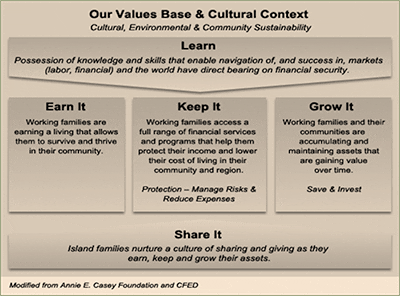
Hawai‘i Island families see wealth as being more than financial–it is also about building assets from the perspective of island people and taking into account the contexts of lifestyle, values, and culture. Within an island context, wealth-building policies should focus on families and their extended ‘ohana. When faced with adversity, people survive and thrive by receiving support from family, non-profit organizations, and local community networks. The following graphic shows the 'Earn It, Keep It, Grow It' framework of the island perspective–underpinned by Hawai‘i’s culture of sharing and giving.
The Ho‘owaiwai Network is a space for that sharing to occur on an organizational and institutional level with the ultimate goal of better supporting Hawai‘i Island families where they are at in their journey to build genuine wealth. The County, through OHCD, supports the Network by adding its institutional influence to bring additional partners, particularly other County and State agencies, to the table to hear concerns from the community through the different service provider partners. The County also leverages its resources to support ongoing communities of practice that maintain an ongoing dialogue. In this process, the County participants are open and flexible to adapt their approaches and funding opportunities based on what the service provider and community partners express to better integrate other supports – in the case of OHCD, this has meant including financial literacy and counseling to supplement its traditional housing focus. In addition, the County works with a local partner to provide targeted technical assistance and capacity building support to other members in the Ho‘owaiwai Network in hopes of better supporting Hawai‘i Island families achieve their vision of genuine wealth.
The efforts of the County as an institutional champion of this network approach and more specifically the Ho'owaiwai Network has received national attention as the County is a part of the Cities for Financial Empowerment Coalition, which focuses on leveraging municipal engagement to improve the financial stability of low and moderate income households by embedding financial empowerment strategies into local government infrastructure. While efforts are not perfect, it is hard to find a municipality that is willing to be vulnerable and open to ambiguity rather than prescriptive and definitive – and then uses its institutional influence to play the role of facilitator, convener, and connector and directly supports and engages in community dialogue and organizational capacity building on a regular basis. Perhaps these are approaches more municipalities in both rural and urban areas can incorporate in their own work to support communities and families where they are at to build genuine wealth.
(Photo credit: Image courtesy of the the Ho‘owaiwai Network)
About the Author

I’ve always felt that the tenant of creating and keeping wealth was a goal of supportive services and supportive community development.
It may be a matter of semantics but changing the conversation to wealth creation puts us into the arena of looking to the future and not just today. Great work in Hawaii