


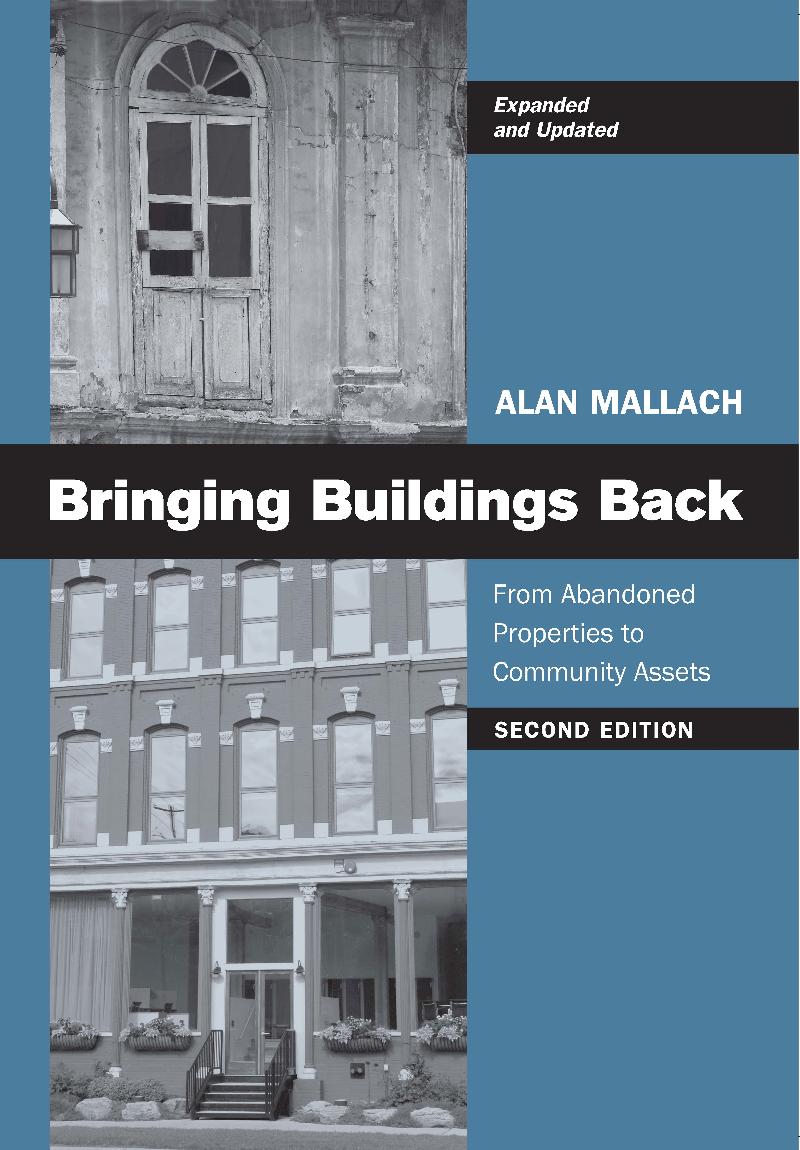
 Abandoned properties are a plague across the United States, from rust belt cities like Detroit and Buffalo to small towns like Lima, Ohio, and Waterloo, Iowa. Even in Sunbelt cities such as Houston and Las Vegas, abandonment is a major problem, as investment flows to the periphery, leaving the older, inner neighborhoods behind. In Bringing Buildings Back, Alan Mallach provides policymakers and practitioners with the first in-depth guide to understanding and dealing with the many ramifications that this issue holds for the future of our older cities.
Combining practical suggestions with a thoughtful exploration of policy, Bringing Buildings Back provides insights from law, economics, planning, and design to address all sides of the abandoned and vacant property problem, from how abandonment can be prevented to how best to bring these properties back into productive reuse. Bringing Buildings Back provides policymakers and practitioners with the first in-depth guide to understanding and dealing with the many ramifications that this issue holds for the future of our older cities. The book is replete with examples of how cities, community development corporations, and others have devised creative, effective solutions.
Written by a distinguished urban planner and practitioner with three decades of experience, Bringing Buildings Back is both a detailed toolkit and a call to rethink the way America carries out urban redevelopment. It is a book that should be on the desk of every mayor, city planner, community developer, or neighborhood activist, and that can be used in every course on urban redevelopment or neighborhood revitalization. With a new chapter on the foreclosure crisis and neighborhood stabilization, the second edition is an invaluable, up-to-the-minute resource for student or practitioner.
Praise for Bringing Buildings Back
“In countless towns and cities, reusing abandoned houses and vacant lots is tortuously complicated and time-consuming. Alan Mallach’s groundbreaking book is an exceptional ‘how-to’ guide to help communities transform these dangerous eyesores into safe and productive homes, work places, parks and gardens.”
– Don Chen, Program Officer, Metropolitan Opportunity Unit, Ford Foundation
“Blighted, abandoned properties are one of the greatest challenges facing many cities throughout the country. Thoughtful planning for their reuse takes not only leadership but also faith in the future of our cities and towns. Bringing these properties back can revive neighborhoods, provide affordable housing, and relieve pressure to build in open space. This insightful work offers communities a range of effective tools to reclaim properties from abandonment. It is a strong contribution to the field.”
– Parris N. Glendening, President, Smart Growth Leadership Institute and Governor of Maryland (1995-2003)
“Abandonment remains a significant challenge to neighborhood revitalization and it is important for communities to explore long-term and strategic approaches to reclaiming vacant and abandoned properties. A comprehensive guide that highlights successful strategies and lessons is long overdue.”
– Michael Rubinger, President and CEO of Local Initiatives Support Corporation
About the Author
Alan Mallach is senior research fellow of the National Housing Institute and a nonresident fellow at the Brookings Institution. He has written widely on planning, housing, and community development while working in business, government, and academe.
Research support for this project was provided by the Fannie Mae and Ford foundations.
A National Housing Institute book, distributed by Rutgers University Press.
Bringing Buildings Back is available now. Order it here.
About the Author


Comments