



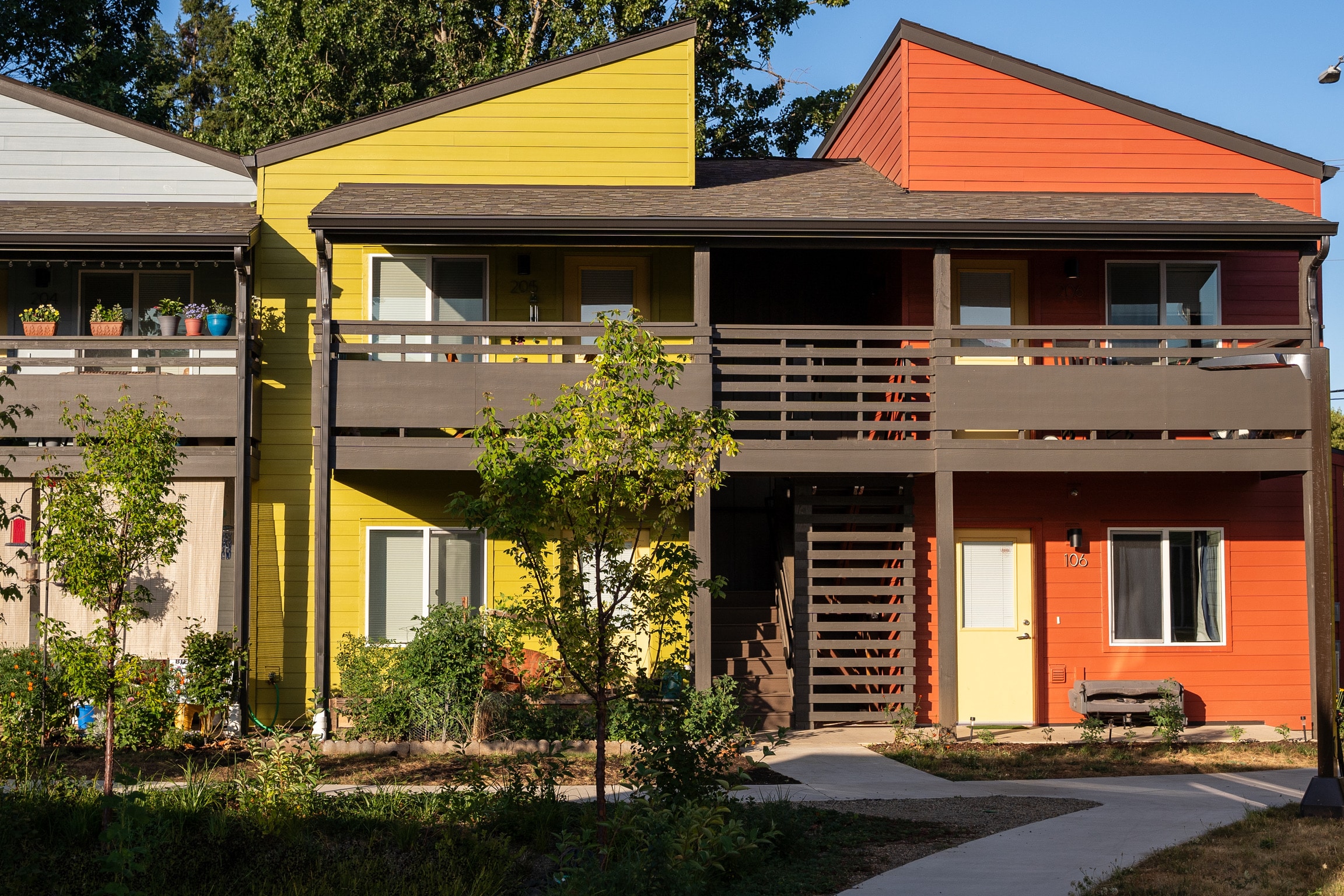
Cohousing residential communities are designed to foster neighborliness, encouraging practices like borrowing ingredients from neighbors, sharing occasional meals, and watching one another’s children. Cohousing is a “community intentionally designed with ample common spaces surrounded by private homes,” according to the Cohousing Association of the United States (CohoUS), a national nonprofit that promotes these types of neighborhoods.
As CohoUS Board President Laurie Frank explains, “You bring in architects who know how to build for people who connect. … You’re always crossing paths. An example is that parking is on the outskirts of the building, not right outside your door.”
Nationally, there are about 160 cohousing communities across the U.S., says Trish Becker-Hafnor, CohoUS’s executive director. Industry numbers are imprecise, but a cohousing community in Santa Cruz, California, estimates that around 13,000 people nationally and over 60,000 worldwide live in cohousing communities. These communities are typically structured legally as condominiums, though other structures such as cooperatives can be used.
For affordable housing advocates, cohousing has often had one distinct disadvantage: buying in can be costly. In Tulsa, Oklahoma, for example, a local public radio reporter noted that the cheapest cohousing property cost more than $350,000 in a city where the median home price, according to Zillow, was just shy of $213,000, as of Feb. 28, 2026.
Can cohousing also be affordable housing? The short answer is yes. But this is rare in the U.S. The leaders of CohoUS, however, have recently adopted a new strategic plan that aims to change that—both by focusing more on converting existing neighborhoods into cohousing through what is often called a “retrofit” model and by developing in partnership with existing affordable housing providers, such as community land trusts (CLTs).
Cohousing and Affordability: Addressing the Challenges
Greg Rosenberg, executive director of the International Center for Community Land Trusts, previously helped develop two cohousing communities in Madison, Wisconsin: The Troy Gardens Cohousing Community (TGCC), which opened in 2006, was developed as part of the Madison Area Community Land Trust (MACLT); and Linden Cohousing, which opened in 2019.
Rosenberg loves the idea of cohousing. These communities, he notes, span “multiple generations, so you’ve got supports for others in the community as well as people with disabilities, and then … for families with young children, you have honorary grandparents around, which is a beautiful thing both for the kids as well as for the elders.”
Both communities that Rosenberg helped develop include affordable units.

At TGCC, a 30-unit development, two-thirds of the homes are income restricted, and one-third are market rate. According to the land trust, the average income of homebuyers was 65 percent of area median income (AMI). Linden Cohousing, a 45-unit development, has 11 income-restricted units (priced, Rosenberg says, to be affordable to people earning 65 percent to 70 percent of AMI, and no more than 80 percent of AMI). The other 34 units are unrestricted, but prices when the community was founded were purposefully kept low enough to be affordable to people earning 120 percent of AMI.
Part of what made the development of these projects feasible was Rosenberg’s background in affordable housing. TGCC was developed while Rosenberg was executive director of MACLT, and the community remains part of the land trust. [CLT properties are affordable because residents own the property while the land trust owns the land. Learn more here.] Linden was developed years after Rosenberg had left MACLT to work as a consultant.
Despite these two Madison examples—and a smattering of others, such as Nomad Cohousing in Boulder, Colorado—affordable cohousing remains a rarity in the U.S.

Rosenberg wants to change this.
Often, cohousing can cost more than typical homeownership. As Rosenberg explains, this should not be the case. Cohousing is designed to trade out private space for common space. Developed in Denmark, the idea, he explains, is, “You have very compact private units and generous shared spaces. You have shared guest rooms … [so] you don’t have to worry about having a big dining room table. You have a common house that has a room where you can host large family events.”
But, Rosenberg notes, that’s not how the concept developed in the U.S. “People want generous individual units, and they want generous shared spaces. And so, from a space perspective, that can result in more square feet than a conventional condo project where you have a clubhouse room and maybe a workout room.”
The design process brings additional challenges. Cohousing communities often take many years to form before homes become available for residents. This requires people who have the time to participate in intensive community organizing. Cohousing groups also typically operate by consensus—and they aren’t always adept at determining which decisions must be made by the group and which decisions are better suited for an external consultant.
People want generous individual units, and they want generous shared spaces. And so, from a space perspective, that can result in more square feet. . .”
Greg Rosenberg, executive director of the International Center for Community Land Trusts
Rosenberg emphasizes that for cohousing to go from an idea to a built community, it is important for organizing groups to focus on “core decisions.” This, he explains, is what “makes for a more efficient development process. And the more efficient your development process is, the greater the likelihood that you will actually complete the project, and the easier it will be for other folks to partner with you.”
Rosenberg adds that “the group should focus on use cases, not what kind of siding we’re going to have.” This is difficult, he notes, because people often like to focus on that stuff “because it’s so [much] fun. What kind of siding? What kind of roof? What kind of this and that?”
Delegation is doubly important if the goal is to create affordable cohousing. As Rosenberg puts it, “My mantra has been, if you are serious about affordability, you want to work with somebody who has that very specific expertise.” In the case of Linden Cohousing, for instance, the volunteer organizing group was largely stuck until, Rosenberg explains, “they reached a point where they said, ‘OK, we got to get serious,’ and they pulled their money together and … hired a development team,” including Rosenberg, an architect, and a local attorney.
At the national association level, Frank and Becker-Hafnor offer their takes on how to make it easier to organize new cohousing communities that are affordable. One key strategy they are pursuing is broadening the definition of cohousing to include “community-rooted housing,” a framing that encompasses less costly retrofit models and new-build cohousing communities.

For Becker-Hafnor, for example, the Colorado home where she lives isn’t technically part of a cohousing community, but it is part of a community that follows cohousing principles and fits this broader “community-rooted” framework. As she explains, “There are examples of communities that have literally started with a traditional neighborhood and have, over the course of many years, torn down the fences and started a regular meal program. And we call that ‘retrofit communities.’” Because these “retrofit” communities are not new builds, the costs involved in creating them are considerably lower.
N Street Cohousing in Davis, California, is an example of a retrofit community, comprising 19 homes with about 50 residents. Affordability is one of its core principles, and while home prices are at market rates, room rentals, according to the organization’s website, are available at $400 to $800 a month in a city where the median rent for a one-bedroom apartment exceeds $1,900. As Frank explains, “I just visited [N Street Cohousing]. Over 25 years, they pulled down their fences, and they created a fairly informal governance structure. They are not a condo association or anything like that. They took one of the houses and remodeled the kitchen so they could gather there. Kids run all over.”
Becker-Hafnor says that thinking of CohoUS’s mission in terms of supporting community-rooted housing like N Street, rather than just new-build communities, offers “a way to pursue greater diversity and affordability in the model that we believe in.” She adds that CohoUS “always highlight[s] that cohousing is not a legal model or a financial model; it is really more a social model.”
This makes cohousing flexible and allows it to be combined with different existing affordable housing models, such as CLTs and limited equity housing cooperatives. TGCC, for example, built its cohousing community on top of a CLT structure.
Cohousing, Rosenberg notes, is typically attached to a condominium structure in the U.S. However, as Becker-Hafnor points out, it can be, and often is, paired with other ownership models. In Denmark, for instance, cohousing is often connected to a housing cooperative ownership model.
A Community-Led Housing Model Emerges in the United Kingdom
In the U.S., the cohousing and affordable housing movements are rarely linked. But in the United Kingdom, national cooperatives, CLTs, and cohousing leaders routinely work together.
Tom Chance, executive director of the Community Land Trust Network in the U.K., says, “I don’t think we see any contradiction between affordable housing and cohousing. You just need to make the systems work to enable [affordable cohousing to flourish].”
Chance notes that in the communities of Bridport, Bristol, and York, CLTs and cohousing have been combined. As Chance explains, “You can do the day-to-day management of your common house and facilities, but we are going to retain ownership of the land underneath it so we can do more of these developments. That has been sort of organic from communities wanting to develop these models.”
You got co-ops, you’ve got community land trusts, you’ve got cohousing. … A joint voice has been more effective for us than … just trying to plug our own particular model.”
Tom Chance, executive director of the Community Land Trust Network in the UK
But the collaboration goes beyond individual projects to advocating for local and national policy. “You got co-ops, you’ve got community land trusts, you’ve got cohousing. … A joint voice has been more effective for us than … just trying to plug our own particular model,” says Chance, using the framing of community-led housing.
In 2016, the Community Land Trust Network succeeded in getting Prime Minister David Cameron’s Tory government to allocate funding for building community-led housing. A government press release announced £60 million in funding in December 2016. According to Chance, “between 2016 and 2021, we managed to get £160 million [between $210 and $220 million U.S. according to fluctuating exchange rates] for community-led approaches that include co-ops, cohousing, [and CLTs]. We tried to do that broadly, not one or the other.”
Owen Jarvis, CEO of the UK Cohousing Network, says the first major policy breakthrough, which occurred before he and Chance were in their current positions, was the result of a confluence of factors: “The [Conservative] government had an election on the horizon, and CLTs were very popular in the southwest of the U.K., and so it all kind of aligned at once. So, some community-led housing movements worked together to negotiate government funding to support CLTs, co-ops, and cohousing related to that.” According to Jarvis, it was at a 2018 conference held in Birmingham that the idea of community-led housing gained popular currency—a moment, he says, when activists “could suddenly see community-led housing as a thing.”
Jarvis cautions that the political funding window appeared to close a couple of years afterward. “We’ve been fighting to reopen it ever since,” he says. However, Jarvis is optimistic that a new policy moment may soon arise. The current Labour government, for instance, has a commitment, Jarvis explains, to diversify housing supply to deliver over 1 million homes, and includes more than 40 members of parliament from the Co-operative Party, a record number. A joint policy report, coauthored by cohousing, cooperative, and CLT leaders, was published last year. Chance and Jarvis hope that the report and their other efforts will help get community-led housing included in the U.K.’s housing strategy.
Both cohousing and CLTs remain limited in scope. Jarvis estimates that there are about 25 open cohousing communities in the U.K. network, 11 of which are new builds. The remainder, Jarvis says, involve converting large houses or farms into cohousing—the British equivalent of what Frank and Becker-Hafnor describe as “community-rooted” housing. Jarvis says that an additional 45 communities are in some stage of development within the UK Cohousing Network, and a similar number outside of it. “There are around 550 homes in cohousing within our network,” Jarvis adds. All told, Jarvis says, “We believe there are 180 cohousing and collective living communities of various sorts in the U.K.”
CLTs are more prevalent; Chance estimates that 2,080 families in the U.K. live in them. The potential for growth is evident.
“We have a national waiting list of … 2,000 people who are keen to get into cohousing,” Jarvis notes. This list can help existing cohousing communities fill vacancies and gives cohousing project developers the option to build the housing first and then recruit residents, rather than the more laborious (and expensive) method of working with a group of individuals and keeping them together through a multiyear development process. Jarvis adds that he anticipates as much as 50 percent growth in the national cohousing network over the next three to four years.
How Cohousing Could Advance Affordability
Cohousing has rarely been affordable. But if the development obstacles that increase the purchase price can be surmounted, cohousing has the potential to not only build community but also increase affordability.
As Frank explains, once you move in, “You don’t need as much. You share. … Not everybody needs their own vacuum cleaners, for instance. [You share] food. Anything I need I just put it out to the community. … It’s a way of life. I think those of us in cohousing know that. We want more people to have access to it.”
In a blog post written last summer, Jarvis makes the case for community-led housing. Cooperatives, CLTs, and cohousing, he contends, should not be seen as competitors but as complements. “Housing co-ops thrive when paired with long-term land stewardship and a strong community culture,” while CLTs benefit from “resident engagement and sociable design.” And cohousing becomes more affordable when paired with these strategies.
You don’t need as much. You share. … Not everybody needs their own vacuum cleaners, for instance. [You share] food. Anything I need I just put it out to the community.”
Laurie Frank, co-president of the Cohousing Association of the United States
“There is potential there. It feels like there is a sweet spot where the land trust secures the land, the co-op provides the governance, and the cohousing physical and community design model can be applied. There is a potential for a sweet spot there around affordability,” Jarvis says.
While the community-led housing framework has yet to make it across the Atlantic, elements of that approach are starting to gain U.S. adherents. Frank highlights some possible areas for collaboration: in cohousing, she notes, “Our superpower [is] to build community. … One of the superpowers of the land trust is affordability.”
Frank adds, “If it doesn’t intersect with another affordability strategy, it is not inherently affordable; it is just regular housing. So, we are looking … [for ways] to pursue greater diversity and affordability in the model that we believe in.”
About the Author



Great and useful article looking at costs of co-housing in the USA. CLT’s and co-ops would bring affordability to the front. For example, the individual cost of each mortgage transaction for seller and buyer is eliminated by using a limited equity housing cooperative. (LEHCo-op.
I am so glad that Shelterforce brought Steve Dubb on board. He brings expertise and a point of view that will widen both thinking and actions.
A great article on the state of the art in cohousing that emphasizes the rooted in community component which is the most critical aspect. The design and development process is important but not as critical as the community building aspect.
The comment about the Nyland community as being the only Colorado community with affordable units is not correct. There are four cohousing communities in Boulder developed by Wonderland that each have over 30% deed restricted affordable units thanks to Boulders unique affordable housing program. Nyland does not have any deed restricted units but at the time it was developed over 30 years ago many of the units were quite affordably priced, plus many of the units have basements that have been finished and are leased at affordable rents. – Jim Leach
Jim, thanks for your comment. To be fair, the article does not claim that Nomad is the only affordable cohousing community in Boulder. Rather, it was cited as an affordable cohousing community outside of Madison, Wisconsin.. It is good to know about the four other affordable cohousing communities in Boulder. A contributed article for Shelterforce discussing those four cohousing communities and how Boulder’s program makes that work would be most welcome.
Awesome paper- thanks Steve. I’d love a follow-up article analyzing the pro formas of rental cohousing. Or as my place calls it “Intentional Community.” We have 2 houses, 2 ADUs on 2 side-by-side parcels with a shared garden in between. One person (who lives down the street) owns the land and property, and utilizes a property management company for the nitty gritty leases/background checks etc. 22 of us rent rooms. None of our rooms are huge, many have our own bathrooms, and we share 4 kitchens, 4 living areas, 2 laundry rooms and a fire pit. We love it! It’s an affordable option for people who LIKE living with other people. We waste less by not duplicating everything (as mentioned in the article), and share chores and celebrations. I think we might technically be classified as an SRO. More people should look into this as an option! I’m not sure how hard it would be to duplicate the idea elsewhere zoning/building code-wise. But it’s working well for us. (Built in 2019, I’ve been there 2.5 years)
True affordability will only come to cohousing when the value of affordability encompasses the whole of the community. All units should be affordable. Even if some cost more or are larger or whatever, we need to stop building bigger and better, stop taking up so much space. That will mean going against the grain as cohousing did initially with DIY projects, smaller units, no 2-car garages, etc. The fear of market prices and bank requirements drives the construction. Years ago I worked with a community in Florida where the majority of requests were for 1-bedrooms or 1-bedroom and a den. The bank refused to finance anything under 2-bedrooms because in the regular condo communities, 1 bedrooms didn’t sell — or they didn’t sell at the rate that the banks wanted to finance. Experienced developers have found that the paperwork on a loan of less than a $100,000 mortgage is more expensive than the loan is profitable. Banks make money loaning money.. Until we have other ways of financing real estate market rates will be determined by the forces that control financing and zoning requirements — banks, city governments, the construction industry, etc.
The “community-led housing framework” has definitely made it across the Atlantic – the book Community Led Housing: A Cohousing Development Approach was written by two Canadian developers.
While it is true that most co-housing properties are priced above competitive condos in the US. There are some exceptions.
I’ve downsized from a two bedroom unit into a studio and Zillow believe my retail price is well under $200,000. Our four bedroom townhouses sell under $400,000 and we have no subsidized units.
My community was the first one built in Portland, Oregon, which is not as affordable as Tulsa Oklahoma