


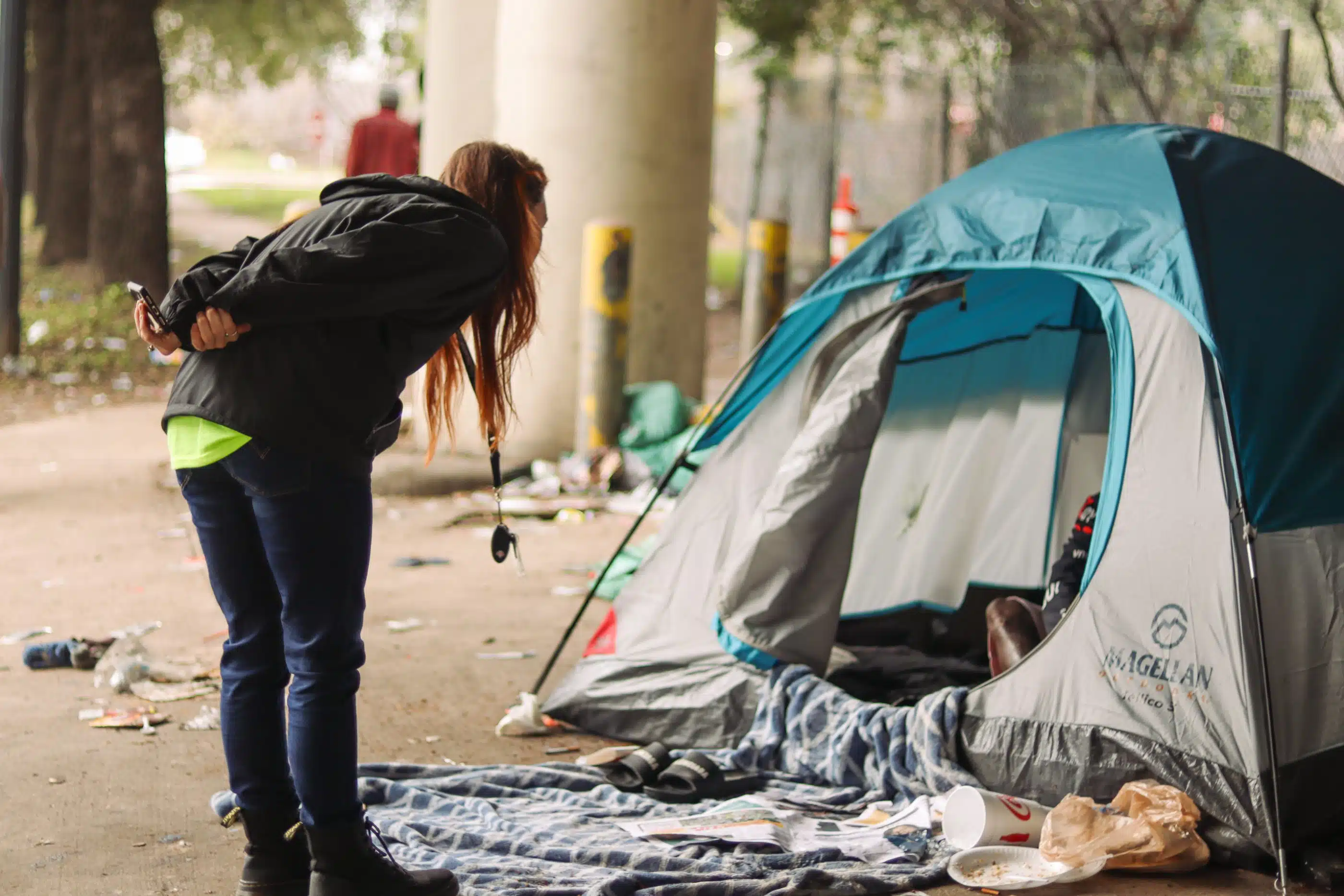
After the Trump administration tried to change the rollout of the federal government’s largest pool of funds for housing homeless people, court action has forced a return to the original funding plan—for now.
On Nov. 13, 2025, the U.S. Department of Housing and Urban Development (HUD) released a Notice of Funding Opportunity (NOFO) for its Continuum of Care (CoC) Program, which funds shelters, permanent supportive housing, and other responses to homelessness. It also said it would not renew two-year awards that were approved by Congress in 2024.
But on Dec. 23, 2025, a judge ruled that HUD would have to return to the original, Biden-era NOFO—pending a final order—and on Jan. 9, 2026, HUD reinstated the original NOFO. For now, legal action has halted a funding plan that would have forced shelters to discriminate against transgender people, encouraged criminalization, and redirected funding from permanent supportive housing to temporary shelter systems. The National Low Income Housing Coalition estimated that the changes would have put 170,000 people at risk of homelessness.
Inside HUD’s Notice of Funding Opportunity
HUD’s 2025 Notice of Funding Opportunity—since rescinded and shut down by a judge—was in the amount of $3.9 billion, higher than the $3.6 billion in funding available last year. But this number was deceptive, according to Deborah Thrope, deputy director of the National Housing Law Project: HUD pulled some of its other funds for permanent housing, instead pooling them into Continuum of Care funds that were tailored to prioritize temporary housing.
The notice had a January deadline. Many providers said the rapid timeline would be implausible, especially since programs were being asked to drastically change their offerings within months.
“This administration basically waited until the last minute, changed it, and now they’re saying we’re going to get funding up and running in March, but that’s wholly unrealistic,” Thrope told Shelterforce/Next City before the judge’s ruling.
Subscribe to Shelterforce
Sign up for our free newsletter and get our original reporting, new series, and more in your inbox.
According to a summary from the National Alliance to End Homelessness, the $3.9 billion funding notice included $100 million originally designated for developing permanent supportive housing and $294 million of Section 231 funds, which provide mortgage loans for building and rehabilitating housing for seniors and/or people with disabilities.
Agencies, nonprofits and other designated providers applying for federal funds under the now-canceled notice could apportion only 30 percent of those funds toward permanent housing projects. Any amount exceeding that 30 percent had to go toward transitional solutions, such as shelter.

HUD also said it could reject projects that have “racial preferences,” use “harm reduction,” or use a definition of sex “other than binary,” according to the National Alliance to End Homelessness.
Most concerning to many of the providers applying for grants is that HUD moved the majority of its grant funds to a more competitive classification, giving the agency greater discretion over who receives funding. In the past, about 90 percent of funds, while technically competitive, were renewed as long as projects met all of HUD’s requirements.
To Thrope and others, the added discretion meant that the Trump administration could dangle funding to strong-arm counties and agencies into adopting its other agenda items—and potentially use it to punish jurisdictions with which the administration is in conflict.
“The administration can pick and choose winners and losers. It’s very alarming, because we know there are certain jurisdictions that are being a bit bullied by the administration right now,” Thrope said before the judge’s December ruling. “There’s a huge fear that some of the funds would be taken away from Continuum of Care [programs] in jurisdictions that allegedly don’t comply with the ideology of this administration.”
At a webinar held by Monarch Housing Associates for New Jersey housing providers on Dec. 17, 2025, Melissa Bellamy, who heads Middlesex County’s Division of Housing, Community Development, and Social Services, expressed alarm at the new requirements.
Bellamy said most providers already had the option to use transitional solutions like shelters, but they chose permanent housing instead because it’s more successful. Those who shifted to transitional services, she said, shifted back when they didn’t work.
[RELATED ARTICLE: Why Aren’t Homeless Shelters Accommodating People Who Have Disabilities?]
Bellamy also said that the notice created requirements that agencies had no control over, like immigration enforcement and criminalization. In many cases, she added, new rules banning the language of diversity, equity, and inclusion contradicted what was requested by funding notices published under Biden’s HUD only a year earlier.
“It’s disheartening to see what we’ve built up blown to pieces,” Bellamy said on the webinar. “You’ve taken away one of the biggest tools helping people exit the system.” She said providers were frantically seeking bridge funding, assuming that HUD funding would be delayed.
Raisa Rubin-Stankiewicz, a policy associate at New Jersey Coalition to End Homelessness, told Shelterforce/Next City prior to the December ruling that for providers, “it’s been absolute chaos.” She said that some of the providers the coalition works with focus exclusively on permanent supportive housing and rely almost entirely on federal funding.
“The kind of cuts that you’re talking about to permanent supportive housing, there isn’t something there to fill that gap,” Rubin-Stankiewicz said. “And the people who are in permanent supportive housing, oftentimes those are the hardest people to rehouse.”
In a statement sent to legislators and shared with Shelterforce/Next City, New Jersey nonprofit housing provider HABcore estimated that, “based on historical timelines,” funding under the November NOFO would likely not have arrived before June 2026, months after the nonprofit’s current funding runs out on Jan. 31 of this year. In the letter, Steve Heisman, HABcore’s executive director, also estimated that his organization would have ended up with 9 percent of its previous funding levels.
Lawsuits and Arguments
At the end of 2025, two lawsuits were filed challenging HUD’s 2025 NOFO. A lawsuit was filed in November by the attorneys general and governors of 20 states, including Arizona, California, New Jersey, New York, and Vermont, alleging that it was illegal to alter the program so drastically without congressional authorization and that the last-minute changes would cause immediate harm by delaying funding. According to the lawsuit, changes in HUD’s November notice of funding “threaten to cancel thousands of existing projects, require providers to fundamentally reshape their programs on an impossible timeline, and essentially guarantee that tens of thousands of formerly homeless individuals and families will be evicted back into homelessness.”
It also called the move away from the Housing First model, or barrier-free permanent supportive housing, “arbitrary and capricious,” alleging, “Defendants have made no effort whatsoever to explain their utter abandonment of Housing First policies and sudden cap on permanent housing.”
The 20-state lawsuit called on the judge to halt the new one-year notice and reinstate the two-year notice released by the Biden administration. It pointed out that the McKinney-Vento Act of 1987, which established HUD’s homeless funding, and the 2009 HEARTH Act, which amended it, specifically single out permanent supportive housing as an evidence-based solution that should be incentivized by the CoC Program.
“This directly reflects a Housing First approach that is centered on permanent housing, including permanent supportive housing, without preconditions regarding employment, sobriety, or the like,” the lawsuit stated.
A second lawsuit was filed on Dec. 1, 2025, by organizations including the National Alliance to End Homelessness and the National Low Income Housing Coalition; the cities of Boston, Tucson and San Francisco; and the county of Santa Clara. The suit alleged that, “The late-stage decision to rescind and replace the original two-year NOFO is unlawful, even without considering the unlawful terms of the new NOFO.”
According to the lawsuit, HUD missed a statutory deadline in June 2025 for announcing a new funding competition. The lawsuit argued that HUD’s funding changes would slash funding for permanent supportive housing by two-thirds and that they would shift “funding to disruptive and punitive models that are contrary to well-established and proven strategies that reduce homelessness.”
In response to both lawsuits, which were consolidated into one trial in the Rhode Island District Court, HUD rescinded the one-year NOFO on Dec. 8, 2025, the day of the first hearing. Lawyers argued that it was a clear attempt to cancel the proceedings.
On Dec. 10, 2025, Congresswoman Maxine Waters released a statement about the notice’s cancellation, saying, “While I am pleased that the Trump Administration was forced to back down this time, unfortunately, many local programs may now face an even longer gap in funding, which also puts lives at risk. These communities cannot wait. HUD must move quickly to renew existing grants under last year’s rules, so families do not lose the housing support they depend on.”
The Judge’s Decision, and What’s Next for Homelessness Funding
Rhode Island District Court Judge Mary McElroy was clear that the government’s rescission letter issued prior to the hearing would not cancel the ongoing trial.
HUD made no attempt to defend the provisions of the rescinded funding notice or its restriction of permanent supportive housing funds, instead arguing broadly at a hearing on Dec. 19, 2025 that it did not have to consult Congress before making large changes to the program. Judge McElroy was not persuaded.
Zane Muller, an attorney representing the states suing HUD, said that programs were already turning away homeless people because of uncertainty in funding.
HUD’s attorney said the government was “working diligently” to file a new NOFO and that it would be filed before the close of business that day. McElroy issued a preliminary injunction blocking HUD’s use of the November NOFO, but allowed the agency a chance to submit a revised version, which HUD posted that evening, with the disclaimer that the agency understood it couldn’t be implemented or enforced due to the preliminary injunction. The notice made some changes to the previous version, according to an analysis by the National Alliance to End Homelessness. It created two separate sets of deadlines for applications, with an extended deadline for permanent housing and a shorter deadline for most other projects. New permanent supportive housing projects would no longer be constrained by the 30 percent funding cap.
Judge McElroy was clear that the drastic changes the government attempted to implement under the last notice were illegal, ruling in a written preliminary injunction on Dec. 23, 2025, that HUD had to honor the terms of the original, Biden-era 2024–2025 NOFO and reinstate full funding for the next year. HUD is complying. But the agency has also made clear that it will return to the NOFO issued on Dec. 19, 2025, if permitted by future legal action.
Meanwhile, providers remain in a state of unsurety, awaiting a final court decision. But for now, the 2024–2025 funding notice is open for applications.
This story was published through a collaboration between Shelterforce and Next City. Next City is a nonprofit news outlet that publishes solutions to the problems that oppress people in cities, inspiring social, economic, and environmental change through journalism and events around the world.
About the Author


We are contacting you because we have a documented story of corruption within the Hudson County courts and multiple Jersey City agencies involving housing enforcement and tenants’ rights. Court officials and city agencies have failed to carry out enacted housing laws, ignored written records, and allowed eviction proceedings to continue while legally required protections are not provided.
We have documentation showing agencies refusing to enforce housing laws, courts engaging in blatant misconduct assisting landlords, and tenants losing housing while public institutions avoid accountability. This is a record-based story showing how state and local housing laws are being neutralized in practice through misconduct, official inaction and concealment.