



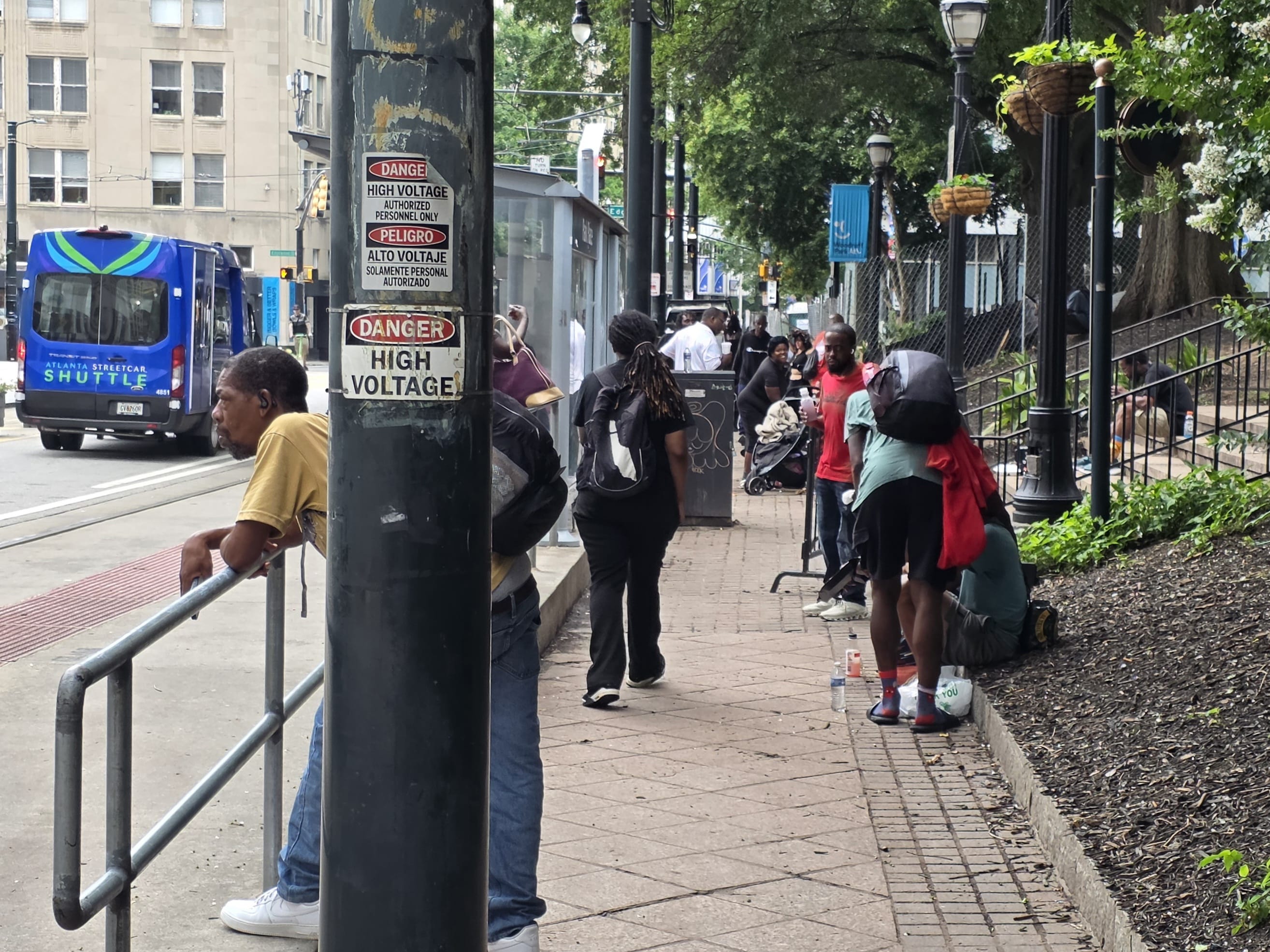
Nearly two years ago, the Supreme Court ruled in City of Grants Pass v. Johnson that jurisdictions can criminalize sleeping outside, even when there is no adequate shelter. The June 2024 ruling created ripple effects across the country, as state and local governments unleashed increased aggression in tearing down encampments and destroying people’s belongings.
While many Democratic elected officials tried to posture as opponents of the ruling, some gloated. California Gov. Gavin Newsom seemed to celebrate the ruling with a photo op in which he destroyed a homeless encampment. In his newly released memoir, he writes that he believes addressing homelessness requires both “the carrot and the stick.”
Experts tell Shelterforce/Next City that the overall trend has been a marked increase in policies increasing the criminalization of public homelessness since the Supreme Court’s ruling. But they also point to some promising interventions that have made headway or are in their early stages.
Some cities and states have introduced bills or passed laws to minimize the decision’s impact by declining to criminalize public camping, revamping public spaces to be less hostile, and addressing the root causes of homelessness.
Gloria Johnson Act
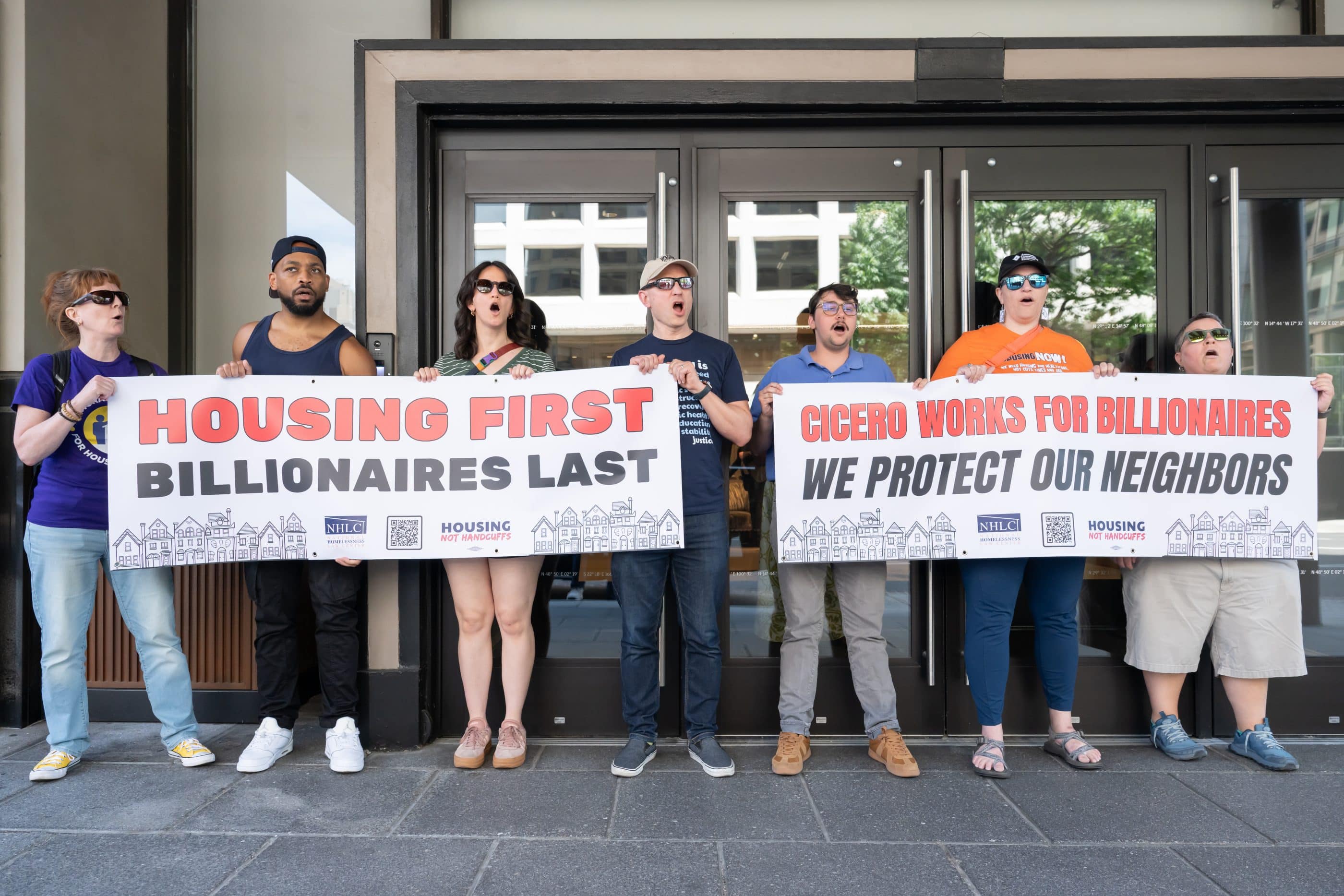
At the federal level, the National Homelessness Law Center (NHLC) is still trying to get traction for the Housing Not Handcuffs Act, introduced in June 2025. Despite its more than two dozen cosponsors, the bill has still never received a hearing, according to Jesse Rabinowitz, campaign and communications director at NHLC.
The Housing Not Handcuffs Act would protect homeless people from being arrested or otherwise penalized for conducting “life sustaining activities on public land.” The bill defines these activities as “moving, resting, sitting, standing, lying down, sleeping, protecting oneself and personal property from the elements, eating, and drinking.” It would grant the same protections against search and seizure for property stored on public land as belongings stored in a private dwelling.
While I think it’s a long shot, I don’t think it’s impossible. … People recognize that the solution to homelessness is housing.”
Jesse Rabinowitz, National Homelessness Law Center
Under the act, conducting life-sustaining activities on public land would not be permitted if someone has access to “adequate alternative indoor space,” which the law defines as a space that is accessible; free of charge; that does not restrict a person’s rights; and that allows the person to remain with pets, relatives, and partners (regardless of marriage status). It can include so-called tiny homes or similar structures that meet set requirements.
The bill faces long odds. Republicans hold majorities in both the House and Senate, and although many in the party paid lip service to more compassionate policy, multiple Democrats sent amicus briefs asking the Supreme Court to take up Grants Pass.
“While I think it’s a long shot, I don’t think it’s impossible,” Rabinowitz says. “People recognize that the solution to homelessness is housing.”
A similar state- and local-level model legislation—also crafted by NHLC—called the Gloria Johnson Act, is yet to be passed. The legislation is intended for communities that wish to enshrine the status quo as it existed in the 9th Circuit prior to the Supreme Court’s Grants Pass ruling: Criminalization of homelessness would be illegal “in the absence of adequate alternative housing and shelter.”
State and Local Encampment Decriminalization
Other places have taken their own approaches to bills that decriminalize public camping, independent of the Gloria Johnson Act.
In July 2024, one month after the Grants Pass ruling, the Los Angeles County Board of Supervisors reaffirmed its policy against criminalizing homelessness and using county jails to enforce anti-camping ordinances.
Yet the city of Los Angeles was one of the California jurisdictions that filed an amicus brief urging the Supreme Court to take on Grants Pass. The city has since moved forward with aggressive encampment removals under its CARE+ program and Mayor Bass’s signature Inside Safe program.
Despite his public support for the Grants Pass decision, Gov. Newsom signed legislation in October that prevents the criminalization of people providing aid to homeless people. According to CalMatters, the law comes after the city of Fremont’s brief criminalization of “aiding, abetting or concealing” a homeless encampment. Within a month, the city council gave in to pressure and changed this language.
In Maryland, a bill partially based on the Gloria Johnson model legislation was introduced by State Delegate Jessica Feldmark in February 2025 but stalled after its first reading.

In January 2025, Illinois introduced House Bill 1429, based on the Gloria Johnson Act; it has 31 cosponsors as of May. The bill prohibits the arrest of people experiencing unsheltered homelessness for “engaging in life-sustaining activities” on public property. This is defined in the first version of the bill as “moving, resting, sitting, standing, lying down, sleeping, protecting oneself from the elements, eating, drinking, and storing such personal property as needed to shelter oneself.” It was amended and re-referred to the Rules Committee in April.
Unlike many similar bills, this bill does not explicitly include exceptions to its protections based on available shelter space. But the first version of the bill defines “unsheltered homelessness” as “lack of access to a legally operated indoor shelter or other temporary residence that is appropriate and safe.”
The first version of the bill created a “necessity defense” for people who have been criminalized for conducting “life-sustaining” activities while “experiencing unsheltered homelessness.” If an attorney invoked this defense, the onus would be on the defense to prove the individual is homeless. But the first amendment to the bill removed this provision, according to Claire Sloss, director of strategic and policy communications for the Chicago Coalition to End Homelessness (CCH).
The latest amendment to the bill would also create a subcommittee in the Office to Prevent and End Homelessness to facilitate a plan to remove encampments on state property “if removal is necessary.”
People experiencing homelessness deserve to be treated with dignity and respect, not penalized for simply trying to survive.”
Illinois Rep. Kevin Olickal
The latest version of the bill was approved by the state House of Representatives in April. “This [new version of the bill] neutralized opposition from the Illinois Parks [and Recreation] Association and [Northwest Municipal Conference], making us more optimistic about the path forward, but we understand that we may need more time in the House,” Sloss told Shelterforce/Next City in an email.
According to CCH, “Before and since the US Supreme Court decision, local governments in Illinois have had the power to make people move from public spaces when necessary, using a variety of local ordinances—this legislation does not change that.” The coalition says Illinois has a shortage of more than 5,300 shelter beds and 10,900 permanent supportive housing units.
In an emailed statement to Shelterforce/Next City, Illinois Rep. Kevin Olickal, who introduced House Bill 1429, said it was a response to the Grants Pass decision. Since the decision was handed down, he said, 40 municipalities across Illinois have introduced measures to increase fines and criminalization of unsheltered homelessness.
“This is not the way to address homelessness, particularly at a time when housing costs and rents are rising sharply, federal funding for homelessness services is being cut, and more people are being pushed into unstable housing situations,” he said. “People experiencing homelessness deserve to be treated with dignity and respect, not penalized for simply trying to survive. We know what works: a Housing First model that prioritizes stable housing and supportive services, not punishment.”
In Pennsylvania, lawmakers announced a plan for legislative action immediately after the Supreme Court’s ruling. In November 2025, they introduced a “Shelter First” approach through two bills, Senate Bill 1089 and House Bill 2028. The bills would make it illegal to enforce public camping bans unless there is “adequate indoor alternative space” that accommodates any disabilities; personal property; and partners (regardless of marriage status), family, and pets.

According to Natasha Cahill, communications director for state Sen. Nikil Saval, who introduced Senate Bill 1089, “there seems to be a real possibility that [House Bill 2028] will come to a full vote on the House floor,” although the timeline is unclear. The Senate version of the bill has been assigned to the judiciary committee and “there are no current plans to bring this bill for consideration” there, Cahill says.
“It’s clear that this is an initiative that people want to see enacted. We know that an effective response to homelessness will take all levels of government, and our hope is that municipalities might use this as a blueprint for their work even as we build political will at the state level,” according to an email from Natasha Cahill.
Following the Grants Pass decision, the city of Pittsburgh initially declined to remove a homeless encampment until credible offers of shelter could be made despite the encampment violating city guidelines requiring six feet of distance from a public right-of-way, according to CBS News. The encampment was eventually removed when encampment residents were moved to either shelter or permanent housing.
Banning Hostile Architecture
Proposals in multiple states have attempted to ban the practice of “hostile architecture,” or intentional design decisions that make it difficult to sit or lie down outside to dissuade homeless people from sleeping.
A Connecticut law passed in November 2025 as part of a broader comprehensive zoning update is the first to ban hostile architecture in the country, according to the National Housing Law Project, which tracks laws pertaining to homelessness.
The provision bans towns and cities from installing hostile architecture in any publicly owned or accessible building. The bill also includes a pilot program to provide portable showers and laundry facilities to people experiencing homelessness, which requires at least three shower trailers and three laundry trucks.
An earlier version of the proposal, House Bill 5002, would have required towns to submit affordable housing plans, similar to requirements in New Jersey, but was vetoed by Gov. Ned Lamont last year.
According to Jessica Kubicki, chief initiative officer at the Housing Collective, a Connecticut-based nonprofit that advocated for the law, the affordable housing plan requirement was removed after Gov. Lamont received pushback from town and city lawmakers concerned about their “autonomy.” But Kubicki says the veto of that earlier version of the legislation may have led Gov. Lamont to add the ban on hostile architecture as a conciliatory gesture.
“I think it kind of worked in our favor,” Kubicki says.
Connecticut’s annual Point-in-Time count for unsheltered homelessness increased by 45 percent between 2024 and 2025, Kubicki says, which also led to increased pressure to address the issue.
“This felt like a little bit of a small win,” she says. She notes that the state does not have much hostile architecture as it stands, but the law will prevent the trend from taking hold.
According to Partnership for Strong Communities, which advocated for both bills, the law also provides increased rental assistance, first-time homebuyer plans, and grants to encourage housing growth near public transit. Additionally, it allows public housing authorities to use bond funds to develop “middle housing” and permits the state housing finance authority, local housing authorities, or nonprofits to buy homes and keep them in an affordable trust.
A bill banning hostile architecture was introduced in Washington in 2024 but never made it to a vote. A Massachusetts bill that would ban hostile architecture targeting homeless people was introduced in February 2025, but it has not seen motion since December of that year. It is the third such attempt, following similar bills introduced in 2021 and 2023. Like the Connecticut law, it would ban hostile architecture in publicly accessible buildings or property owned or controlled by the municipality.
Correction: This piece has been updated to reflect that Illinois House Bill 1429 would not create a state Office to Prevent and End Homelessness, which is already established. The subcommittee required by the bill would be tasked with a plan to remove encampments only on state property. It has also been updated to correctly identify the people in the images provided by the Pennsylvania Senate Democratic Caucus and the amount of time passed since the SCOTUS decision.
This story was published through a collaboration between Shelterforce and Next City. Next City is a nonprofit news outlet that publishes solutions to the problems that oppress people in cities, inspiring social, economic, and environmental change through journalism and events around the world.
About the Author


Comments