


Atlanta promises a welcoming World Cup for everyone. But just days before kickoff, homeless advocates worry the city lacks the safety net needed to keep unhoused residents from being displaced or jailed amid the influx of hundreds of thousands of visitors.
The concern is not just that Atlanta lacks enough units to house everyone. (That’s typical of a major city grappling with mounting homelessness.) The greater fear is that Atlanta’s alternatives to arrest—outreach, shelter access, and pre-arrest diversion—are so strained that the city cannot absorb the pressures of a global event. If tourists or downtown businesses respond to visible homelessness by calling the police, activists warn, Atlanta could return to the strategies employed in 1996.
Back then, in the lead-up to the Olympic Games, Atlanta built a jail. In the 18 months before the festivities, thousands of poor people were arrested on minor charges, many of them unhoused. Others received one-way bus tickets out of town. Allen Hall, who was homeless during the Olympics, summed it up in an interview with Atlanta Civic Circle: “The jails became homeless shelters.”
With housing scarce and supportive services stretched thin before the World Cup, advocates worry that the more than 3,000 Atlantans without stable housing could face a police crackdown, even if city leaders never explicitly order one.
The city has repeatedly vowed not to further criminalize poverty to polish downtown and its environs for well-to-do visitors who might be unaccustomed to unsheltered people. But choosing not to criminalize homelessness requires political will, coordination, and resources. Advocates say Atlanta is short on all three.
Last June, Mayor Andre Dickens pledged to “make sure those unsheltered individuals don’t come anywhere downtown, and throughout the city of Atlanta.” He added, “If you break the law, we have measures to deal with that like any other lawbreaker.”

To advocates for unhoused people, that framing leaves an eye-popping amount of room for police enforcement against people whose homelessness already makes them more likely to be cited or arrested for conduct that housed people rarely have to consider: sleeping outside, sitting too long in a public place, walking in the road, trespassing, and urinating outdoors when bathrooms are unavailable.
“Atlanta has gone out of its way to focus so much on our World Cup guests that [the city is] willing to do that to the detriment of our neighbors experiencing homelessness,” says Tiffany Roberts, the public policy director for the Southern Center for Human Rights (SCHR). “It’s a lot like what happened before the Olympics.”
To its credit, the city recently completed an unprecedented “rapid housing” program, creating 500 apartments for unhoused people in about two years. It now has almost 2,400 permanent housing units citywide and nearly 2,800 shelter beds, according to Cathryn Vassell, CEO of Partners for HOME, the lead agency in Atlanta’s Continuum of Care network.
But capacity is not the same as availability. Most permanent housing units are already occupied. Shelter beds may be full; restricted by household type or eligibility; or unusable for people who cannot safely stay in congregate settings, have pets or partners, or fear losing their belongings. And the latest federally mandated Point-in-Time headcount of Atlanta’s homeless population—which found 3,060 people unhoused citywide, over a third of whom were unsheltered—is widely considered a vast undercount.
That leaves overlapping problems: Atlanta does not have enough permanent housing to end homelessness for everyone, and even its temporary options may not be sufficient— or accessible enough—for the unsheltered people most likely to encounter residents, tourists, and police during the World Cup.
“Common sense will tell you that those people, if they’re not going to be here, are either going to be bussed out of the city to other cities in the South or be arrested and put in jail,” says Matthew Nursey, organizing director with Housing Justice League. “We know this because Atlanta [and Fulton County] did exactly that during the 1996 Olympics.”
That frustration is compounded by the ongoing encampment removal operations across the city over the last year. Between May 2025 and May 2026, the city and its homeless services partners relocated 490 unsheltered people from more than 30 locations in and around downtown into housing, says Annie Hyrila, Partners for HOME’s chief program officer. The number of people who did not ultimately receive housing assistance, however, is unknown, reflected only in Atlanta’s latest Point-in-Time Count.
The Legacy of a Deceased Tent City Resident
Atlanta’s recent approach to tent communities is shaped by the death of Cornelius Taylor, an unhoused man killed in January 2025 when a city bulldozer ran over his makeshift home during the destruction of an encampment. His death spurred procedural reforms, including new safety checks and clearer protocols for removals. But advocates say those changes do not address a larger question: Why are people being forced to move when the city still cannot provide enough stable places for them to go?
Roberts says the city’s public posture—that its recent homelessness work is not about the World Cup but about connecting people to housing—is undercut by its own policies. She points especially to the Atlanta Police Department’s (APD) Homeless Outreach Proactive Enforcement (H.O.P.E.) unit, whose standard operating procedures, she says, center on clearing encampments and bringing in police enforcement when people cannot or will not move.
APD declined to make the H.O.P.E. team’s commander, Maj. Jeff Cantin, available for an interview, but says in a statement that “We will enforce the law when safety concerns require it.”
But internal documents and communications obtained by SCHR and reviewed by Shelterforce depict the H.O.P.E. team as an operation limited by business hours—the team works only between 7 a.m. and 4 p.m. on weekdays—and largely driven by nonemergency “disturbance” calls, including complaints about people sleeping near businesses or eating out of trash cans. Essentially, the H.O.P.E. team shows up when people feel uncomfortable around unhoused residents and want something done—but its officers rarely request help from the Policing Alternatives and Diversion Initiative (PAD), which is supposed to be the city’s go-to arrest alternative.
Emails and other public records also underscore tensions between the city and PAD. A ledger of the H.O.P.E. unit’s January 2025 calls for service, for instance, revealed that a police officer seeking assistance sheltering someone was told that the city “is no longer working with PAD” and that the H.O.P.E. team was unavailable that evening.
That call occurred during a contract dispute among the city, Grady Memorial Hospital, and PAD, which ultimately led to PAD’s reactivation but left it unable to assist at downtown’s Center for Diversion and Services, a Grady-operated facility where police can bring people instead of booking them into the local jails. Grady previously subcontracted with PAD and the Georgia Justice Project to provide case management and legal services at the center, but it did not renew PAD’s contract for 2026 and 2027.
PAD was originally funded to facilitate about 40 daily diversions—reroutes from a jail cell to supportive services—but “more often than not, less than 10 are actually being done” because coordination between the city and PAD has fallen apart, says PAD executive director Moki Macías.
“PAD continues to provide case management services to 150 people on our caseload, and we continue to accept diversions from law enforcement and jail,” Macías says. But without the renewed contract, PAD has stopped accepting referrals from the diversion center because it no longer has funding for intake staff there, she says.
“We have not had intake staff at the center for the last two months, which means that people diverted to the center are no longer being connected to PAD services,” Macías says. “Diversion away from jail without connection to community-based services is not diversion; it is just a nicer revolving door.”
“Atlanta is not ready, in part, because the city is attacking everything that is not within its own system,” Roberts adds.
That strife reflects the law enforcement–centric approach advocates for unhoused people say will shape the World Cup.
“If you look at the Downtown Rising plan and … the standard operating procedures for the H.O.P.E. team, what you see is [that] the primary goal is to remove people from encampments and to use enforcement to do that,” Roberts says. “If people can’t be housed, then the directive is essentially to jail them if there’s probable cause for an arrest.”
According to APD, the department and Grady “continue to operate the Center for Diversion and Services to reduce arrests for non-violent offenses associated with mental health challenges, substance use, homelessness, and extreme poverty,” The APD statement says that in May alone, the center diverted 155 people from arrest “to immediate care and long-term support services,” and that between January 2025 and June 2026, APD officers completed 1,885 diversions.
Nonetheless, Fulton County Superior Court Judge Robert McBurney echoed advocates’ concerns in an interview with The Atlanta Journal-Constitution, saying the city’s plan to “eliminate” unsheltered homelessness through outreach and housing initiatives before the World Cup could result in mass arrests, “solely to make the city look nice.”
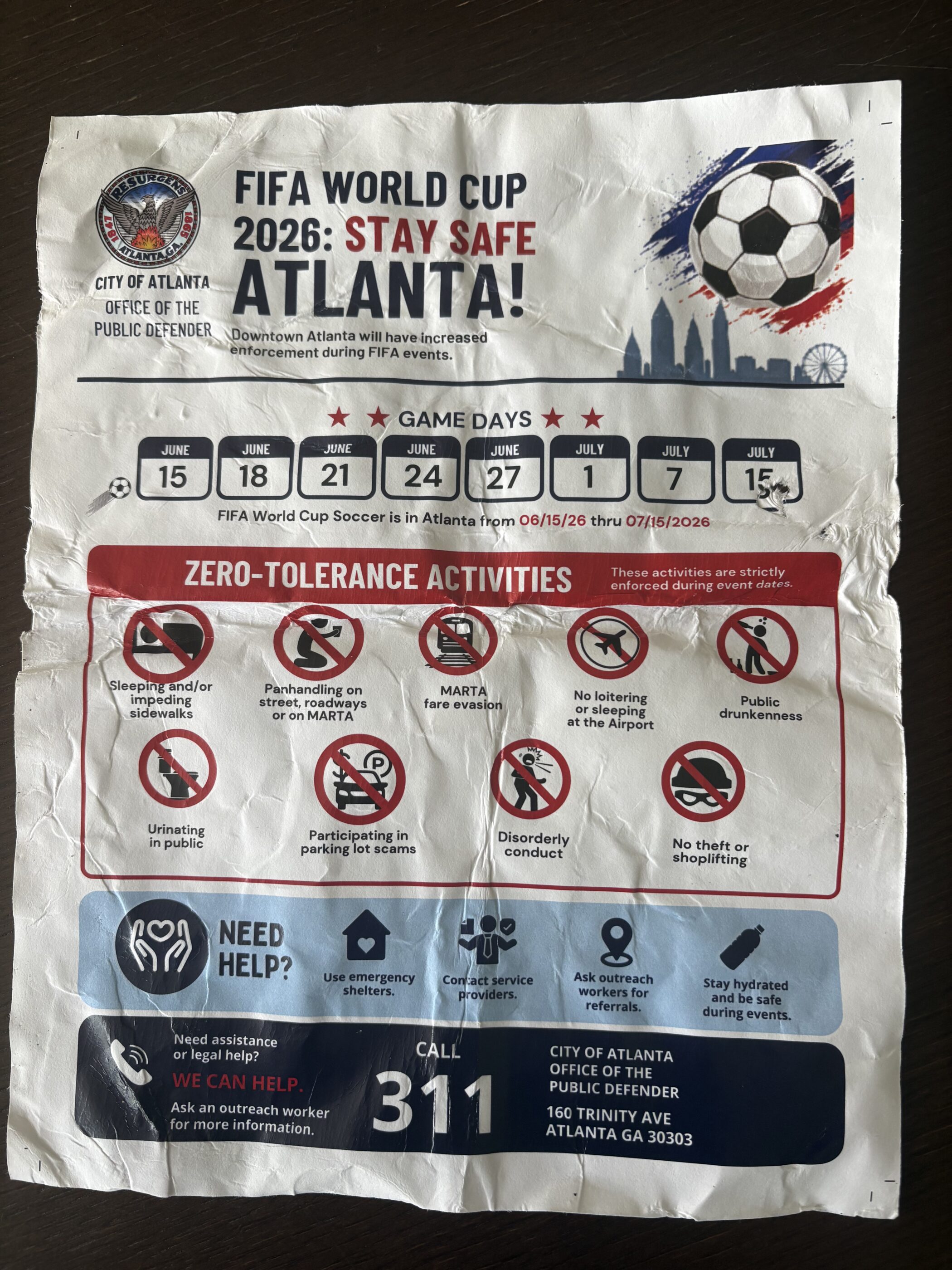
Since early June, Atlanta’s public defender’s office has been distributing flyers in homeless communities warning of “increased enforcement” against what it calls “zero-tolerance activities,” including sleeping on sidewalks, panhandling, and public urination—so-called quality-of-life offenses that unhoused Atlantans are especially vulnerable to being charged with.
Chief Public Defender Kenneth Days says the flyers aren’t meant to threaten a police crackdown on homelessness; they’re meant to put houseless residents on notice: “I don’t think the intention is that there’s some kind of plan to arrest more people or use this as an opportunity to arrest anybody, but I think [the flyer] gets the message across that any behavior that might normally be tolerated may not be during such a large-scale event.”
APD spokesperson Chata Spikes says the department was “not aware that this flyer had been created or distributed and therefore cannot speak to the reasoning behind the use of the term ‘increased enforcement.’”
‘Hostile Architecture’
That gap—between available resources and what’s happening on the ground—matters because the World Cup could bring thousands of visitors who may not recognize the difference between a public safety emergency and visible poverty.
“You’re exposing, in the case of Atlanta, 3,000 people to people from across the world who don’t know how to respond—who think [that] calling the police or informing law enforcement will mean they’re going to be treated humanely,” says Jonathan Alingu, co-director of Central Florida Jobs with Justice who has assisted with Miami’s World Cup preparations. “Culturally, we know that’s not the case.”
The threat is already visible, advocates say, in downtown planning conversations.
A February email from Vassell to top city officials described months of meetings with downtown stakeholders who were “strongly opposed” to creating a navigation center—a place where unhoused people could be connected to services.
In another email, Vassell asked city officials to consider removing workout equipment from Woodruff Park—a hot spot for unhoused people just east of the stadium where matches will take place—and installing planters along the park’s water fixture, which she called a “huge priority to reduce sitting/lounging on the ledges.”

Those emails do not show the city ordering people to be driven out of downtown for the World Cup. But they do show that business and civic stakeholders have pressured city officials and homelessness leaders to close encampments, increase police capacity, and make public-space changes meant to discourage people from lingering in one of downtown’s most prominent parks.
Vassell says Partners for HOME has not called for removing unhoused people from downtown and insists there is “no talk or plans” to bus or arrest people during the World Cup. The focus, she says, is “heightened outreach, support, and access to shelter and cooling centers.”
She defends the Woodruff Park changes as part of an effort to make the park accessible for everyone—not just a haven for people experiencing homelessness.
“Some would call it ‘hostile architecture,’” Vassell says. “I think, in general, a planter with flowers is a way to reduce the amount of people just hanging out and sort of taking over the park.”
She says Woodruff Park has become a focal point because of a “density problem,” including open-air drug use and sales, gambling, and unsheltered people congregating in a place where public bathrooms have often been unavailable.

“We’re stuck between a rock and a hard place,” Vassell says. “We are intentionally focused on getting people off the streets and into housing. We’re also trying to have a balanced approach that takes into consideration the residents and the students and everybody else [who] would love to walk through Woodruff Park and not smell urine and feces [or] … feel unsafe.”
For advocates, though, that is exactly the problem: The city can promise compassion, but once the goal becomes making public spaces comfortable for visitors, the people who have no private place to go become the obstacle.
“What we’ve seen downtown is, unfortunately, a little bit of a blurring of the lines between outreach for the sake of getting people connected to care and outreach for the sake of getting people to not be in public view,” Macías, with PAD, says.
An Anti-Homeless Law—and a Possible Counterweight
In just the past few months, the legal landscape in Georgia has become more punitive. This spring, Gov. Brian Kemp signed House Bill 295, a state law that allows property owners to seek compensation from local governments they argue have failed to enforce certain laws, including bans on public camping, loitering, panhandling, drug possession, and shoplifting. Advocates say this will pressure local governments to prioritize enforcement over housing and services, especially in places like downtown Atlanta.
The World Cup, they say, could become a proving ground for that pressure.
Jennifer Li, leader of Dignity 2026, a national coalition advocating for more compassionate World Cup planning, says mega-events don’t directly create homelessness, but they magnify the consequences of already strained systems.
In that vein, Li says, the World Cup could become a “threat multiplier” for people whose lives on the streets already leave them disproportionately vulnerable to arrest.
That’s why advocates celebrated a recent policy change in Fulton County.
Devin Barrington-Ward, a member of the criminal justice reform coalition Communities Over Cages, says the group helped pressure Fulton County leaders and Sheriff Pat Labat to limit misdemeanor bookings at the county’s infamously dangerous Rice Street jail.
The change, announced by the sheriff’s office in May, is not a new law but a booking policy set to take effect July 1, during the tail end of the World Cup. Under the policy, the jail will stop accepting most people arrested on non-violent misdemeanor charges. County officials have said between 200 and 300 people are incarcerated across Fulton County’s four jails on any given day for misdemeanor charges—from jaywalking to criminal trespass to domestic violence—and the new policy is intended to drastically reduce the number of people locked up.
But Barrington-Ward warns that it won’t be effective unless the city and county fully fund and utilize alternative options. “We can’t risk creating a door to nowhere by turning people away from being booked at the jail, but then not providing those services for people to get stabilized,” he says.
The Bigger Picture
As World Cup crowds descend on Atlanta for the city’s first game on June 15, the specter of the 1996 Olympics looms. Will we default to mass arrests? Will unhoused residents who are uprooted be able to return? Will Atlanta learn from the mistakes it could be making? The anxiety felt in the so-called Capital of the South is familiar to activists nationwide.
Li, of Dignity 2026, says human rights planning has fallen by the wayside in many World Cup host cities preparing for the explosion of visitors.
“What we see instead are these superficial measures to sweep problems under the rug and to hide the problem of homelessness, rather than fix it,” she says.
Alingu, with Central Florida Jobs with Justice, says that’s especially visible in Atlanta, Houston, Kansas City, Miami, and other cities where community groups have asked for clearer plans; more nonpolice outreach; increased shelter and cooling capacity; public bathrooms; harm reduction resources; storage for belongings; hotel rooms or other temporary placements for people displaced by the event; and public data on arrests, citations, and encampment clearings during the tournament. “We have the means. We have the resources. We have the human talent to help organize and mobilize people into housing and shelters,” he says. “We just don’t have the coordination that’s required to do that.”
Planning conversations, Alingu explains, are dominated by FIFA representatives seeking little more than tourist amenities rather than policy solutions to lingering challenges such as homelessness. In other words, the problem is not purely financial or political; host committees, local governments, law enforcement, service providers, and community advocates are not in lockstep, leaving police to fill the vacuum.
At this point, advocates say the most realistic best-case scenario may be modest: no mass arrests, no surprise encampment clearings, no displacement masquerading as outreach, and no one shoved out of sight just because the world is watching. Simply put, let unhoused people exist.
That would not solve homelessness. But it could prevent the World Cup from making life worse for people already living in crisis.
The consequences of getting it wrong can outlast the tournament: an arrest record that makes housing or employment harder to secure; a tent, medication, documents, phone, or family photos lost during an encampment clearing; a person pushed away from outreach workers who know them; a fragile support network broken because a public place became inconvenient for visitors.
The World Cup fracas will eventually leave town, says Li. The stadiums will empty, the fans will fly home, and the TV cameras will turn elsewhere. But the consequences for unhoused people in Atlanta and beyond could last far longer.
By moving them out of sight, “you’re not actually fixing the problem,” says Li. “You’re just temporarily putting them in timeout, [causing] extreme harm to the people who are being detained.”
About the Author




Comments