


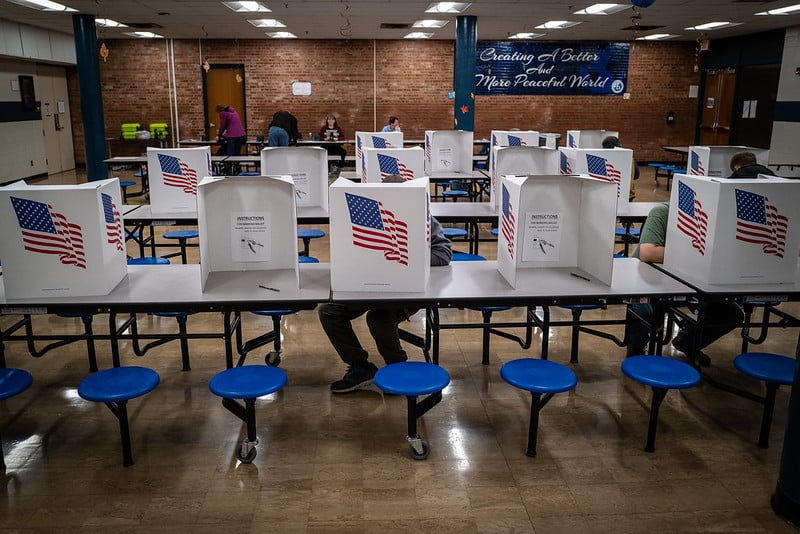
On Nov. 4, Americans headed to the polls, stressed about their rent and historic levels of homelessness, among other things. And it showed: Voters mostly approved ballot measures that addressed affordable housing plans. The details of those ballot measures range from straightforward to convoluted. But one thing that’s consistent is that a decades-long decline in federal funding to produce deeply affordable housing is increasingly pushing locals to find funds anywhere they can to pay for it and to loosen regulations to build it.
California
In Santa Cruz County, voters approved Measure C, a proposal to fund “workforce” housing, simultaneously rejecting a similarly named proposal pushed by the Santa Cruz County Association of Realtors.
The ballot measure, officially called the Workforce Housing Affordability Act of 2025, will impose a $96 annual parcel tax and an increased real estate transfer tax on home sales above $1.8 million. It is expected to bring in $4.5 million a year. The money goes into the city’s affordable housing trust fund and will fund the construction of social housing, new affordable units, preservation of affordable units, planning of affordable housing, and more. A portion will also fund permanent supportive housing for people experiencing homelessness.
Real estate industry stakeholders designed Measure B earlier this year directly in response to this proposal, according to Lookout Santa Cruz, while Measure C was developed through a two-year process involving multiple housing stakeholders. Though similarly structured, Measure B would only tax transfer sales above $4 million and would reduce the parcel tax to $50 a year.
Colorado
In Denver, residents voted to increase municipal bond debt by $59.3 million to pay for new housing, including affordable housing in shared structures with libraries, and making housing and homeless shelters accessible for people with disabilities.
Denver Ballot Measure 2E was part of a slate of five successful ballot measures that will cumulatively issue $1 billion in debt for infrastructure, and, according to Axios, repayment costs of $2 billion over time, all of which will be paid back by property taxes. If enough new properties are developed as a result of the ballot measures, the newly generated property taxes could theoretically help pay for the significant bond debt.
The ballot measures received nearly $2 million in support from donors.
In the ski resort town of Vail, a ballot measure to increase taxes on short-term rentals from 10 percent to 16.8 percent was narrowly defeated. If passed, the tax would have brought in $7.2 million a year in revenue to be used for new housing, according to the Colorado Sun. Meanwhile, the nearby town of Basalt—also a hub for outdoor enthusiasts—voted to raise its tax on short-term rentals from 4 percent to 6 percent. The proceeds will go to fund affordable housing.
Residents of Louisville, Colorado, rejected two ballot proposals, one of which would have restricted residential rezonings in three properties but created an exception for projects with 30 percent affordable set-asides. Another would have allowed development fees to pay for a wider range of infrastructure, including affordable housing.
New York
Three of six ballot measures New York City residents voted on were related to housing. Voters approved all three measures, which circumvent City Council approval for housing projects in different ways. Housing organizations took different stances: The Association of Neighborhood Housing Developers (ANHD) asked voters to approve one of these measures, Ballot Proposal 2, while the Met Council on Housing and grassroots tenant organizations like Crown Heights Tenant Union asked voters to reject all the proposals. Former Gov. Andrew Cuomo and now Mayor-elect Zohran Mamdani both said they’d vote for all the proposals—though Mamdani, who has a long connection to New York’s tenant movement, only revealed his selections on Election Day. The ballot proposals were created through a charter revision commission convened by Mayor Eric Adams and have been vociferously opposed by City Council, which sent out mailers and called for a review of the charter revision process. (While the ballot proposals mentioned below are the only ones that dealt exclusively with housing, NYC Charter Commission spokesperson Casey Berkovitz told Shelterforce/Next City that a proposal on digitizing city maps—which also passed—would speed up housing approvals as zoning changes will no longer have to be made to physical maps in borough offices.)
Ballot Proposal 2, which ANHD supported, creates a narrow set of circumstances where publicly financed housing that is 100 percent affordable and created by Housing Development Fund Companies would skip the city’s typical seven-month-long land use review process and City Council vote and will instead be sent to the Board of Standards and Appeals for approval. That proposal also allows affordable housing projects in the 12 community districts that produce the least affordable housing to skip City Council review, instead receiving final approval at the City Planning Commission—a board whose members are appointed by the mayor, along with one appointee from each of the five borough presidents and one from the public advocate. This board is currently staffed by urban planners, professors, a housing activist, architects, and a hedge fund CEO, but could see six new appointees under the Mamdani administration.
Ballot Proposal 3 similarly skips city council review and the longer Uniform Land Use Review Procedure process for “modest” housing projects and minor infrastructure projects to “prepare the city for extreme weather or other future challenges.” The language on the ballot did not define modest or small, although that is defined in a charter revision commission report; for low-density neighborhoods, it includes multifamily housing that is up to 45 feet high. For medium and high density neighborhoods, this includes projects that increase the residential density by 30 percent or less. The language leaves open the possibility that contentious projects like the East River Park debacle (which garnered massive backlash that died down upon re-opening) could get approved more quickly.
Berkovitz says the language was not on the ballot because, “ballot language is limited in length by state law, and getting into height/density specifics wouldn’t have been legible to most voters even if there was room.” He says that the commission tried to direct voters to educational materials through their website Charter.nyc, which they linked to on social ads and included on mailers.
Ballot Proposal 4 creates an “Affordable Housing Appeals Board” consisting of the mayor, city council speaker, and local borough president to approve an affordable housing project rejected by the City Council, including those that meet the requirements of the city’s Mandatory Inclusionary Housing law, which can include projects with mostly market-rate units. Only two-thirds of members would need to approve, meaning in theory the City Council could be frozen out of the process entirely. All of the ballot measures retain community board input, which is purely advisory.
City Council approval is a crucial part of New York City’s housing development process. The threat of veto is often used to push for deeper levels of affordability than developers initially propose. This is a frequent demand from working-class and poor tenants who associate luxury housing with gentrification and displacement, an assessment supported by granular studies on the uneven benefits of housing production.
Changing the way that communities provide input on the production of new housing requires policymakers to navigate the way that class and power in the city work. Under former Mayor Bill de Blasio, rezonings to produce more housing density mostly occurred in lower-income neighborhoods, as more affluent neighborhoods had the political will to deflect both affordable and market-rate housing. While the threat of a City Council veto can help communities negotiate for deeper affordability, in theory it can also act as a tool for upper middle class and affluent residents to exclude lower-income residents from their neighborhoods. According to the New York Housing Conference, in 2024, 11 districts produced less than 400 units of affordable housing while 4 added more than 1300. Some districts, including Gale Brewer and Linda Lee’s districts, added 0 units of affordable housing, while council speaker Adrienne Adams’s district added only 2 units of affordable housing.
Adams told Hell Gate in October that the council approves 93 percent of all proposals that come before it. Berkovitz from the Charter Commission told Shelterforce/Next City that developers told the commission in public hearings and private settings that they did not propose affordable housing in districts where the council member was likely to veto it.
For decades, activists in New York City have been attempting to empower working-class tenants seeking deeper affordability while also circumventing affluent residents resisting affordability. It’s an issue that requires nuance—or a comprehensive city plan, a major part of Mayor-elect Mamdani’s campaign platform. None of the ballot measures address these questions head-on, instead side-stepping the process with speedier bureaucracy, but they’ve all passed and the city’s housing activists will have to work within their guidelines.
[RELATED ARTICLE: Photos: New York’s Rich History of Housing Activism]
Ohio
In Cleveland, voters can select housing court judges to deal with tenant disputes and building code violations, although those judges aren’t allowed to say much about how they approach cases.
Judge Cheryl Wiltshire won against incumbent W. Moná Scott in an election where the main dispute was over unionized bailiffs, according to Signal Cleveland. Wiltshire, who is endorsed by the police union, told the outlet that Scott should have renewed a collective bargaining agreement for the housing court bailiffs, who organize with the same union as police officers. Wiltshire also questioned Scott’s judgment in criticizing prosecutors for not being aggressive enough in bringing building code violations.
Wiltshire will now play a key role in the city’s effort to hold out-of-town property owners and investors responsible for their properties. In response to a survey question from Signal Cleveland about how judges should address this issue, Wiltshire said: “Individuals and/or entities must come to Court if summoned, and if they don’t, then the court should use all of the tools in its tool box to bring them to Court. That means that the Court should be making use of what currently exists: the Corporate Docket, the ‘Clean Hands’ Docket and Warrant Docket where appropriate.”
Tennessee
In Knoxville, a half-percent sales tax increase that would have gone to, among other measures, $10 million for affordable housing, was voted down.
The tax would have amounted to $7 a month for families making $40,000-49,000, WBIR 10News reported. But after years of inflation, the price tag seems to have been too much for residents, some of whom did not feel that the city had presented a clear enough plan for spending. “We have to find ways to do it. I’m just not as supportive of the administration or transparency,” a voter told WBIR 10News.
Although the mayor announced in June that one of the benefits of the change would be to fund affordable housing, it was only days before the election that the city council approved a resolution to spend 22 percent of the expected revenue on affordable housing.
Washington
In Bellingham, a city 90 miles north of Seattle, residents passed a referendum that protects the right of tenants to assemble without retaliation from landlords. It also protects tenants’ ability to report conditions to the government, inform other tenants of their rights, or bring civil action without retaliation. Under the measure, retaliation includes threatening to evict a tenant, threatening to call government agencies to report a tenant for being undocumented, or refusing to renew a lease as a result of tenant organizing.
This story was published through a collaboration between Shelterforce and Next City. Next City is a nonprofit news outlet that publishes solutions to the problems that oppress people in cities, inspiring social, economic, and environmental change through journalism and events around the world.
About the Author


Oddly I think, for Ohio, you left out that the City of Columbus approved a bond issue to raise $250,000,000 for affordable housing & related community development costs.