


The Virginia Housing Coalition (VHC) and the Virginia Coalition to End Homelessness (VCEH) both began in the early 1980’s as grassroots statewide advocacy organizations. They supported each other’s work and had their own policy and legislative agendas. Though there had been some conversation over the years about merging, neither of our groups were willing to actively engage in a process because we felt our missions would be diluted.
Over the last ten years, as solutions to homelessness have evolved from short-term to long-term strategies, the homeless service industry shifted emphasis from shelters to permanent affordable housing. More and more, the lines between homeless service providers and housing providers blurred, as many homeless service organizations began creating affordable housing for their clientele and many housing organizations began housing homeless individuals and families. Before our merger, VCEH and VHC worked closely on the establishment of a State Housing Trust Fund, which had a set aside for homelessness and funding for other homeless programs like Permanent Supportive Housing and Rapid Rehousing.
In the Fall of 2013, a few board members from each group, the executive director of VCEH, and the contractor managing VHC met to preliminarily discuss the possibility of joining forces, but it wasn’t until a year later that a merger was seriously explored. VCEH hired an interim director and applied for and received a capacity building grant to hire a consultant to facilitate a potential merger.
In the Fall of 2014, the boards voted to explore a merger and appointed a Merger Study Committee comprised of Board members and staff from VCEH and VHC. Members on the mailing lists of both organizations were surveyed for input on the merger and stakeholder meetings were conducted by the merger consultant to gauge any potential pitfalls.
After analyzing the survey results and stakeholder meetings, the committee felt strongly that joining forces was in everyone’s best interest, and so a joint board meeting was held the following spring to review a drafted merger agreement and decide whether or not to proceed.
One of the benefits that accrued from the long dialogue process was that it gave time to work through concerns raised along the way—and there were many.
Foremost among them was the worry that the special focus on homelessness that VCEH brought might be lost when integrated into a broader affordable housing message; and some from VHC had the opposite concern—that broader housing issues might be overshadowed by the urgency of homelessness. Others were worried that the smaller number of board members would result in less grassroots involvement and support. Some felt that resources would decline, as people who had donated to both organizations in the past would reduce their overall giving to a merged organization. The merger team reviewed and analyzed all of these concerns, and approached their task with the attitude that they didn’t want to lose a single supporter as a result of the merger. The final result very nearly met that goal.
A merger plan was refined over the summer of 2015, and with a name change to the Virginia Housing Alliance (VHA), members unanimously agreed and the boards approved the legal documents in November of 2015 to be effective January 1, 2016.
Advantages in a new alliance
The integration of our two groups resulted in a number of positive outcomes that will allow VHA to have an even greater impact than the combined efforts of the two original organizations.
1. Perhaps the most important outcome is the opportunity for the Alliance to present a unified voice to the Governor, the members of the General Assembly, and local and Federal officials. While VHC and VCEH had cooperated on aspects of their legislative agendas in recent years, there was inevitable confusion among legislators about the objectives of the two groups.
2. In addition to strengthening its advocacy voice, the merger brought together complementary programs and activities. For many years, VCEH ran a strong technical assistance (TA) program that included training on rapid re-housing and assistance with applications for local continuums for federal and state assistance. VHC focused more on state and federal housing policy and advocacy—organizing successful state and federal housing education days each year in Richmond and Washington. It also maintained a larger membership base.
3. The new organization is far more financially sustainable. At times both VCEH and VHC struggled to raise money, but over the past several years had developed more reliable funding sources. Now the combined group is strong enough to support a staff of seven including a new executive director, that is working on policy, training, communications, and events that are attracting new and expanded financial support. The steady staffing has already allowed the organization to amplify awareness of its work and raise its profile with both providers and policy makers.
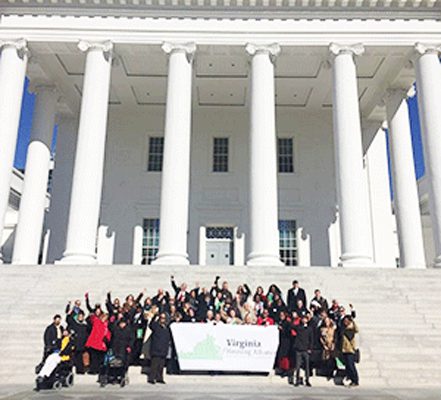
The future of affordable housing education and awareness in Virginia looks brighter than ever due to our well planned and timed merger, and the Virginia Housing Alliance is already making waves in our state. On Thursday, February 11, 2016, it convened more than 100 housing and homeless service advocates in Richmond for Housing Day, its annual lobby day at the General Assembly.
(Photo: Virginia Housing Alliance convenes for Housing Day, 2016. Courtesy of VHA)
About the Author



Comments