


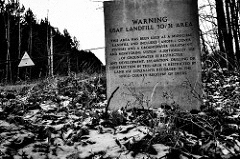
 It’s probably the worst Superfund site in the U.S.: a smoldering fire in a mismanaged landfill is less than 1,000 feet away from a radioactive waste dump in Bridgeton, Missouri.
Experts predict that the fire could reach the radioactive waste within months, potentially causing a “Chernobyl–like” event. Children and adults are getting sick and some are dying from exposure to radioactive and other dangerous wastes. A state health authority study found over a 300 percent increase, above what would be expected in the population, of childhood brain and central nervous system cancers.
If an explosion happens, the first response is for people to “shelter in place,” by closing windows in their homes, schools or workplaces. But toxic fumes, and possibly particulate matter, could spread throughout the region and potentially force people into shelters or to evacuate, according to the county’s emergency plan. Those who live in surrounding neighborhoods would be directly affected.
Understandably, local activists are becoming increasingly afraid and angry.
A coalition of St. Louis mothers has been a highly effective, all-volunteer group of local parents fighting for their families health and safety. They’ve mobilized every week with rallies, demonstrations, pickets, online petitions, and fly-ins to Washington, and have received national media attention for their efforts—they were recently featured on the CBS news hour three times in one week. State and national environmental groups like the Missouri Coalition for the Environment and the Center for Health, Environment and Justice (CHEJ) have worked with Just Moms STL, the Franciscan Sisters of Mary, and other local players for several years to help boost their organizing efforts.
So where's Superfund? The U.S. Environmental Protection Agency (EPA) has been supervising the site for years, but has not yet created a plan of action. Many of the local activists, including Just Moms STL and the Missouri Coalition for the Environment (MCE) want the Army Corps of Engineers to take over the site and to remove the waste. Both groups want those who live within one mile of the waste to have an immediate option to move as well as a property assurance option for those within five miles of the waste, which the U.S. EPA could do under the auspices of Superfund.
It's incredible that no action has been taken by the U.S. Environmental Protection Agency (EPA) to secure the site. Missouri's congressional delegation filed a bipartisan bill in both houses of congress to have the site's clean-up transferred to the Army Corps of Engineers, who is already cleaning up several nearby sites with Manhattan project radioactive waste. (When you see Senators as ideologically opposed on most issues as Senators Blunt and McCaskill and Representatives Clay and Wagner acting as a well-coordinated team, you know how deadly serious this problem has become). You can help by signing this online petition to get Governor Jay Nixon of Missouri to declare a state of emergency.
It's clear that EPA must act, and act quickly. Residents joke that if they had food poisoning, they could get medical assistance and immediate help from the Food and Drug Administration, FDA. But this is no joke, the EPA must be more effective. People's lives are depending on it.
(Photo credit: Mike Fritcher, via flickr, CC BY-NC 2.0)
About the Author

Great job Laura! Thank you for all of your hard work and dedication, we are lucky to have you!!