


 [Editor's Note: This is our friend and regular Rooflines blogger Laura Barrett's last post as campaign director of Gamaliel. Laura will continue posting to the blog as the new director of the Center for Health, Environment & Justice, and we look forward to reading her thoughftul and challenging posts in that new role.
For a roundup of Laura's past posts, click here. We're also very pleased that Gamaliel will continue to contribute its unique perspective to Rooflines.]
President Obama is doing more than speaking out for criminal justice reform, he is taking action.
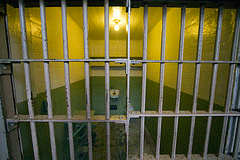
Earlier this week, President Barak Obama took decisive and impressive action by commuting the sentences of 46 non-violent drug offenders. This was the most commutations in one day in over 40 years. He told the crowd at the NAACP convention that he would call for a review of solitary confinement and a reduction or an end to mandatory minimum sentences.
It seems like the campaign to end solitary confinement, pushed by WISDOM, the National Religious Campaign Against Torture and other groups, is gaining some momentum.
It's a becoming a bi-partisan movement and even Republican presidential candidates are getting on board. New Jersey Governor Chris Christie is focusing on non-violent drug offenders. Senator Rand Paul (R-KY), wants to restore voting rights to nonviolent felons who have served their terms. Senate Judiciary Committee Chair Chuck Grassley (R-IA) has staked out mandatory minimums. Senator Rob Portman (R-OH) and Senator Sheldon Whitehouse (R-RI) are promoting a bill to help lower-risk inmates win earlier release. . .
The movement has a local face in the St. Louis area:
– The Ferguson Commission headed by Rich McClure and Rev. Starsky Wilson is promoting 57 separate reforms, many of them focused on the criminal justice system.
– St. Louis County Executive Steve Stenger has endorsed a plan to consolidate police departments. Stenger, who governs a county with 57 police departments, is casting policing as a public health issue, according to the Post-Dispatch.
– In just one session, the Missouri legislature, a notoriously slow-moving group, passed Sen. Bill 5 and Governor Jay Nixon just has signed it. It limits the traffic revenue that small cities like Ferguson can collect, which will eventually lead to the consolidation and professionalization of municipalities, courts and police departments.
What will this mean to those of us who are still hoping for real substantial change before the one year anniversary of Mike Brown's killing and the beginning of the Black Lives Matter movement? These are all steps in the right direction, but so much remains to be done.
At this juncture, let's remind ourselves of Margaret Mead’s sage and hopeful observation: Never doubt that a small group of thoughtful, committed citizens can change the world. Indeed, it is the only thing that ever has.”
Activists: continue to protest and work for policy change until systemic racism is ended and the “beloved community” that Dr. King spoke of becomes a reality.
(Photo credit: By Flickr user Chris Miller, CC BY 2.0)
About the Author

Comments