


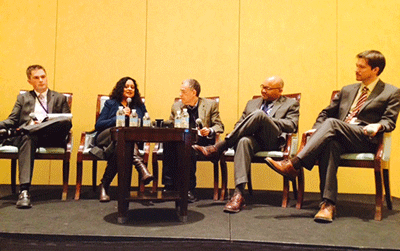
 I go to a lot of conferences. I enjoy them, generally, as places to get to talk to all the great people doing great work in the field. But also sometimes they can blur into one another.
People and Places, which took place March 4-6 in Washington, D.C., was different.
In many ways it looked like a fairly traditional conference—plenary panels, tracks of workshops, keynote speakers at meals.
But the difference was in who planned it, who was there, and the subjects they were open to talking about. The conference was planned and hosted jointly by four national organizations: National Alliance for Community Economic Development Associations (NACEDA, the national membership group for state and regional community development networks), National Coalition for Asian Pacific Islander American Community Development (CAPACD), National Association for Latino Community Asset Builders (NALCAB), and the National Urban League.
This partnership was truly exciting. While the leadership of NACEDA, CAPACD, and NALCAB knew each other and had collaborated before somewhat, their members had less cross-over. And with the National Urban League, the overlap has been even slimmer, so there were a lot of new relationships being started in those halls.
On a very basic level, the partnership of these organizations meant no more looking around a conference room and thinking “Why is this panel/audience so white?” It meant experienced, talented organizers and community developers speaking to audiences who hadn’t seen their organization go by on conference panels several times before. It meant that discussing “leadership development” and future of the field evoked a sense of optimism, not hand-wringing, given the evidence of new leaders all around us. And it meant that we talked about race—openly, seriously, both in sessions devoted specifically to the topic and other times when it just came up.
At one a session, for example, on small business lending and immigrants, an African-American woman asked the panel about dealing with tensions among merchants of different ethnicities along a commercial corridor, including between native-born people of color and immigrants.
She got interesting answers from several people, including a panelist from Asian Americans for Equality about how they organized a multiethnic chamber of commerce in a neighborhood in Queens and someone from the Latino Economic Development Corporation in Minneapolis about creating a building in which organizations serving different populations could co-locate and start learning to work together. (We’ll be diving into each of these stories here at Shelterforce in coming months.)
The panel and small group discussion that happened after it on race and community development was one of the most powerful parts of the conference. The panel touched on many things, including the difficulty of getting explicitly social justice oriented work funded, the detailed work of helping two communities who distrust each other come together and increase their understanding, and as, Miranda Jones of Better Family Life in St. Louis noted, the idea that “You can’t heal Ferguson without healing the region.”
There was a huge amount of discussion at and after that session about both the need to reinvigorate community organizing work, and about the need and potential for different groups of people of color to work together. One conversation between an African-American woman and a South Asian woman about the profiling and targeted violence experiences in the Muslim and African-American communities, and how they needed to recognize that common, horrible experience and not perpetuate it on each other, brought tears to the eyes of many, many people in the room.
I think that I and many others left invigorated and feeling hopeful about the possibility of a more unified field that might actually at some point reclaim the mantle of “movement,” as NALCAB’s Noel Poyo encouraged the group to do in the opening discussion, hosted by Shelterforce‘s publisher, Harold Simon.
We’ve asked a number of people to write for us about some of the things they shared and learned at People & Places over the coming months, and we look forward to learning more about where the relationships and conversations that were started or strengthened there lead us.
If you were there and have stories or observations, share them with us as well!
(Photo credit, courtesy of Shelterforce. Pictured: Frank Woodruff, NACEDA; Seema Agnani, National CAPCD; Harold Simon, Shelterforce; Cy Richardson, National Urban League; Noel Poyo, NALCAB)
About the Author
Comments