


 This op-ed originally appeared in the St. Louis Post Dispatch on October 8, 2014.
Recent events in Ferguson constitute the logical outcome of forces spelled out in 1968 by the National Advisory Panel on Civil Disorders, better known as the Kerner Commission. The report warned of a “permanent division of our country into two societies: one, largely Negro and poor, located in the central cities; the other predominantly white and affluent, located in the suburbs and outlying areas.”
Cities have not become pockets of black poverty surrounded by prosperous white suburbs. But the reality of uneven development documented in the Kerner report persists in the nation’s metropolitan areas. Central features of that development are persisting racial segregation and surging economic segregation.
To understand recent events in Ferguson, and similar tension around the U.S., we need to go beyond an understanding (accurate or inaccurate) of individual or cultural characteristics (e.g., work ethic of minorities, culture of poverty among the urban poor, racial prejudice on the part of police) and examine the institutions that shape continuing uneven metropolitan development.
While nationwide, most measures of segregation peaked in the 1970s, hypersegregation persists in older industrial cities where the African-American population is concentrated, what Brown University sociologist John Logan labeled the ghetto belt, including Washington, Cleveland, Chicago, St. Louis and many others.
Meanwhile, economic segregation, like economic inequality generally, is surging. As the Pew Research Center reported, between 1980 and 2010 the share of low-income census tracts (where most residents have incomes below two-thirds the national median) in the nation’s 30 largest metropolitan areas grew from 12 percent to 18 percent. The share of upper-income tracts (where the majority had incomes double the median) grew from 3 percent to 6 percent. Poor people and rich people are living increasingly apart.
These are not simply cold numbers. In poor neighborhoods, schools are more likely to be failing, poverty and unemployment rates are higher, racial profiling and mass incarceration turn ordinary citizens into criminals, banks are few but payday lenders and other predatory financial services are prevalent, food deserts persist, and many other social problems are concentrated. These problems are spilling into suburbs like Ferguson where the Brookings Institution reported the poverty level doubled between 2000 and 2012, reaching 25 percent, and unemployment jumped from 5 percent to 13 percent. Context matters.
These are among the institutional forces generating tension across many segments of the nation’s metropolitan regions. Compounding these pressures in Ferguson are the facts that while two-thirds of the population is black, the mayor, five of six City Council members, six of seven school board members, and 50 of 53 police officers are white.
Another key finding of the Kerner Commission was that violence was often triggered by an encounter between the police and ordinary citizens in neighborhoods where the police had long been mistrusted and feared. In Ferguson, such an encounter tragically ended in the death of Michael Brown. We should not be surprised.
And there is no surprise regarding next steps. Demilitarizing and diversifying the police force are essential. But it is equally important to counter the uneven development of communities.
Elimination of exclusionary zoning ordinances in St. Louis (and virtually all metropolitan areas nationwide) keeping low-income people out of prosperous communities and stronger inclusionary zoning laws creating more economically and racially integrated neighborhoods would be a start.
Policies fostering balanced urban communities and discouraging climate-destroying sprawl should follow, including a national urban policy that invests more in mass transit and less on highways. Transit-oriented development (encouraging construction of homes and location of businesses near mass transit) and location-efficient mortgages (providing lower-cost loans near mass transit) are two approaches.
A tax system that does not privilege capital gains over wages would be a next step. The global wealthy tax Thomas Piketty called for in his celebrated book, Capital in the 21st Century may not be politically feasible today, but might be in a few years, or election cycles.
Uneven development remains the dominant force creating conflicts in Ferguson and throughout the nation’s metropolitan areas. Balanced, equitable development will reduce the number of distressed neighborhoods and, consequently, stereotypes attached to many urban residents, reducing police/community tensions and other problems. While it is important to understand and develop capabilities of the various players, it is equally important to understand and change the rules of the game.
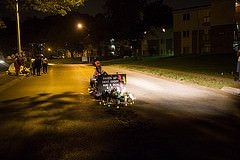
(Photo credit: Flickr user Youth Radio, CC BY-NC-SA 2.0)
Comments