


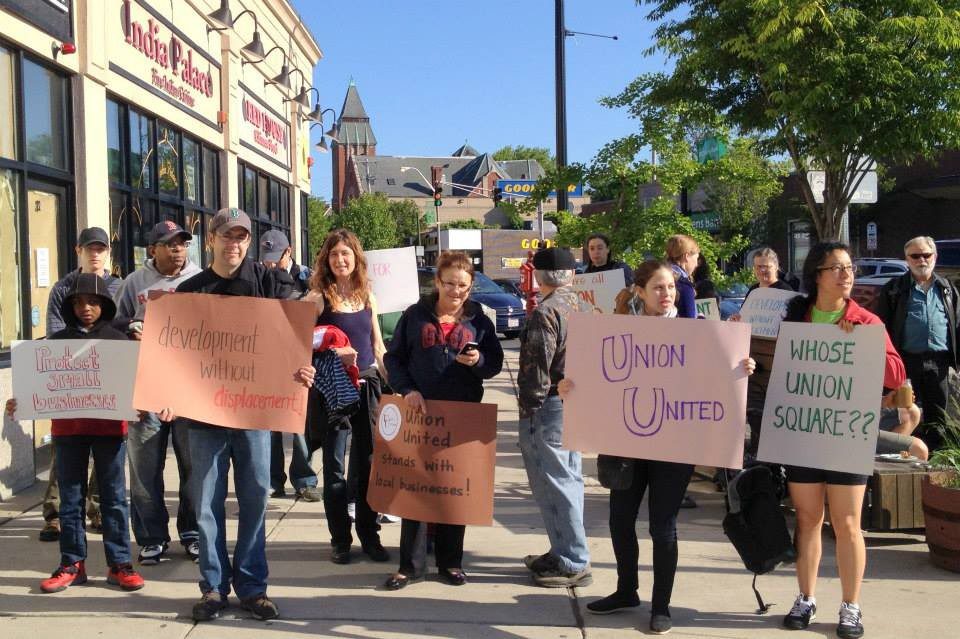
When Union United, a recently formed coalition of residents, local business owners, labor unions, and community and faith-based organizations in Somerville, Mass., read a local newspaper commentary about the proposed redevelopment of their neighborhood that didn't share their concerns about displacement, they saw it not as a disappointment, but as an opportunity to get the word out about their efforts to ensure that the community will benefit from the development.
The coalition’s published response, co-authored by six of its members, critiqued the article’s suggestion that the large scale of the transit-oriented development and the city’s expressed commitment to values-based, community-oriented redevelopment were sufficient to forestall gentrification.
The 18 coalition members who exchanged e-mails over five days and multiple drafts sought to speak truth to power. At the same time, the collective writing process allowed them to discover more about the truth, empower diverse constituents, and speak as a unified group whose members respect and learn from one another’s differences. They were writing truth for power.
This worked in several ways:
Writing to Discover: Writing the response was a process of discovering what is true and meaningful to the coalition members and the audiences they are trying to reach. Thanks to the collective writing process, each draft was more concise and powerfully worded. They also edited for accuracy. The final draft corrected the census figures for the percentage of foreign born residents and clarified evidence that increasing rents are already displacing residents and businesses.
Contributors also compared interpretations of official meetings to select the master developer for the project. The iterations of drafts translated concerns about the transparency of the process and accountability to the community into an expression of the coalition’s expectation to engage in constructive deliberation with the development team, public officials, the city-appointed advisory committee, and other resident groups.
Writing to Empower: Writing collectively was both a product and a practice of community organizing. The campaign strategy committee enlisted a community organizer from the Somerville Community Corporation, which is a member of Union United, to draft the first version. In addition to sending the draft out to the coalition’s growing e-mail lists for feedback, she encouraged constituents to voice their perspectives.
The final draft included a quotation from Dirce Silva, a local business owner who joined Union United to stay informed and support the community while ensuring that her business would survive and thrive as a result of the redevelopment.
Another contribution was an excerpt from a letter Ed Halloran, president of the Somerville Municipal Employees Association and co-chair of the Somerville Labor Coalition, sent to the nearly 700 union members he represents to introduce them to Union United and encourage them to get involved.
The invitation to write a paragraph of the response inspired Union Square resident Bridget Breton to articulate her desire for the neighborhood to remain a multicultural community where working families can enjoy affordable housing and places for their children to play. Writing gave Breton, a recent immigrant, the courage to speak publically at the Civic Advisory Committee’s convening to meet the lead staff of the master developer selected for the project.
Writing to Unite: The writing process also surfaced a diversity of perspectives and interpretations among the members. Differences often yield friction. But resolving differences respectfully may have made the coalition stronger. As one member suggested in an e-mail exchanged during the writing process, “As we go through the process, we’re going to have many areas we’ll disagree on. If our observations, analysis, and critiques are couched in negative terms, it’s harder to extract the meaning of what is being said. It’s much easier to understand criticism if it’s constructive and accompanied by suggestions as to how to make it better. It’s difficult crafting a letter by committee and we need to be respectful of each other as we go through this process.”
Union United members will have lots of chances to practice writing together. The Coalition is currently drafting a commmunity benefits agreement to ensure that the redevelopment plans include affordable housing, good local job opportunities, small business protections, other amenities, and a voice in the redevelopment process.
And conveying those proposed provisions to the developers, city officials, and other community members and negotiating the demands will likely involve even more writing.
(Photo: Union United members call attention to small business rent increases of 30-50% in the heart of Union Square in Somerville, MA on May 30, 2014.)
About the Author


Comments