


It took a few iterations, but HUD last week officially rolled out a demonstration project designed to showcase its plan to address the capital needs backlog in public housing by allowing PHAs to leverage private financing.
From HUD:
“In the near term, RAD [Rental Assistance Demonstration] is expected to preserve and enhance more than 13,000 units of affordable housing and generate more than $650 million in private capital to address the estimated $26 billion backlog in capital needs faced by public housing authorities in the U.S. This additional capital will also stimulate employment in the construction trades across the country.
RAD allows public housing agencies and private owners of certain at-risk, federally assisted properties to convert their current assistance to long-term Section 8 contracts. Such contracts will allow owners to leverage millions of dollars in debt and equity to better address immediate capital needs and preserve these affordable housing units. In addition, participating agencies are freed from antiquated public housing rules and restrictions that hindered their ability to best preserve and manage their housing similar to other affordable housing owners and managers.”
RAD was approved by Congress as a budget-neutral demonstration in Nov. 2011. There was considerable controversy over previous versions of the plan, known as PETRA.
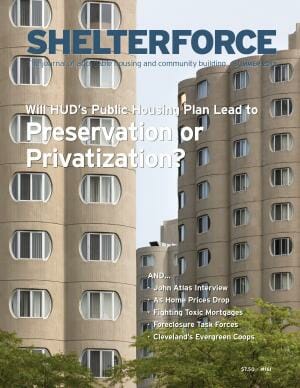
Shelterforce covered that debate in our Summer 2010 issue. Everyone agreed that something must be done, but many charged that there were not enough safeguards to ensure that public resources and assets would truly be preserved with the introduction of private debt, and some argued forcefully against it on principle.
In 2011, Rep. Keith Ellison stepped in with new legislation, the Rental Housing Revitalization Act, which tried to address many of the critics’ concerns. Though RHRA itself couldn’t gain traction, RAD was passed as an attempt to show it can work. Ellison spoke with Shelterforce about RAD in an interview last year, saying: “I think we need a little more time to see if the Rental Assistance Demonstration is scalable and if housing authorities can service the debt they incur when they leverage the private capital.
Here’s the reality: Public housing needs about $30 billion-something worth of investment. We have moldy facilities; we have elevators that aren’t working; people have been injured and killed. It’s just crazy. So bottom line is, if we can use RAD to get some real money to have good, decent, and nice places to live, we could be better off.
I mean, we’ve got to try things. Imagine being seven years old, walking upstairs in your public housing unit, and there’s no lights—or no heat. That’s just the reality that people are living in, and it’s a shame. So if the private sector can help, and we can retain ownership of that public asset, I’m willing to at least see if it’s workable.”
HUD approved 112 of 116 applications for the first round of RAD, which represents 11,910 units in 110 projects at 68 housing authorities, plus 343 units at two “moderate rehab” level projects. It also awarded 11 of 24 applications for rolling conversions of tenant-based vouchers to project-based vouchers at contract expiration.
HUD says the $650 million in leverage that RAD represents will create 9470 jobs:
-
- 4,895 Direct Jobs
- 1,565 Indirect Jobs
- 3,010 Induced Jobs
We look forward to hearing more about how RAD plays out where it’s being tried and invite those involved to weigh in with us about what they see.
About the Author



Comments