


Congregations that want to build affordable and supportive housing on their properties could benefit from a professional matchmaker.
It’s a daunting task to find responsible development partners and navigate yearslong construction timelines (and their associated costs), especially when church leaders have limited to even no affordable housing background and are dipping their toes into faith-based development—which has steadily gained traction across the country.
There are allies in this burgeoning space, intermediary organizations that are serving as a matchmaker of sorts for these congregations by connecting them with developers and equipping them with the financial and intellectual resources they need to help them realize their vision for housing.
One group doing this sort of work is the Interfaith Affordable Housing Collaborative, based in New York. The collaborative pre-screens houses of worship for viable development opportunities and offers education and planning resources before they engage with prospective development partners.
“Whereas developers come with a plan that they want to develop, we flip it around,” says Rashida Tyler, the collaborative’s project manager. “What does your community need? What do you need as a congregation? And from there, the profile is written, and you go out and you find who matches that profile.”
The collaborative believes it’s important for faith-based institutions to have a structured process like this on their side.
“It was really in response to seeing a lot of churches, particularly in New York City, [being] exploited by developers who basically came in and said, ‘Sign here, I’ll build what you want,’” says the Rev. Peter Cook, the collaborative’s vice president. “We just felt like faith-based institutions needed to have a structured process on their side to know how to work with developers.”
We spoke with several groups like the Interfaith Affordable Housing Collaborative to see how they’re helping congregations avoid exploitation, access funding, and navigate a long-term development process.
A Steep Learning Curve
Cook says there is plenty of enthusiasm among New York churches to pursue faith-based development to help meet the ever-growing demand for affordable housing; they just need guidance on how to do it.
Intermediary programs like the New York collaborative take houses of worship through a discernment process to articulate how they’re being called to serve their community, then an intensive training course on the affordable housing development process, particularly, what and who is involved, as well as the timeline.
After completion of the course, congregations decide on what some call the “go, no go” with development. That’s when the congregation’s stakeholders and decision makers—who likely have no familiarity with real estate development—decide together whether repurposing their land is right for them.
If they want to move forward, intermediaries will help congregations develop a project concept plan based on what’s feasible on their properties and in their communities, then create a request for proposals to solicit development partners. Next, Cook says, is “matchmaking” congregations with the right developer. The collaborative will also help negotiate an agreement that serves the mission and the financial needs of the house of worship.
Enterprise Community Partners, a national housing nonprofit, also offers guidance to houses of worship via its Faith-Based Development Initiative (FBDI). The program is designed to help congregations understand the development process, and access development experts and resources, “clergy coaching,” and grant funding to support pre-development work like market studies and feasibility analyses.
“How to run a pro forma, how to negotiate a land disposition deal, how to really think about doing community engagement and economic development—those are things that aren’t typically taught in seminary,” says David Bowers, Enterprise’s Mid-Atlantic vice president and senior advisor for the initiative.
But even though it’s a steep learning curve, he says, “we’re not trying to make clergy and lay leaders [into housing] experts but make them comfortable conversing.”
Access to Funding
Religious institutions that decide to develop housing on their land often have deferred maintenance on their properties, among other ailments, says Jill Shook, co-founder of Making Housing & Community Happen, a Southern California–based nonprofit that engages congregations to address homelessness and housing affordability. “They’re hurting,” Shook says, and need revenue to continue their service as a house of worship.
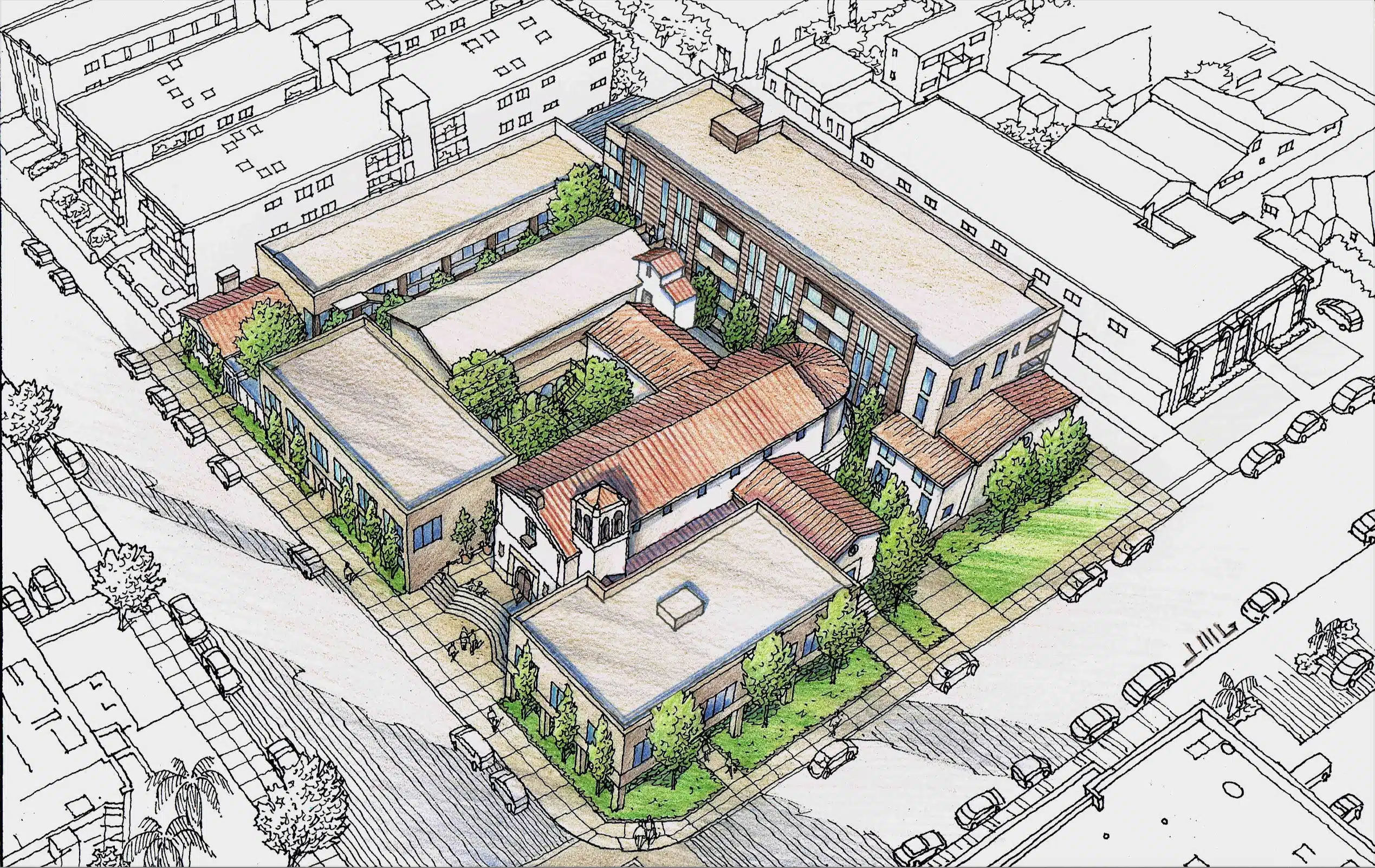
The nonprofit offered programming similar to FBDI’s through its Congregational Land Committee, which was recently launched as a separate nonprofit called Congregational Land Partners. The nonprofit not only guides houses of worship through pre-development technical support, but also often continues on as the owner representative during development. Its programming puts particular emphasis on empowering houses of worship to understand their value in the development partnership—and be properly remunerated for what their land is worth.
“We explain the different structures of the deal,” says Shook. “You can sell, you can do a joint venture, or you can do a long-term ground lease. And almost everybody chooses a ground lease because it’s a win-win.”
Ground leases are typically for 55 to 65 years, she says, and can be paid in one lump sum upfront or in installments over time.
“We highly recommend they don’t sell to the developer, because they’ll never get that land back. They don’t have control of anything anymore, but in some cases, that’s what they need to do,” Shook says. “Once in a while, they do a joint venture. We highly recommend they don’t, [because] when you put your land as collateral, then the church is totally at risk. If it’s not a good developer and it falls through, they’ve lost everything, so we warn them.”
Most faith-based institutions are land rich and cash poor, but even so, they bring far more to the table than they realize, she says.
“There are a lot of benefits for a developer to work on a church property,” says Shook. “They don’t have to buy the land, and they’re not paying on it the whole time that they’re doing pre-development. They don’t have to carry any of the insurance cost. All of that’s covered by the church.”
Faith-based development projects can also utilize tax credits targeting housing for specific populations—such as for homeless community members, seniors, or veterans—but religious institutions seldom cover the development costs on their own. Nor should they, says Shook.
“Why are they even doing that? They should be partnering with the right developer that knows how to get all the funding, and a developer should not be asking them for funding,” she says. “If they are expecting the church to raise money, it means they’re not a very good developer if they can’t even cover their own expenses.”
Still, as with any other affordable housing development, financing is a perennial issue—and the greatest challenge to faith-based development.
“We’re not immune to construction cost, and markets have been crazy,” says Evan Gerber, a developer and consultant for San Diego-based Yes in God’s Backyard, a group that also supports local religious institutions with technical support and access to funding. “So, we’re having to deal with that.”
A developer should not be asking them for funding . . . If they are expecting the church to raise money, it means they’re not a very good developer.”
Jill Shook, Making Housing & Community Happen
And as tariffs on construction materials and cuts to the U.S. Department of Housing and Urban Development magnify project costs, faith-based development faces an uphill battle to cover the expense.
Fortunately, local jurisdictions are beginning to remove the regulatory red tape that prohibited religious properties from being anything else. In the process, faith-based development laws are paving inroads into development where other types of affordable housing hit financial speedbumps.
California’s SB 4, which went into effect last year, is perhaps the most shining example of permissive legislation. The law allows “by-right” development to nonprofit colleges and religious institutions that want to build 100-percent affordable housing projects on their properties, fast-tracking development as it bypasses local permitting processes (so long as the project meets state-mandated criteria).
“From the affordable housing developers’ perspective, the benefit there is that when they’re talking to donors, they can say, ‘Look, we have this by-right, streamlined process. If we get the money, we know the development will happen,’” explained Mahdi Manji, director of policy at the Inner City Law Center, a Los Angeles-based nonprofit law firm that co-sponsored SB 4.
In Los Angeles, nearly 76 percent of religious land citywide could be eligible for redevelopment under SB 4, according to a city planning department report.
“If you’re talking about affordable housing, the biggest barrier continues to be funding, [but] the second biggest barrier is zoning,” says Manji. “At least now, there are some opportunities for it.”
The real expense for houses of worship to bear is in pre-development work, which often is enough of a cost burden to rule out the option altogether. Intermediaries step in here as well: The Interfaith Affordable Housing Collaborative offers up to $30,000 in forgivable loans to cover that work, and Enterprise’s FBDI offers grant funding for it. And, in some cases, as a developer and a community development financial institution, FBDI will also connect houses of worships with those other arms of the organization.
The Congregational Land Committee at Making Housing & Community Happen covered its pre-development technical support through grant funding, and the new nonprofit will do the same. Some of those costs can be recovered in the ground-lease agreement, but only if congregations make it that far into the process. The nonprofit assumes a large margin of risk while exploring with congregations, but it stands firm in its belief that religious institutions should not bear the cost.
“We know churches don’t have money, and that’s why they come to us,” says Shook.
A Long-Term Commitment
All involved parties must be committed for the long haul, as even bringing the right partners to the table can be a time-intensive process. Just developing a concept plan and then selecting a development partner can take two to three years, says Bowers of Enterprise Community Partners.
“The natural lifespan of a development project, depending on the market, depending on the project, could easily run seven or eight years, certainly longer at times.”
To survive the development timeline, houses of worship must commit to their new vision of serving their community through housing, say church and housing advocates. “What does it mean for the neighborhood to be OK?” says the Rev. Josh Hayashi, CEO and co-founder of Honolulu-based Mission Management Company, which helps faith-based institutions in Hawaii repurpose their assets. “We need to give them the ability to make a decision based on their value system.”
The same goes for intermediaries and developers.
Faith communities are really the perfect entities to do housing . . . Churches and faith-based organizations are best positioned to act as a model for how real estate actually should be, which is centering people.’
Rashida Tyler, Interfaith Affordable Housing Collaborative
“Development is not easy. It’s very risky, it takes a lot of money, [and] it takes a lot of expertise,” says Gerber of San Diego-based Yes in God’s Backyard. “We should be excited about it, and we should talk about it, but getting it done with the church does require a lot of effort and a third party, to really help churches activate their land with housing.”
But as the ecosystem builds and more faith-based institutions access the space, “we will probably see more and more developers eager and willing to work with [them],” says Bowers, “particularly if these congregations are prepared and equipped to be strong, informed partners.”
If they are empowered to do so, says Tyler, houses of worship can set a new standard for housing development.
“Faith communities are really the perfect entities to do housing,” she says. “Churches and faith-based organizations are best positioned to act as a model for how real estate actually should be, which is centering people.”
About the Author

Great article! As a FBO looking to develop our property for community & housing, this is extremely helpful. Thank you!
This article touches on a reality many communities are beginning to recognize: churches are uniquely positioned to steward land and legacy toward housing solutions, but they often need trusted guidance to navigate the complexity of development.
The idea of “matchmakers” is both practical and necessary. Congregations carry deep neighborhood roots, social trust, and purpose-driven missions. Developers bring technical knowledge, financial structuring, and the ability to deliver. When done responsibly, these partnerships can preserve community identity while addressing real housing shortages.
What resonates most is the emphasis on capacity-building. Too often, congregations are approached only as landholders instead of mission partners. When they are equipped to understand timelines, risk, long-term ownership, and resident impact, they can make decisions that protect both their faith mission and the people they serve.
I would love to see more national conversation around:
Long-term stewardship models vs. short-term transactions
Education for congregational boards and leadership teams
Transparent financial structures that prevent exploitation
Community engagement that honors existing residents
This is more than development. It is stewardship, equity, and the re-imagining of sacred space as community infrastructure.
When done well, everyone benefits: the congregation, the neighborhood, and the families seeking safe housing.
— Maritza Guillaume-Émile
Bara Ex Nihilo Holdings LLC