


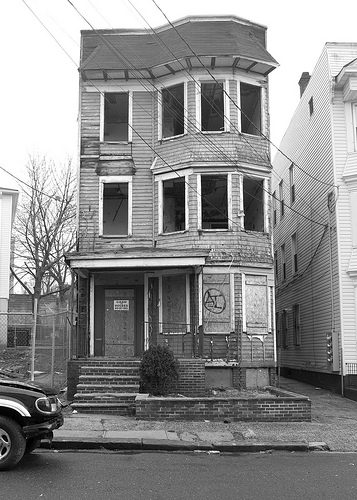
“What can cities do when limited-liability entities start buying up distressed properties as investments and then ignore basic maintenance?” asks Stephen Clowney, an assistant law professor at the University of Kentucky College of Law. His question (as well as the title that preceded his question) struck precisely the tone of the conversation that is going on in cities across the country, so we present it here, in its unmolested form.
His comment was in response to an article published in The Pittsburgh Post-Gazette that describes a foreclosed, vacant house owned by an increasingly likely neighbor, “Res Distressed Asset Fund XXI LLC, 44 Wall St., NYC,” (how do you keep up with them, let alone the Joneses?). The article describes a familiar scenario:
“[The house] was taken in foreclosure by Deutsche Bank National Trust for $3,245 and six months later sold for $5,600 to an obscure entity called Res Distressed Asset Fund XXI LLC.”
The article continues:
“County property records show that Res Distressed is located at 44 Wall St. in New York City. There is almost no public record available on the fund. It appears to be one of innumerable private funds created since the foreclosure crisis began through which investors seek to make money on troubled property.”
Clowney raises the question on his PropertyProf Blog, but it’s also a question that is asked and addressed by Kermit Lind in the Fall 2011 issue of Shelterforce that examines Cleveland Housing Court Judge Raymond Pianka’s use of innovative legal tactics to achieve code compliance and how this helps promote neighborhood stabilization. Lind discusses enforcing code compliance without necessarily imposing punitive measures, getting owners to court, as well as other techniques. Bottom line, there’s been success, but it’s just one tool toward comprehensive neighborhood stabilization:
“The Cleveland Housing Court adjudicates only one house and one owner at a time, while the investors and speculators in blighted properties operate in secret at high volume from a distance.”
Advancements in addressing this issue continue, however. Lind noted later that ordinances continue to be enacted by cities facing problems like the described in the Post-Gazette article. For example, Lind said, Cleveland recently outlawed any business entity to buy or sell houses in the city “if it has not complied with an existing state statute requiring foreign entities to register with the secretary of state.”
Cities will keep chipping away, but fighting a faceless owner remains a challenge. Let us know how your town or city is addressing this problem in the comments section below.
Photo by Brian Stromberg via Creative Commons
www.flickr.com/photos/brianstromberg
About the Author



Comments