


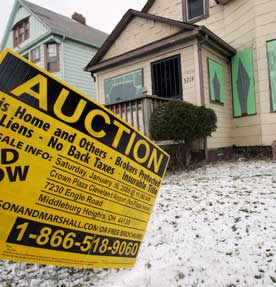
An auction sign sits in the front yard of a foreclosed home in Cleveland on Jan. 14, 2008.
In 2003, the Community Development Committee of the Cleveland City Council was holding hearings on the annual Community Development Block Grant (CDBG) allocation. Included in the proposed legislation was a line item to contract with a housing advocacy group to provide foreclosure counseling for the growing number of victims of predatory lending. The hearing room was filled with the staff and directors of the city’s community development corporations (CDCs). But they weren’t there to support predatory-lending counseling. They’d come to protest the diversion of funds from their housing-production activities to counseling assistance.
The protesting CDC practitioners believed that the best way to deal with neighborhood problems was to produce housing that would be attractive to outsiders. Even in Cleveland, which has been a canary in the coal mine of subprime meltdown, CDCs have stuck with their old methods, continuing to view physical development as the appropriate tool for community revitalization. Many hope the foreclosure crisis will be brief and provide an opportunity to acquire developable land.
In fact, the foreclosure crisis has hit Cleveland especially hard, and the real-estate market in the city has frozen as prices reset dramatically lower — not because of intervention or its absence, but because the real-estate market is doing what markets do. Just as the relative recovery of Cleveland’s neighborhoods was not simply the result of CDCs creating market activity where there otherwise wouldn’t be any, the emerging neighborhood crisis is not the fault of CDC activity. Over the past two decades, the community-development system worked because community developers were able to swiftly and effectively adapt themselves to a moment when market revitalization, through physical development, had many positive effects and few negative ones. That moment has passed.
The Cleveland meeting illustrates the degree to which some community developers have become so invested in physical development that it prevents them from seeing other needs and opportunities. Their faith in the power of market activity rests on forgetting that community development has its origins in dealing with localized problems of market failure. Once, community developers around the country used a holistic model that emphasized human wellbeing and nurturing community social ties. But for the past 20 years, the community-development industry regarded housing production as a cure-all.
The current structural organization of the community-development industry amounts to a sustained bet on the positive benefits of higher real-estate values and the use of market mechanisms. Organizations have become development engines, funders assess success in terms of unit production, and staff members are more likely to have financial skills than community-building ones. In a context of expensive credit and the collapse of the real-estate market, this bet is unlikely to pay off either for the industry or the communities they serve.
The neighborhood crisis of the 1970s was central to the formation of the community-development industry. Government and private investment transferred investment from poor, urban neighborhoods in the North where it would yield low returns, while concentrating loans, infrastructure, and capital investment in the new suburbs of the South and West. In neighborhoods that were starved for these resources, community development naturally came to be about rebuilding and revitalizing communities through the use of available resources, including the social, human, cultural, and economic capital of neighborhood residents.
Although CDCs in the 1970s attempted to revitalize local real-estate markets through physical redevelopment, limited resources ensured that redevelopment would be on a very small scale. These early physical-development success stories were the inspiration for the current community-development industry. However, unlike today, they also used a host of other tools and services to accomplish their goals, including community organizing, skills development, sweat equity, and cooperative businesses. Most important, in the 1970s there was a widespread understanding in the industry that markets were not a blanket solution to neighborhood difficulties, they were part of the problem.
Addressing the negative effects of markets in neighborhoods resulted in the passage of the Home Mortgage Disclosure Act in 1974 and the Community Reinvestment Act (CRA) in 1977 — measures designed to manage the negative effects of markets, namely, the movement of liquid capital to locales where it will earn the highest return. Similar efforts were made to place controls on heating and fuel costs.

Attempting to mitigate the negative effects of markets did not prevent early community developers from leveraging their positive effects. For example, they worked to improve neighborhoods’ appearance in the hope that doing so would attract new homeowners and, in turn, lead to healthier neighborhoods. These early community developers were pragmatic and nonideological in their understanding of the value of market mechanisms. Their successes made them attractive to philanthropies and government agencies, which increasingly turned to community developers to address pressing urban problems.
The early pragmatic, holistic view of development has largely been supplanted by the idea that communities are in crisis because of the absence of market mechanisms rather than the negative effects of markets. A host of tools were developed by government, philanthropies, and intermediary organizations to leverage markets’ positive effects. The most notable of them, the Low-Income Housing Tax Credit (LIHTC) passed in 1986, has been instrumental in the creation of an efficient market for investment in the production of low-income housing. This is a stunning achievement, for which Local Initiatives Support Corporation (LISC) and the Enterprise Foundation deserve the credit (although bankers concede privately that the LIHTC would not work in the absence of the CRA, suggesting that it depends upon regulatory limitations on markets as much as their free operation).
Philanthropies figured out new ways to leverage resources to support these activities through the use of program-related investments rather than grants. States and municipalities developed land banks and housing trust funds. CDCs leveraged their hard-won development skill to branch out into market-rate housing and commercial development. The payoff of this tremendous institutional innovation has been rebuilt and unquestionably healthier neighborhoods. And because it is difficult to argue with success, the negative effects of leveraging markets, such as gentrification and displacement, are frequently debated but rarely acted upon in any serious way.
The notable success of the community-development industry over the past 25 years is unquestionably the product of tremendous innovation and imagination. It is built upon the willingness of a variety of people and organizations to figure out new ways to work together to make reinvestment and development happen. The amazing thing is that it has worked. Neighborhoods such as the South Bronx, once characterized by abandoned buildings and vacant lots, now have little available land left, and what is there is subject to speculative flipping. Investment is flowing and building is happening.
Those who considered CDCs as developers of last resort were right, but not because their one-sided analysis hit the mark. Instead, they were correct because CDCs’ physical-development efforts corresponded with a sustained economic expansion that was capped off by a wild speculative boom in real-estate markets.
Widely available credit made payments cheaper for homeowners and made tax credits attractive to investors. Combined with efficient nonprofit production and an overheated housing market, quality housing was produced efficiently and cheaply while new homeowners have benefited from real-estate values that have increased at a historically unprecedented rate. This made homeownership a temporarily attractive investment option for banks and for new, more marginal borrowers.
Without the speculative fuel, housing production is unlikely to yield the same benefits. Indeed, in cities like Cleveland, the turning of the credit market is creating a whole new round of urban social problems: increasing crime, housing abandonment, and newly strained municipal budgets.
In Cleveland’s municipal community-development department, a color-coded map charts the health of the city’s neighborhood real-estate markets — blue for a thriving area, red for a disinvested area. Considering the racialized nature of U.S. real-estate markets, it’s not surprising that the heavily white, middle-class West Side is shaded a pleasant blue and the largely impoverished and African-American East Side is an alarming red. Asked if there are any neighborhoods where the color can be attributed to the activity of a CDC rather than the operation of the market, a staff member identifies two areas of light pink in the East Side’s sea of red. The CDC in one area whole-heartedly implements the real-estate market strategy of a local intermediary, Neighborhood Progress, Inc. In the other, the CDC is pursuing a political strategy for physical redevelopment. In Cleveland, with its highly lauded community-development industry, only two CDCs out of 40 or so can be credited with making real-estate markets better than they would be otherwise. Pretty much everywhere else, the city looks like what you would expect, given the current economic mix, employment levels, and demographic distribution. In other words, community-development activity has barely made a noticeable impact on real-estate markets. Instead, the city’s real-estate markets gradually improved in a context of economic expansion and historically cheap credit. This is about to change. Soon there will be a lot more red on the map.
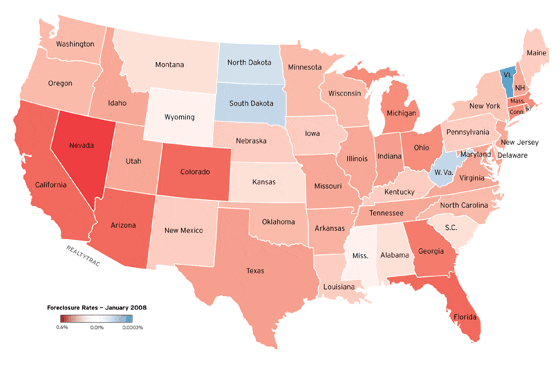
The current foreclosure crisis has been unfolding for a number of years, even if it has only become an issue that is national in scope recently. As early as 1999, Harvard’s Joint Center on Housing Studies and Woodstock Institute issued separate reports calling for anti-predatory lending legislation, along with other measures, in order to rein in the emerging problem. Neighborhoods are now paying a tremendous price for the lack of foresight about the outcome of the credit bubble. In many cities, abandonment is becoming a serious problem. And, as we learned in the 1970s, along with abandonment comes crime, arson, and financial and physical deterioration. Despite long-standing knowledge of the mortgage problem, community developers have not always made a positive contribution to solving it — not because they don’t want to, but because they have lost the organizational capacity to do so.
The end of the real-estate boom is likely to result in a shakeout of the industry that will favor organizations and partnerships that are not organizationally over-invested in rising real-estate values. This moment also provides a window of opportunity for community developers and their funders to revisit what community development means and what community development corporations should do.
The worst possible response to the crisis is to continue to bet on the power of physical development in a context of declining home prices and more expensive credit. Yet some community developers view foreclosed houses as an opportunity to acquire desirable properties that can be redeveloped for more strategic uses. This may be a viable strategy, but only if real-estate values recover quickly. If they do not, and nonprofit developers can’t sell new housing or lease up new commercial space, this strategy amounts to doubling down on physical redevelopment at a time when such a bet seems insupportable. Many real-estate moguls have built their fortunes by making just such a bet, but they have the luxury of not worrying about the cost of their activity. In the case of community developers, such a bet is indicative of an ideological rather than an analytical understanding of markets and their virtues.
It is time that community developers start looking at their current organizations, practices, and strategy as ill-adapted to emerging conditions. Doing so is not surrendering to pessimism, but recognizing an opportunity. However, realizing the opportunity requires community developers to start reimagining alternative approaches to their work. Funders and investors will likewise have to recognize that the current infrastructure needs to be reworked. Barring a quick recovery in real-estate markets, the work is imperative.
The assumption that physical development is a cure for all ills was a good strategy, but one that made sense in a particular historical moment of cheap credit and a sustained rise in real-estate values. The question is how much the bet on that strategy will limit the ability of community developers to be as adaptable and innovative as they once were.
About the Author

Comments