



This article is part of the Under the Lens series
Fit to Live In: Fixing Our Housing Stock
Twenty years after Hurricane Katrina, block after block of New Orleans neighborhoods still bear the storm’s deep scars. Empty lots where homes once stood are choked with vines. Trees push through cracked driveways in open expanses where nothing is left but concrete foundations. In the city’s lush, humid climate, nature has reclaimed entire neighborhoods—especially in the devastated Lower Ninth Ward.
Similar levels of neglect are evident in many of the homes that remain. Across the city, renters regularly deal with broken heating and cooling systems. Their walls drip and stain under roofs that leak with every storm. Kids get sick from the black mold that spreads behind drywall. Older residents teeter uncertainly on rotten stairways that creak and lean.
Y. Frank Southall, an organizing and community engagement manager at Jane Place Neighborhood Sustainability Initiative, a New Orleans housing justice nonprofit, estimates that at least 50 percent of the occupied homes his organization canvasses aren’t fit for human habitation. “Anytime we have multiple water leak complaints in an apartment complex, there is a massive chance that the roof will cave in or fly away during a hurricane,” Southall says. In one apartment he visited recently, an entire wall curled inward because the landlord ignored water and termite damage for so long. “If you imagine a gigantic ice cream scoop carving out soft ice cream, and the way that it curls—literally, the walls curled this way.”
[RELATED: In Over a Dozen Cities, Housing Activities Connect HUD Cuts and Local Issues]

New Orleans hadn’t been able to get and keep its rental housing livable, let alone resilient, by the time Hurricane Ida walloped the region in 2021. The following year, the city promised a fix: the Healthy Homes Ordinance, a sweeping registry and inspection program designed to hold landlords accountable and protect renters from retaliation. But going on four years later, the program is still rife with issues (one glaring issue: landlords self-certify habitability, no third-party inspection is required). It’s also underfunded and under-enforced, leaving many unsafe units “certified habitable” on paper while families continue to get sick.
As climate change brings harsher heat waves and stronger hurricanes—and the city’s population continues to shrink (around 120,000 Black New Orleanians left between 2000 and 2024)—the central question is: Can New Orleans turn Healthy Homes from a policy victory into a functioning safety net before the next disaster?
The Scope of the Crisis
After the federal government pumped the floodwater out of New Orleans, it pumped in billions of recovery dollars. Even so, much of the rental housing occupied by low-income tenants was left to deteriorate. And while hurricanes expose the worst failures in spectacular fashion—roofs peeling off, walls collapsing—it’s the day-to-day neglect that steadily erodes the livability of thousands of homes.
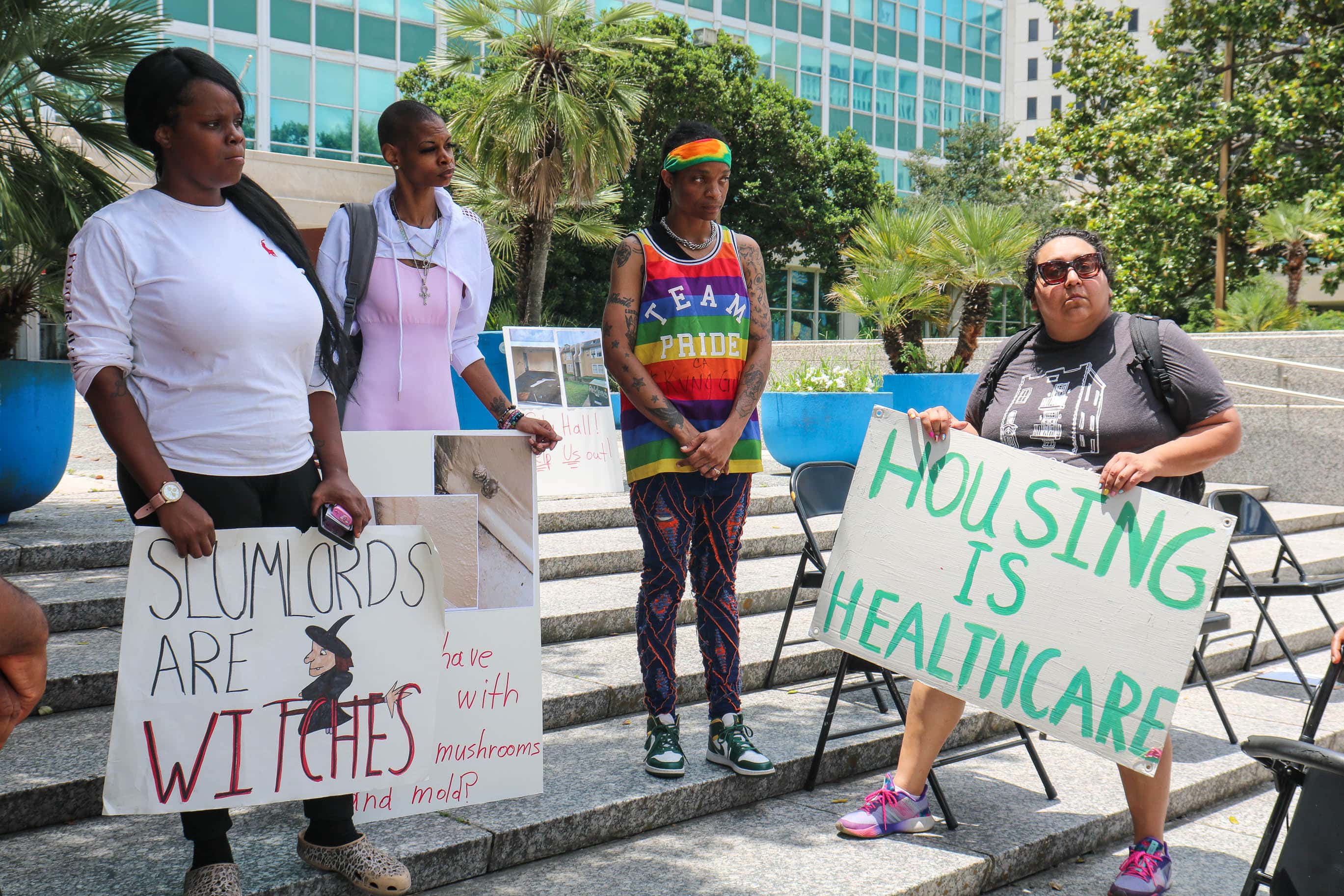
Many of the buildings that survived Katrina haven’t fared well in the last two decades. Layers of blue tarps cover roof after roof, loose corners flapping. Even the “new” homes built with the billions in recovery dollars aren’t in much better shape. The city got a lot of high-profile buy in. For example, from 2008 to 2015 Brad Pitt’s Make It Right Foundation developed 109 affordable homes. Today, many of those sleek, angular homes are falling apart—one quite publicly. The ceiling sagged so badly in one notorious New Orleans apartment complex, The Willows, that mushrooms sprouted from the floor below. Yet on paper, the building owner self-certified the property as “habitable,” and the city listed the property as “pending” approval. With no money allocated for inspections or enforcement, the self-certification provision leaves renters responsible for reporting issues, even in situations, like at The Willows, where residents complained for years of “deplorable” conditions. For the city’s large renter population, it’s a crisis that threatens their health, safety, and stability. (In June 2025, a local bank began foreclosure proceedings against The Willows’s owner, a Tennessee-based nonprofit; it’s unclear what will happen to the residents.)
While hurricanes expose the worst failures in spectacular fashion—roofs peeling off, walls collapsing—it’s the day-to-day neglect that steadily erodes the livability of thousands of homes.

A large chunk of New Orleans renters live in aging shotgun shacks—long, narrow, single-family homes that are a cherished and recognizable part of the city’s history. While picturesque, they often have little insulation in the walls or under the floors, and many have ceilings that soar 12 or 15 feet. This means cooling systems are forced to run constantly. In the sweltering Louisiana summers, “if your landlord goes and gets you the cheapest window unit at Lowe’s, it’s not going to cool off a room with tall ceilings that’s not insulated,” says Monique Blossom, director of policy and communications at Louisiana Fair Housing Action Center. Blossom knows firsthand, because she lives in one of these homes. New Orleans landlords are required by the Healthy Homes Program to provide a cooling system that will keep the unit below 80 degrees. And while this is an improvement from when no laws existed, Blossom wonders: “Who can sleep in 80-degree heat, anyway? I mean, that’s like going camping.”
In New Orleans, the definition of “habitable” has always been slippery. Back in 2015, then-City Council member LaToya Cantrell (now the mayor) tried, unsuccessfully, to pass a law similar to Healthy Homes. According to the National Low Income Housing Coalition, the American Housing Survey in 2015—a decade after Katrina—found that of the 190,200 rental units in the city, nearly 80,000 showed signs of cockroaches, 15,100 had open cracks or holes, and 14,600 had water leaks.
Today, tenants in New Orleans aren’t just cost-burdened, they’re risk-burdened. More than half of the city’s renters are Black, and many live either in homes like Blossom’s, or in aging post–World War II multifamily complexes (sometimes called “garden” apartments). Over the last two decades, corporate owners have descended upon New Orleans, many from out of state. As in many areas, property acquisition by corporate landlords, shell LLCs, and investor groups has surged across Orleans Parish. These entities often hide behind opaque networks registered in business-friendly states, making it harder for tenants or local agencies to identify who’s responsible for repairs. Often, a single investor holds dozens of units across neighborhoods, rotating ownership among LLCs to evade regulation or inspection. Because code enforcement and courts struggle to pin down real ownership, tenants are left chasing phantom landlords who may never respond, complicating everything from habitability complaints to eviction defense.
Tenant advocates like Andreanecia Morris, executive director of HousingNOLA, a housing justice nonprofit, hear about these issues every day. “How quickly things deteriorate—or how quickly your landlord, frankly, responds—is a big part of the problem,” Morris says.
These aren’t just housing problems. They are health problems, climate problems, and, ultimately, resilience problems—ones that fall hardest on residents who possess the least power to demand change. And not only do renters in these homes have few legal tools to compel repairs, they often have nowhere else to go. According to Morris, roughly one in five of the city’s 90,000-ish occupiable rental units has severe habitability issues, and another 10,000 sit vacant but require major work before they can be occupied, leaving an already tight market with far fewer safe, available units than demand requires.
Healthy Homes: Wins and Loopholes
When New Orleans’ Healthy Homes Ordinance finally passed in 2022, advocates hailed it as a major victory. For the first time, the city would maintain a comprehensive rental registry—an essential step toward knowing where rental units are, who owns them, and whether they meet basic standards. The law requires landlords to ensure plumbing, heating, cooling, and electrical systems are safe and functional, and it explicitly protects tenants from mold, pests, and structural hazards. Property owners must register their units and obtain a certificate of compliance, and tenants gained new rights to request inspections and report unsafe conditions without fear of retaliation. Landlords who fail to register face escalating fines—starting at $50 per property and increasing to as much as $200 for continued non-compliance. State law allows a maximum daily fine of $500 in particularly egregious situations. On paper, it marked a turning point: a shift toward accountability in a city where renters regularly live in unsafe housing.
The program’s rollout began with large multifamily complexes, expanding gradually to cover smaller buildings. Landlords received postcards notifying them to register (timelines depended on the size of the building being registered), and the city waived registration fees during the first term to boost compliance. By most accounts, landlords registered. On paper, it was a victory: New Orleans finally had the beginnings of a tool to hold bad actors accountable.

The ordinance also secured a major win on retaliation and gave renters new tools to fight back. For tenants in good standing on their leases, landlords are barred from evicting them for the six months after they’ve registered a complaint. In a state where many renters live on month-to-month agreements, that win was unprecedented. “In a Deep South context, that kind of retaliation protection is super powerful and amazing,” Blossom says.
But Blossom adds that those protections aren’t well-publicized and lack enforcement, diluting their effectiveness. “We hear from tenants all the time that are at risk of being evicted because they’ve made complaints about habitability concerns,” she says. “Some landlords just don’t know about the protections. A lot of landlords just don’t care.”
Advocates like Blossom, Morris, and Southall argue the protections are only as strong as a tenant’s ability to use them. Because the ordinance requires renters to be current on rent, many of the most vulnerable tenants, including those living in the worst conditions, are excluded from its shield. And even those who qualify may not make it to court to assert their rights. “They think, ‘Oh, I complained about the hole in the floor, the landlord’s going to evict me. It’s easier just to leave than to go to court or to deal with all of this.’ Or they can’t show up to court because they can’t afford to,” Morris says.
That’s especially unfortunate considering New Orleans recently passed a right to counsel ordinance, meaning tenants summoned to eviction court will be provided with free legal counsel. (In many jurisdictions, only people charged with criminal offenses are provided with a public defender free of charge.) But many renters don’t know about any of these provisions, and “Landlords don’t know their responsibilities,” Blossom says.
Another glaring omission in the protections, advocates argue: Instead of proactive inspections, the law relies on landlords to self-certify that their units are habitable—effectively letting owners police themselves. Advocates call this a missed opportunity. “What got taken out was the fact that every unit has to be inspected,” Morris says. “That’s what gives the ordinance its teeth.”
During negotiations, landlord and real estate lobbyists pushed back hard against provisions that would have required the city to inspect every rental unit on a regular schedule, Morris remembers. By the time the measure passed, those proactive inspection requirements were stripped out, leaving only a self-certification system and a complaint-driven enforcement model. In practice, that meant the responsibility for identifying unsafe units fell back on tenants—the same dynamic the ordinance was meant to fix.
“The lack of proactive inspection just puts the burden again on the tenants where it’s not the tenants’ responsibility to be making repairs in a home,” Blossom says. “Without funding, the program can’t do what it was designed to do: get the bad actors into compliance or out of the business.”
And funding is exactly what’s missing. The ordinance created an anti-displacement fund to help tenants relocate when buildings collapse, flood, or become too moldy to live in. But the council has never guaranteed that dollars will flow into it—in fact, the mayor’s fiscal year 2024 budget proposal omitted funding for Healthy Homes entirely, forcing advocates to secure a late $2.5 million allocation. Absent regular appropriations, the fund remains largely inactive, leaving many tenants to shoulder relocation costs themselves or remain in unsafe homes.
Enforcement capacity is another glaring hole. Inspectors are shared with the city’s broader code enforcement office, which prioritizes visible exterior issues over interior hazards. Advocates have called for a dedicated team of eight to 10 inspectors trained specifically on rental habitability. Even if lawmakers had funded an adequate inspector team, there’s no guarantee qualified applicants would take the offer. In New Orleans, inspector salaries hover around $38,000—and positions sometimes require a master’s degree—making recruitment nearly impossible in a city where even municipal workers struggle to find affordable housing, Southall says.
Morris says the missed potential is staggering. “What we’ve been doing is just getting everybody registered. That was the first step,” she says. “But without funding for inspections—for enforcement, for relocation—it’s an empty promise.” The ordinance shows both the power and the limits of policy wins. “This is the tool we asked for,” Morris says. “Now it’s up to the city to decide if it’s just a piece of paper or if it’s actually going to protect people’s lives.”
Tenant Rights in the Deep South: A System Stacked Against Renters
Louisiana’s landlord–tenant laws are among the most restrictive in the nation for renters—and the most permissive for property owners. Together, they form a legal structure that keeps tenants paying for unsafe housing with little power to fight back.
- Eviction timelines are unreasonable and unfair: Landlords can file for eviction after just five days’ notice. That means a renter who falls behind or reports unsafe conditions can lose their home in less than a week.
- Rent escrow is explicitly illegal: In most states, tenants can legally withhold rent and place it in escrow until a landlord makes repairs. Louisiana forbids that outright. Southall put it plainly: “If your roof flies off your apartment, you still have to pay rent.”
- Rent control is preempted statewide: The state legislature explicitly banned local rent control, blocking cities or counties from regulating rents or imposing stronger habitability requirements. Even when local leaders act, state law can undo it.
- Tenants report retaliation and experience informal evictions: Tenant protections on paper often collapse in practice. Blossom says renters regularly contact her organization to report landlord retaliation.
- It’s too hot in the summer: Louisiana didn’t even have legal cooling standards until recently, despite increasingly warming summers. “People die from heat here,” Morris says, “and yet our laws still make it illegal to withhold rent when your unit isn’t livable.”
The Climate Multiplier
While weak tenant protections have long made life difficult and unpredictable for New Orleans renters, climate change is making it increasingly dangerous. The city’s aging housing stock wasn’t built for the kinds of storms, floods, and heat waves that are now becoming routine. Deferred maintenance compounds the problem: every leak, crack, and termite infestation becomes a structural failure waiting to happen when the next hurricane hits.
“Over the next 50 to 100 years, if New Orleans is going to survive, it’s going to have to deal with mitigation. Levees are going to have to be built higher. The Mississippi River is going to have to be rerouted,” Southall says. “One thing that people are talking about is, how do we protect large sectors of the population that are living in post-World War II apartment complexes?”
If New Orleans is going to survive, it’s going to have to deal with mitigation. Levees are going to have to be built higher. The Mississippi River is going to have to be rerouted.”
Y. Frank Southall, Jane Place Neighborhood Sustainability Initiative
These midcentury “garden” units are especially vulnerable: built on shallow slab foundations, with aging roofing and simple envelopes, they lack modern waterproofing or resilient building techniques. Their long, horizontal layouts expose lots of wall surface to heat gain, and shared roofing and gutter systems mean a single failure can cascade through multiple units. Many sit in low-lying zones with poor drainage. Climate stress magnifies every flaw, making these homes more susceptible to catastrophic storms. It also amplifies day-to-day habitability problems. During the summer, indoor temperatures in apartments without central air can reach the high 90s. “Most of the people who died in Ida didn’t die in the storm,” Morris says. “They died after, when the power was out and they couldn’t cool their homes.”
The lack of investment compounds existing problems, especially in homes that sat vacant for years before owners had the means to repair storm damage. “The last 20 years we’ve seen an acceleration in climate change; we have weather events that take us to extremes,” Morris says. “Homes that people fought their way back [into] after Katrina are now 20 years old. Even if it took them 10 or 12 years to get back, that’s still a decade worth of wear and tear in an increasingly harsh climate.”
And while these problems hit tenants first, they also ripple outward. Workers in the city’s service economy struggle to stay housed when rents rise after storms, or when habitable units become scarce. Advocates warn that without resilient housing, New Orleans risks hollowing out its workforce as much as its neighborhoods.
Southall says the solutions are clear. What’s missing is the political will. “We know what works. We know what makes homes resilient,” he says. “The question is whether New Orleans is willing to put its money where its mouth is before the next storm hits—because if we don’t, it’s not a matter of if we lose more neighborhoods, it’s when.”
About the Author




Comments