


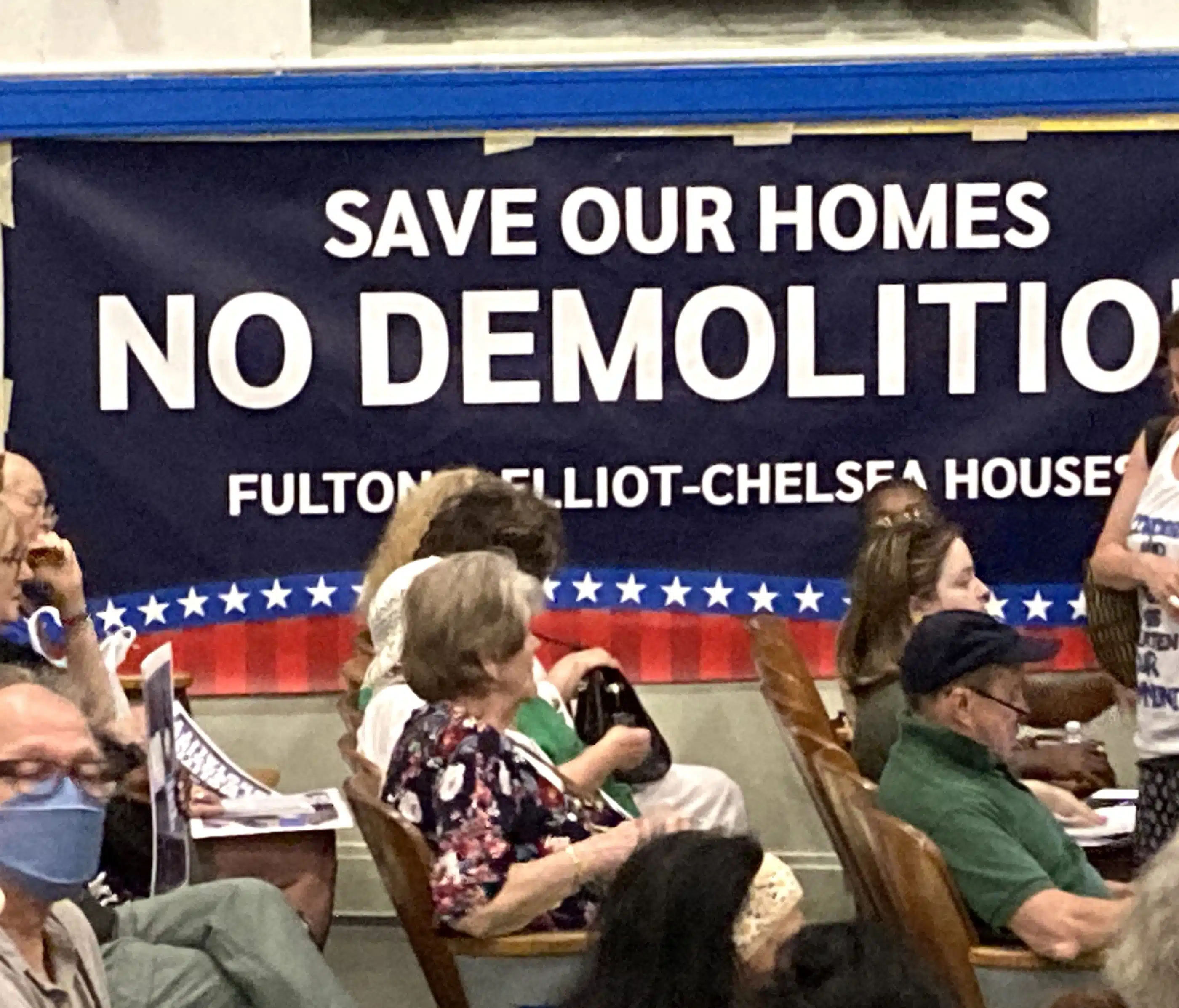

I met public housing resident Milagros Lugo, 48, in early July 2025, when I asked about a banner attached to her fence in silent protest: “Save Our Homes/NO DEMOLITION/Fulton and Elliott-Chelsea Houses.” Since age 8, Lugo has lived in the Elliott-Chelsea Houses, a public housing project in Manhattan’s Chelsea neighborhood. The project comprises the John Lovejoy Elliott Houses and the Chelsea Houses. Today, she shares a home with her 80-year-old mother and two adult sons. Despite long odds, Lugo and her neighbors are fighting to save their homes and community from the wrecking ball.
Two private real estate development firms, Related Companies and Essence Development, want to demolish all 19 residential buildings owned by the New York City Housing Authority (NYCHA) in the Chelsea neighborhood, which includes Elliott-Chelsea Houses and nearby Robert Fulton Houses (often referred to together as Fulton & Elliott Chelsea Houses, or FEC). That means tearing down 2,056 public housing units. The residents of those units will be corralled into three new high-rises on each campus, ranging from 12 to 39 stories. An additional 2,400 market-rate and 1,000 permanently affordable units will be built on the other 70 percent of the land. Construction is projected to last at least 15 years.
This proposal is part of NYC’s Permanent Affordability Commitment Together (PACT), which is the city’s approach to the federal Rental Assistance Demonstration (RAD) program. RAD allows public housing agencies struggling to finance capital improvements because of the persistent federal underfunding of public housing to transfer official public housing (Section 9) to other federal subsidy sources (project-based and tenant-based Section 8) that make it easier to also take on debt financing. Typically in RAD programs, management is transferred to private companies, but the housing authorities retain official ownership.
[RELATED ARTICLE: Does RAD Privatize Public Housing?]
Under the proposal, 94 percent of residents would stay in their current apartments until they move into newly constructed buildings on site. Defying best practices for keeping older adults safe and healthy, however, the 6 percent of residents forced to move twice—into temporary accommodations and before coming back into new units—include approximately 110 residents in the 96-unit Chelsea Addition senior building, one of two buildings slated for demolition this fall. Those who remain past the Oct. 26 deadline and refuse to relocate face the prospect of administrative proceedings and possible eviction. This weekend some tenants who haven’t agreed to move were taken aback when they received “move day confirmation” notices with scheduled lease signings and move-in dates to assigned apartments they have not viewed. The paperwork carried an air of inevitability. Despite their terror, many are staying put, given their multitude of concerns with the safety and disability accessibility of replacement units.
“I’m scared, and I’m alone. It’s only me and my dog,” 76-year-old Aleksandra Jargilo confides. She lost both of her sons. This October, her beloved Westie Terrier named Pumpkin also died. But as frightened as she feels, she remains fiercely determined not to leave her Chelsea Addition apartment.
Like many NYCHA residents, Jargilo has a history of displacement. After spending time in an Austrian refugee camp, she arrived in the United States in 1982 as a Polish refugee. “I escaped Communist Poland,” she says as she reaffirms her commitment to staying, beating her chest and shouting out the words on her American flag T-shirt: “freedom, justice, liberty!” Jargilo becomes distraught when describing the much smaller apartment NYCHA offered her on the Fulton Houses campus, several blocks away. “A cage,” she calls it. She’s been in her apartment since 2018, after waiting 10 and a half years to get it.
“I’m not leaving. I don’t want Section 8. I want Section 9,” she says. She fears losing the robust tenant protections available under public housing (Section 9). While residents going through RAD conversions do retain most tenant protections, that has not always been well enforced. “My friend had a lot of problems on Section 8. She moved to New Jersey after two years,” says Jargilo. Jargilo’s a fighter. For the time being, she’s still brave enough to stay put. “Give me all the lawyers,” she says, laughing and expressing her desire to sue to stop the process. (There are lawsuits in progress or under discussion.)
Diana Chew, 78, considers her Chelsea Addition neighbors her family. “When I moved to this building, I was so happy. I thought this was my final [home]. I thought I would die here,” Chew says. “Now, I don’t know.”
Jakow Shmuel, 81, also refuses to move. “They need to bring the army to bring me out,” he says. Shmuel likes the seniors-only building. “It’s quiet. No traffic. No kids. No one to make a problem.” He adds, “I want a quiet place to live until I die. I don’t need luxury.”

“They’re killing me with nice white gloves,” Maria Krystyna Ember, 81, tells me from the comfort of her ornately decorated apartment, where she has lived since 2017. “You know, it’s terrible. It’s crazy,” she says about the prospect of moving. Ember suffers from a long list of chronic health conditions and gets help from a caregiver. “I would like to stay here,” Ember says. Having to move is “breaking me inside. My psyche is broken.”
Elected officials hail the Chelsea plan as an unprecedented “opportunity,” while community opposition calls it a “land grab.” One of the developers, Related Companies, is also behind the Hudson Yards megaproject—home to some of the nation’s most expensive apartment and office rents. Many Fulton and Elliott-Chelsea residents have serious concerns about their right to return, the design and scale of the construction plan, and the health and environmental impacts of more than a decade of proposed construction.
Manhattan Community Board 4 has taken a stand against the current demolition proposal. They have approved a letter which states that the board does not support any of NYCHA plan’s current plan alternatives and calls for a vote on each campus monitored by a neutral third party to arrive at consensus on how to proceed with redevelopment.
New York City has the largest stock of public housing in the United States, with more than 330,000 tenants. Mayor Eric Adams calls the Chelsea plan “revolutionary” and, along with other elected officials, touts the proposal’s complete rebuild and inclusion of a large amount of market-rate infill as a template for NYCHA to pursue similar privatization and redevelopment. Fulton Elliott-Chelsea would transition to PACT, which allows NYCHA to lease public housing to private developers for 99 years and transfer management to private companies. Proponents claim this pivot unlocks additional funds, while critics argue that funding new units through the Section 8 project-based voucher program may not be as reliable as previously assumed under the Trump administration, which earlier this year floated unfathomable cuts to the program. (The most recent Congressional spending bills included more modest cuts.)
Instead, tenants like Lugo are demanding that NYCHA and elected officials repair and preserve their existing homes as public housing. While the buildings desperately need repairs after years of neglect and deferred maintenance, Assessments by Related and Essence, and NYCHA’s own assessments, find them structurally sound. The tenants dispute the blight narrative as an empty talking point hammered by profit-driven real estate representatives and politicians without sufficient evidence or an obsolescence report.

When asked for comment, a NYCHA spokesperson acknowledged that “there are no structural or emergency conditions in the buildings.” However, they continued, “the 2023 Physical Needs Assessment outlines that the buildings at Fulton & Elliott-Chelsea have over $900 million in capital needs. Due to continued federal disinvestment and deferred maintenance, this amount continues to grow.” The spokesperson also noted that HUD no longer requires obsolescence reports. Related Companies and Essence Development did not respond to a request for comment.
Informed by her construction background, Lugo concedes that the pipes and elevators need replacing but questions claims of irreparable deterioration: “Where does it show we live in decrepit conditions? No one ever knocked on my door and said, ‘Let’s inspect your apartments.’ Show me the proof.” The NYCHA spokesperson says that PACT partners conducted inspections in 2022.
Residents also challenge the argument that demolition is cheaper than rehabilitation, as construction costs escalate due to inflation and tariffs. The $344 million project estimate has now climbed to a whopping $1.9 billion, with no ceiling in sight. The NYCHA spokesperson says that “the goal of the project is not to proceed with the cheapest option. It is to be receptive to residents who want a better quality of life by providing them with new buildings, inclusive of fully functional, reliable systems and infrastructure, modern amenities, and other community priorities. This includes buildings that have accessible elevators, amenity spaces, in-unit features, and space for community programming and services.”
Lugo’s first name, Milagros, which means “miracles,” reminds me of the scale of intervention it would take for these public housing tenants to overcome a project that benefits Related Companies—a well-organized real estate company valued at over $60 billion. Three blocks north, Related’s Hudson Yards project rises like a real-life Emerald City. The shadow of that sleek glass behemoth falls on both Fulton and Elliot-Chelsea Houses and Penn South, a 10-building limited-equity cooperative community where I grew up and my family has lived since 1983. Even if the sky’s the limit in upwards expansion, people in the way still need to be moved—or removed altogether—to make room for the new development. And the people being forced out are usually the ones who have the scantiest resources to fall back on.
But if anyone can work a miracle, I believe it is Lugo. She has zero confidence in elected officials, government bureaucrats, or real estate developers, but with her unbreakable faith in God and community, she presses on, continues to question, and invokes the power of objecting.
Walk south from Fulton and Elliott-Chelsea, and you’ll stumble upon the ghost of an earlier David-and-Goliath battle over land use that occurred when another woman and her neighbors faced steep odds and dismissal by public officials, and they still said “no.” A plaque at 555 Hudson St. commemorates the former home of urbanist and activist Jane Jacobs. She successfully defeated “power broker” and mega-developer Robert Moses’s plan to build the Lower Manhattan Expressway, which would have destroyed Washington Square Park and cut a path of devastation through SoHo and Little Italy, demolishing 416 buildings and displacing thousands of families and businesses.
Like Jacobs, who was dismissed as a housewife without a college degree, NYCHA residents fighting the proposed demolition express feeling denigrated, ignored, and silenced by city agencies and politicians. “They speak down on us,” Lugo says, referring to elected officials at a Manhattan Community Board 4 NYCHA Town Hall (or at least those who attended, since three of five were no-shows). The tenants find little assurance from representatives who support the proposal, including Rep. Jerry Nadler (D-NY), District 3 City Council Member Erik Bottcher, District 75 Assembly Member Tony Simone, Manhattan Borough President Mark Levine, and State Sen. Brad Hoylman-Sigal.
Thirty-five-year Chelsea resident Lizette Colón’s open letter to local representatives captures the profound confusion, frustration, and dismissal many residents have felt. “It became evident [at the CB4 town hall] that your responses were primarily tailored to serve the interests of private entities seeking to appropriate Chelsea’s public housing,” she wrote.
Chelsea resident and longtime tenant organizer Tito Delgado, 75, sees “pure racism” on a stage filled with white men promising an audience of mostly Black and brown residents to replace rather than fix their homes. “We’ve seen this before,” Delgado said, invoking countless “slum clearance” projects that decimated entire neighborhoods. Elliott-Chelsea Tenant Association President Renee Keitt, who is Black, invoked the specter of racism and classism, stating, “We are not chattel. We are people. They have said repeatedly [demolition] would cost less. We find out that is not true.”

Lugo stood firm while embracing a neighbor at the town hall: “We’re gonna fight to the death,” she said. With her thick mane of hair, mighty rage, and protectiveness, she was a fierce lioness. “I’m not moving. This is not Gaza. They’re not bombing me out of my home.” Her neighbors expressed similar resoluteness. A decades long Elliott-Chelsea resident said of the new PACT leases, “I’m not signing. Signing means signing yourself out of the community.”
To be fair, some NYCHA residents support the plan. I first learned of the proposal a few years ago from a family friend who’d lived in Fulton Houses for five decades and was excited at the developers’ pitch. I can understand the appeal of the gleaming illustrations depicting what the new campus may look like. But even my friend’s early enthusiasm has since cooled: “I could go either way. I just want repairs.”
Developers and politicians frame the redevelopment process as “resident-led,” but many Fulton Elliott-Chelsea tenants disagree. They point to a lack of transparency in a survey distributed by NYCHA, Related, and Essence in 2023. The survey asked residents to choose among different construction, renovation, and rezoning options, but never mentioned “demolition,” or explained that all existing buildings would be torn down. It’s unclear whether residents fully understood the survey or that it would be considered to have been a vote. Residents rejected a 2019 plan to demolish just two buildings and replace them with new infill construction, leading to questions about how a tenant majority could choose a complete tear-down just a few years later.
This isn’t Pruitt-Igoe, the massive St. Louis public housing project demolished just three decades after its opening and held up as an example of urban dysfunction. The Elliott Houses, for example, contain a stable 78-year-old community. Some original residents remain, like Ana Marie Hernandez, 79, who has lived here since the complex opened in 1947. When she was a baby, her family moved into an apartment The New York Times described as “sunlit” and “spacious.” It has housed four generations, including her parents, sisters, husband, daughter, and grandson. Now in old age, she faces the destruction of the only home she’s ever known.
Nearly a quarter of NYCHA residents are 62 years and older, and as many as 34 percent have a disability. With its large concentration of older adults, Elliott-Chelsea is classified as a NORC, or naturally occurring retirement community. Elders in public housing are among the most vulnerable older adults. They face significant disadvantages, resulting in higher disability rates and worse health outcomes than seniors in market-rate housing. Even moving a few blocks can destabilize the delicate urban ecosystem that supports late life well-being, increasing isolation and severing neighbor relationships crucial for those living alone and without family. “My biggest fear is my mother and how many elderly like her are going to be lost within their own community,” cautions Celines Miranda, a lifelong Elliott-Chelsea resident, tenant association vice president, and member of FEC Tenants Against Demolition.
In her time, Jacobs herself was an ardent critic of NYCHA’s “tower in the park” style of building, suggesting that they reduced the safety that came from lots of neighborly interactions on the street. But it turns out these developments have provided generations of New Yorkers with a collective backyard and place to rear their children, grow old with dignity, and find an urban retreat among the green space, benches, and concrete tables. Here, generations of people have gathered for parties, played dominos, cultivated gardens, and blasted salsa music. Trees form canopies over playgrounds and walkways between buildings; many studies have shown that spending time around and looking at trees reduces stress, lowers blood pressure, and lifts mood.
Potential environmental and health concerns from a decade-plus of proposed construction extend well beyond the projects’ boundaries to the surrounding community. Turning an area of several blocks into a long-term, constant construction site. The accompanying noise, toxic dust, pollution, and loss of 370 mature trees will harm everyone in the area. Under those circumstances, why would anyone want to live, work, visit, or attend school in West Chelsea for at least the next decade and a half?
No one knows better than New Yorkers that home is more than four walls. We live squeezed together into subway cars, sharing common walls and air, and performing our “intricate sidewalk ballet.” Some with means can sequester themselves in exclusive enclaves. But most of us are stuck together, and so we must stick together when it comes to shaping our communities and decisions about precious public land use. As Sir Winston Churchill astutely observed, “We shape our buildings, and afterwards our buildings shape us.” Thoughtful shaping takes time and considered deliberation. Rush jobs rarely go well.
Lugo laments that many neighbors believe the proposal is a done deal—a perception that benefits developers. She wishes more residents were engaged and vocal, invoking a Biblical story. “I could stand here like Noah. And no one believed him. And when everyone realized, they wanted to jump on board.” Neighbors will have to act quickly if they wish to jump aboard Milagros Lugo’s ark. Time’s running out, but it’s not too late. As her family used to take in people who once needed shelter, she has room for everyone: Fulton Elliott-Chelsea neighbors, allies near and far who wish to donate to the Chelsea Public Housing Legal Defense Fund for tenants threatened with eviction, and the public who want a greater say in the future of their communities.
About the Author



One of the joys of Chelsea is the low density of many blocks of brownstones and private homes, and the ability to actually take a leisurely walk with children or the elderly, and in my case with a Rollater due to a broken hip. The pace is leisurely and the sidewalks are not overrun except at school dismissal time. Over building will completely change our small neighborhood and overcrowd our small stores, two drug stores, two coffee shops, and the one (expensive) grocery store.
Thank you, Ms. Torres!
This is a thoughtful article expressing the dilemma of respecting the humanity of the elders who have lived in Chelsea for decades in the midst of the ongoing fight to land grab in the name of progress.
I stand by my warrior sister, Milagros Lugo, and appreciate Lizette Colon’s eloquence in her letter addressing the greedy representatives of the private entities. These are long time, respectable contributors to the vibrant fabric of Chelsea.
But, the vibrancy will be lost if the greedy have their way. The developers won’t care. But, the people who live and thrive there – ESPECIALLY THE ELDERLY – deserve to die there when their time comes. This is their HOME that just needs repairs. If one building really needs to be demolished, then do one! But, to disrupt the harmony and flow by displacing thousands at the same time is ludicrous.
I pray everyone there remembers the politicians who don’t give a damn and countinue to spew asinine comments about the benefits of demolition- disregarding the impact on the 1,000s of displaced residents and the environmental impact that will affect all of Chelsea, particularly north of 23rd street… And, not just during the demo and construction for the next 15-20 years… They’re not considering the aftermath of all that on the infrastructure of 9th & 10th aves, etc. etc.
It’s just disgusting that they DON’T CARE!! Demoralizing the residents and speaking down to them like imbeciles…
Keep fighting Chelsea!!! ✊✊✊✊✊✊
Stay strong Milagros “Miracle Warrior” Lugo! The Most High bless you and your crusade to stand against the wiles of these devils!!
at first a couple of years ago,on first hearing about plans to renovate eliotte chelsea, with the choice between complete demolish vs, only renovating the apartments, hallways,etc with the building still standing, I thought those were the only matters. Now after looking into what is going on, I can see that,it is a matter of realtors in this “pact” program- looking to financially gain from the problems that nycha buildings are facing, or to put it another way, attain private property and wealth at the expense of poor people, under the so called claim,”they are improving your quality of life. Aside from kicking the seniors out of the chelsea addition and worrying eliotte chelsea tenants of the uncertainty of how project based section 8 tenancy will be, and how long they can remain covered with a 30 percent of your rent lease, –as it surely won’t be the same as the length of tenancy that nycha section 9 offered.. I lived for 65 years in public housing,first in the Weldon Johnson projects, now in Eliotte Houses. As with my neighbors, never had any problem ,fear of eviction,as long as you paid your rent, and abided civilly, you could count on having a roofs, over your head the coming year. I’ve done a query on project based sectiom 8 voucher, if is not indefinite like nycha section 9. Hud gives the landlord a set number of years to rent the tenant on project based section 8 voucher, when it expires, the apartment goes to market rate rent, of which is likely unaffordable to the tenant,and he//she gets kicked out. Now how’s that for their claim of improving our quality of life with this pact crap.?The only quality of life that will be improved is the huge financial profit these private realtors will get from this pact crap. There was another avenue that nycha was examining, which was to repair the building from inside, and finance the renovations with sources outside of private sources, resulting in the building staying under both ownership and management of nycha section 9, what ever happened to that plan?